
Five-point Dirichlet Laplacian as a Kronecker sum Created 2026-09-24 Updated 2026-09-24
If is the one-dimensional Dirichlet second-difference matrix on interior points, the two directional parts of the two-dimensional five-point Laplacian areThey commute, and is the Kronecker-sum discretization of the Laplacian.
Crank-Nicolson stability on a finite Dirichlet interval Created 2026-09-24 Updated 2026-09-24
If is the negative semidefinite Dirichlet discrete Laplacian, the Crank-Nicolson amplification matrixhas eigenvalues of modulus at most one for every .
Closed directed walk Created 2026-09-24 Updated 2026-10-03
Direct-sum complement Created 2026-09-24 Updated 2026-09-24
For every subspace of a finite-dimensional vector space , extending a basis of to a basis of produces a subspace such that .
Dimension formula for a sum of subspaces Created 2026-09-24 Updated 2026-10-05
Dimension drop by a non-zero-divisor Created 2026-09-24 Updated 2026-10-07
If is a non-zero-divisor in a finite-dimensional Noetherian ring , thenEvery prime chain above can be extended downward by a minimal prime of , because a non-zero-divisor belongs to no minimal prime.
Positive zero of the digamma function Created 2026-09-24 Updated 2026-09-24
The digamma function is strictly increasing on the positive real axis, whileIt therefore has exactly one positive zero, and that zero lies in .
Trigamma function Created 2026-09-24 Updated 2026-09-24
Transverse-electric Fresnel reflection coefficient Created 2026-09-24 Updated 2026-10-18
When the permeabilities agree, the signed reflected-to-incident electric-field ratio for polarization normal to the plane of incidence isFor incidence from lower to higher refractive index it never vanishes.
Phase matching at a planar wave interface Created 2026-09-24 Updated 2026-09-24
Equality of the boundary fields for every tangential position and time forces equal frequency and equal tangential wavevector for incident, reflected, and transmitted plane waves.
Binomial upper bound for a Ramsey number Created 2026-09-24 Updated 2026-09-24
Baryon-density effect on primordial helium Created 2026-09-24 Updated 2026-09-24
Increasing the baryon-to-photon ratio raises the equilibrium deuterium abundance at fixed temperature, so the deuterium bottleneck ends earlier. Fewer neutrons decay before nuclear burning, and neutron-limited helium synthesis produces a larger primordial helium mass fraction if weak freeze-out is unchanged.
Tridiagonal determinant recurrence Created 2026-09-24 Updated 2026-09-24
For diagonal entries , superdiagonal entries , and subdiagonal entries , the leading principal determinants satisfy
Leibniz formula for determinants Created 2026-09-24 Updated 2026-10-14
Multilinearity of the determinant Created 2026-09-24 Updated 2026-09-24
The determinant is linear in each row and in each column when all the others are held fixed.
Derived sets of an ordinal Created 2026-09-24 Updated 2026-09-24
Chain rule Created 2026-09-24 Updated 2026-10-14
The chain rule calculates the derivative of a function composition by combining local rates. If the inner function is differentiable at and the outer function is differentiable at , thenThe evaluation point matters: the outer derivative is evaluated at the inner output , not at . A small input change first scales by ; the resulting intermediate change then scales by . In terms of linear approximations, composing those two local descriptions multiplies their scale factors. [ref]
https://openstax.org/books/calculus-volume-1/pages/3-6-the-chain-rule. OpenStax, Calculus Volume 1: statement and proof of the chain rule
.For example, applies a quadratic function and then the sine. With and , the chain rule givesHere all angles are in radians. Near , increasing the input by changes by about , and the sine changes by about times that intermediate change. For , the linear approximation predicts an output increase of ; the exact increase is .
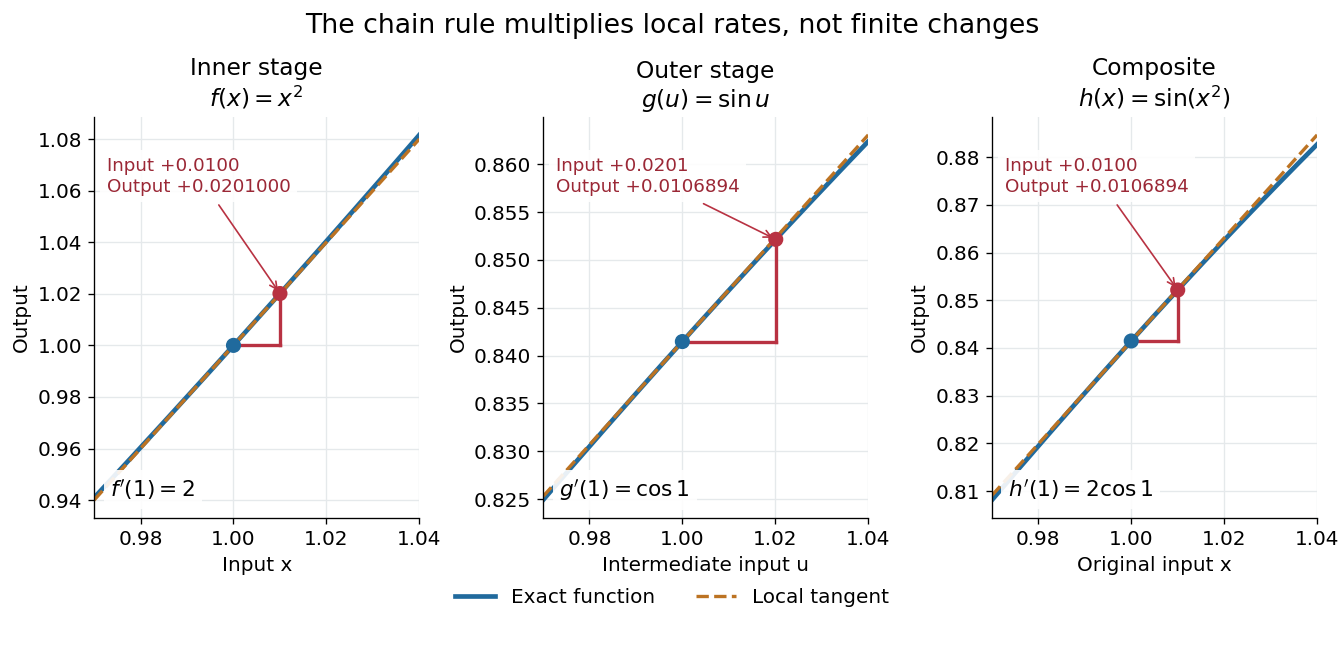

The same rule handles several nested stages. For , the derivative is under the corresponding differentiability assumptions. Writing each intermediate output prevents evaluating a derivative at the wrong stage. It also makes the chain rule useful for propagating sensitivities through a mathematical model, where one measured quantity influences another through several transformations.
For a quick proof idea, replace near by its linear approximation, then replace near by its linear approximation. The composite leading term is their product; differentiability ensures the remaining error is smaller than the original input change. This argument still applies when , so the informal cancellation should not be interpreted as division by a possibly zero finite change. The hypotheses are sufficient, but are not necessary for every composite to be differentiable, as the nondifferentiable inner function with a differentiable nondegenerate composite example shows.
Quotient rule Created 2026-09-24 Updated 2026-09-24
Product rule Created 2026-09-24 Updated 2026-10-14
Complete-bipartite Ramsey completion lemma Created 2026-09-24 Updated 2026-09-24
The completion form of dependent random choice starts with vertices having at least common neighbours in one colour. Reapplying common-neighbourhood sampling inside the remaining polynomial-size set either completes these vertices to a monochromatic in that colour or produces a in the other colour. It yields
There are unlisted articles, also show them or only show them.