
Continuous mapping theorem Created 2026-09-24 Updated 2026-09-24
If and a measurable function is continuous at almost surely, then . The same principle holds for random elements of metric spaces.
Einstein tensor Created 2026-09-24 Updated 2026-10-14
The Einstein tensor isThe contracted Bianchi identity and metric compatibility give
, ensuring compatibility of the Einstein equations with covariant stress-energy conservation.
, ensuring compatibility of the Einstein equations with covariant stress-energy conservation.
Local martingale Created 2026-09-24 Updated 2026-10-05
An adapted process is a local martingale when there are stopping times almost surely such that each stopped process is a martingale. Every martingale is local, while a positive local martingale is a supermartingale.
Birth-death process Created 2026-09-24 Updated 2026-09-24
A birth-death process moves only between neighbouring nonnegative integer states, with state-dependent birth and death rates.
Batch-birth linear-death process Created 2026-09-24 Updated 2026-09-24
Invariant distribution of a continuous-time Markov chain Created 2026-09-24 Updated 2026-10-03
Explosion of a continuous-time Markov chain Created 2026-09-24 Updated 2026-10-14
Explosion is determined by whether the successive holding times of the continuous-time Markov chain have a finite sum.
Jump chain Created 2026-09-24 Updated 2026-10-03
The jump chain records the successive states visited by a continuous-time Markov chain while discarding its holding times.
Recurrence equivalence for a CTMC and its fixed-time skeleton Created 2026-09-24 Updated 2026-09-24
Holding-time reversal along a fixed CTMC jump path Created 2026-09-24 Updated 2026-09-24
Markov jump-process generator Created 2026-09-24 Updated 2026-09-24
For transition rates , the generator acts on a function byWhenever the expectations are finite,Choosing polynomial functions gives differential equations for the moments.
Markov reward model Created 2026-09-24 Updated 2026-10-14
A Markov reward model attaches a reward rate to each state and integrates it over the time spent there.
Transition semigroup of a continuous-time Markov chain Created 2026-09-24 Updated 2026-10-14
For a time-homogeneous continuous-time Markov chain, and the matrices satisfy , the Chapman-Kolmogorov equation. On a finite state space with Q-matrix , the matrix exponential gives .
The distinction from a discrete-time transition matrix is the elapsed-time parameter: describes where the process is after time units, allowing any number of intervening jumps. Each is a stochastic matrix, with . A Q-matrix instead records instantaneous rates and has row sums zero. Sampling at a fixed spacing yields a Discrete-time Markov chain with transition matrix . See Hao Wu's MIT lecture 21, transition semigroups and lecture 22, infinitesimal rates.
Martingale problem for a continuous-time Markov chain Created 2026-09-24 Updated 2026-09-28
Laplace distribution Created 2026-09-24 Updated 2026-10-18
The Laplace distribution, also called the double exponential distribution, is a location-scale family with probability density functionThe location is its mean, median and mode; controls its spread. In the centred rate convention, the same law has and , giving . Keeping track of whether a parameter is a scale or its reciprocal prevents reversing the effect of increasing it. [ref]
1.3.6.6.12. Double Exponential Distribution. NIST and SEMATECH e-Handbook of Statistical Methods; NIST/SEMATECH e-Handbook, Section 1.3.6.6.12, Probability Density Function and Common Statistics; NIST denotes the scale by beta
The two halves of the probability density function are reflected exponential decay curves, each with total probability . Their meeting point has a sharp corner: the left and right derivatives are and . This finite peak is not a positive probability mass at . Indeedso , just as for any absolutely continuous probability distribution.
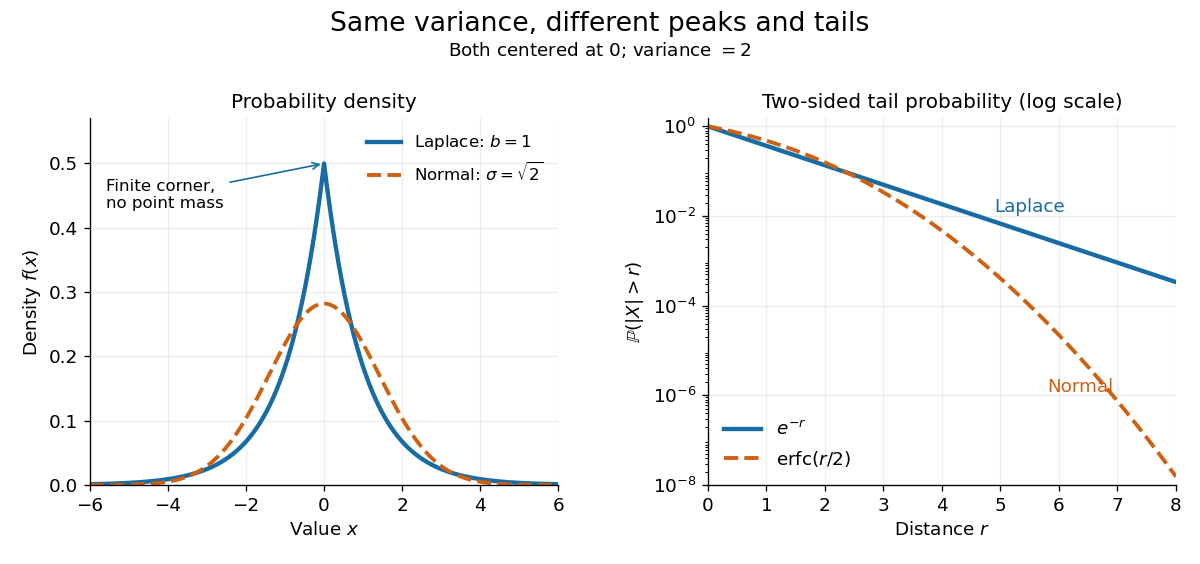

The figure compares a Laplace distribution with , against a normal distribution with mean zero and standard deviation : both have variance 2. The right panel uses a logarithmic scale for the two-sided tail probability . Its straight Laplace distribution curve comes from ; the normal distribution tail falls faster. Thus values far from the center can be more plausible under a Laplace distribution even after matching the variance. These are theoretical curves, not measured frequencies. The tails still have exponential decay; this is not a heavy-tailed distribution in the convention requiring every positive exponential moment to diverge.
Integrating either half of the probability density function gives the cumulative distribution functionIn particular . The basic moments areThus the scale is the expected value of the absolute distance from the center, and is not the standard deviation. [ref]
1.3.6.6.12. Double Exponential Distribution. NIST and SEMATECH e-Handbook of Statistical Methods; NIST/SEMATECH e-Handbook, Section 1.3.6.6.12, Cumulative Distribution Function and Common Statistics; rescale the standard form by x=mu+bz
A short way to obtain the moments is to note that has an exponential distribution with rate : for . Integrating gives and ; the symmetric distribution gives the centered first moment zero. Exponential distribution Created 2026-09-24 Updated 2026-10-07
Gamma distribution Created 2026-09-24 Updated 2026-10-14
Probability density function Created 2026-09-24 Updated 2026-10-14
A probability density function represents probabilities as areas under a nonnegative measurable function. For a real random variable with an absolutely continuous probability distribution, it satisfiesfor every Borel set . Its height is probability per unit of the outcome variable, not the probability of that exact outcome. Thus a probability density function may exceed one, while the probability of a singleton is zero. NIST describes the interval-probability interpretation through integration. [ref].
For the example on , , but and . The cumulative distribution function is within that interval, connecting density height to the local accumulation rate.
Changing the scale changes the density height. If , then on . At the corresponding value , its height is , while is unchanged. The factor compensates for the wider integration variable. This is a change of variables, not a change in the underlying probabilities.
A probability density function is determined only almost everywhere: changing its values on a Lebesgue measure zero set changes no probabilities. The Cantor distribution has no such representation, and a mixed probability distribution can have both a point mass and a density component, so differentiating its cumulative distribution function does not recover all its mass.
Isomorphism of Banach spaces Created 2026-09-24 Updated 2026-10-14
An isomorphism of Banach spaces is a bijective bounded linear map whose inverse is bounded. The bounded inverse theorem makes boundedness of the inverse automatic.
Uniqueness of a rational approximation with bounded denominator Created 2026-09-24 Updated 2026-09-24
Two distinct reduced fractions with denominators below differ by more than , so an interval of radius contains at most one.
There are unlisted articles, also show them or only show them.