
Past exam of the mathematics course of the University of Cambridge 2018 ii Paper 1 15B d Solution Created 2026-09-24 Updated 2026-10-03
Write . As ,so andBecause , the power lies in ; thus and the early expansion decelerates. As , and , givingso the late universe has accelerating expansion.
The transition satisfies . Substitution givesor . ThereforeThis is the transition described by the exact hyperbolic-sine scalar-field cosmology.
Past exam of the mathematics course of the University of Cambridge 2018 ii Paper 1 15B c Solution Created 2026-09-24 Updated 2026-10-03
Put . The hyperbolic cotangent double-angle identity givessoAlsoSolving the Friedmann equation for the scalar potential,therefore gives
Past exam of the mathematics course of the University of Cambridge 2018 ii Paper 1 15B b Solution Created 2026-09-24 Updated 2026-10-03
Past exam of the mathematics course of the University of Cambridge 2018 ii Paper 1 15B a Solution Created 2026-09-24 Updated 2026-10-03
Differentiate the Friedmann equation:The scalar-field equation gives , henceBy continuity this also holds through isolated zeros of , so the Raychaudhuri equation is
Past exam of the mathematics course of the University of Cambridge 2018 ii Paper 1 14B c Solution Created 2026-09-24 Updated 2026-10-03
For real , the exponential decays as , so two allowed contours run from to and from to . For real , it decays as , so reverse the construction: run from or to . These are the infinite contours in the diagram.
For their integrals arefor the corresponding orientation changes only an overall sign. Taking the sum of the two exponentials produces a solution independent of :Its nonzero Wronskian with on proves linear independence.
Past exam of the mathematics course of the University of Cambridge 2018 ii Paper 1 14B b Solution Created 2026-09-24 Updated 2026-10-14
Because , the endpoint factor vanishes at the branch points . A finite contour may therefore run from to on either side of a chosen branch cut; the diagram shows contours bowing through the left and right half-planes.
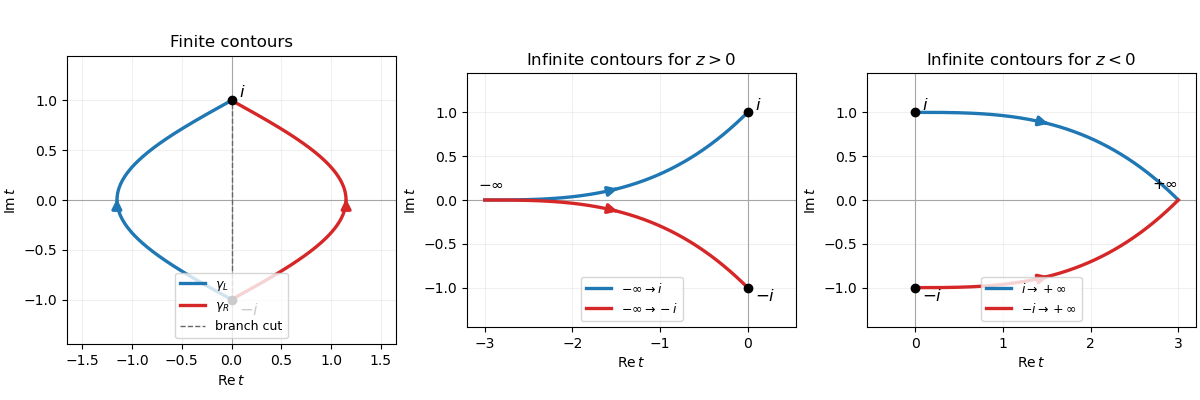
Contour choices for the Laplace transform
. Details. 
For , is entire, so path independence makes either contour give, up to orientation,Hence a nonzero constant multiple gives the solution
Past exam of the mathematics course of the University of Cambridge 2018 ii Paper 1 14B a Solution Created 2026-09-24 Updated 2026-10-03
Past exam of the mathematics course of the University of Cambridge 2018 ii Paper 1 13J c Solution Created 2026-09-24 Updated 2026-10-03
Fit a Poisson regression to artificial responses with meansWith the logarithmic link, this is the generalized linear modelwhere is a known offset. Its log likelihood, apart from constants, isThe differencedoes not depend on . The Poisson surrogate therefore has exactly the same maximum-likelihood estimate of . This is the Poisson surrogate for an uncensored proportional-hazards likelihood.
Past exam of the mathematics course of the University of Cambridge 2018 ii Paper 1 13J b Solution Created 2026-09-24 Updated 2026-10-03
Letbe the baseline cumulative hazard. Under the proportional hazards model,ThusIndependence makes the log likelihood
Past exam of the mathematics course of the University of Cambridge 2018 ii Paper 1 13J a Solution Created 2026-09-24 Updated 2026-10-03
Writing for the survival function, the definition of the hazard function givesSince , integration yieldsThereforeThe exponent is the negative cumulative hazard.
Past exam of the mathematics course of the University of Cambridge 2018 ii Paper 1 12G d iii Created 2026-09-24 Updated 2026-09-24
Past exam of the mathematics course of the University of Cambridge 2018 ii Paper 1 12G d ii Created 2026-09-24 Updated 2026-09-24
Past exam of the mathematics course of the University of Cambridge 2018 ii Paper 1 12G d i Created 2026-09-24 Updated 2026-09-24
Past exam of the mathematics course of the University of Cambridge 2018 ii Paper 1 12G c Solution Created 2026-09-24 Updated 2026-10-03
Let be the successor function. Define by primitive recursionInduction gives . Then defineby composition. Initial functions, composition, and primitive recursion produce primitive recursive functions, so and are partial recursive functions and are visibly defined for every . Both functions are total.
Past exam of the mathematics course of the University of Cambridge 2018 ii Paper 1 12G b Solution Created 2026-09-24 Updated 2026-10-03
A many-one reduction is a total computable function such thatIf is a computably enumerable set, compute and run a semidecision procedure for on that value. It halts exactly when , equivalently exactly when . Therefore is computably enumerable.
Past exam of the mathematics course of the University of Cambridge 2018 ii Paper 1 12G a Solution Created 2026-09-24 Updated 2026-10-03
Fix an effective enumeration of unary partial computable functions. The diagonal halting set isIt is a computably enumerable set: on input , simulate and accept if that computation halts.
Suppose were a computable set. A program could then halt on input exactly when the decider says . Let be its own index. If , the program does not halt, while if , it halts. Both alternatives contradict the definition of . Thus is computably enumerable but not computable.
Past exam of the mathematics course of the University of Cambridge 2018 ii Paper 1 10D b Solution Created 2026-09-24 Updated 2026-10-03
This is superdense coding. To encode , Alice applies respectively to her half of . These local Pauli operators transform the shared state into the four mutually orthogonal Bell states , up to irrelevant global phases. Alice sends her one qubit to Bob. Bob now holds both qubits and performs a Bell-basis measurement, whose outcome identifies Alice's two-bit message with certainty. One transmitted qubit communicates two classical bits because one shared Bell pair was available beforehand.
Past exam of the mathematics course of the University of Cambridge 2018 ii Paper 1 10D a Solution Created 2026-09-24 Updated 2026-10-03
Sincewe haveIts coefficient matrix is proportional towhose determinant is . By the two-qubit product-state determinant criterion, a product state would have determinant zero. Therefore is entangled.
Past exam of the mathematics course of the University of Cambridge 2018 ib Paper 4 9H c Solution Created 2026-09-24 Updated 2026-10-03
Let be the degree of a vertex and putIf and are adjacent, then ; if they are not adjacent, both sides vanish. Thus the walk is in detailed balance, and its invariant distribution is proportional to vertex degree.
Past exam of the mathematics course of the University of Cambridge 2018 ib Paper 4 9H b Solution Created 2026-09-24 Updated 2026-10-03
There are unlisted articles, also show them or only show them.