
Past exam of the mathematics course of the University of Cambridge 2018 ii Paper 1 4G b i Created 2026-09-24 Updated 2026-09-24
Past exam of the mathematics course of the University of Cambridge 2018 ii Paper 1 4G a Solution Created 2026-09-24 Updated 2026-10-03
The pumping lemma for context-free languages states that every context-free language has a pumping length such that every with can be writtenwith , , and for every integer .
Past exam of the mathematics course of the University of Cambridge 2018 ii Paper 1 40E b Solution Created 2026-09-24 Updated 2026-10-03
Let . Since the two columns are linearly independent, the leading block inis invertible. Hence . The hypothesis that is an invariant subspace of implies that this coordinate plane is invariant under . Consequently the first two columns of have no entries below row two, andwhere is the top-left block and is the bottom-right block. Eigenvalue deflation by an invariant subspace now givessoagain counting algebraic multiplicities.
For the required orthogonal reduction, take a thin QR decomposition , extend the two orthonormal columns of to an orthogonal matrix , and set . ThenEquivalently, apply one Householder transformation to annihilate entries of , followed by a second Householder transformation acting only on coordinates to annihilate entries of the transformed .
Past exam of the mathematics course of the University of Cambridge 2018 ii Paper 1 40E a Solution Created 2026-09-24 Updated 2026-10-03
Since and ,Thus the first column of is , and is a block upper triangular matrix:where is its bottom-right submatrix. ThereforeA similarity transformation preserves the characteristic polynomial, sowith algebraic multiplicities included.
To construct , use a Householder transformation. With , choose the sign of to avoid cancellation and setThen is an orthogonal matrix and maps to up to the chosen sign. If already lies on the first coordinate axis, take a suitable diagonal sign matrix. This is the one-vector case of orthogonal coordinate reduction of a subspace.
Past exam of the mathematics course of the University of Cambridge 2018 ii Paper 1 37E d Solution Created 2026-09-24 Updated 2026-10-03
This is the Past incompleteness of the expanding flat slicing of de Sitter spacetime. The coordinate patch covers only half of global de Sitter spacetime, and the surface is its past boundary. The finite proper-time endpoint is a coordinate-patch boundary, not a curvature singularity: the timelike geodesic continues smoothly after passing to global de Sitter coordinates.
Past exam of the mathematics course of the University of Cambridge 2018 ii Paper 1 37E c Solution Created 2026-09-24 Updated 2026-10-03
The Euler-Lagrange equation has the first integralwhere the constant follows from the initial data. Combining this with proper-time normalization gives the Timelike geodesic in the expanding flat slicing of de Sitter spacetime:ConsequentlyIntegrating from , where , givesAs , the first ratio tends to , soThus tends to at the finite proper time .
Past exam of the mathematics course of the University of Cambridge 2018 ii Paper 1 37E b Solution Created 2026-09-24 Updated 2026-10-03
Because is proper time, the four-velocity has normalizationAt , the initial data therefore giveBoth and are future oriented, so the positive root must be chosen:
Past exam of the mathematics course of the University of Cambridge 2018 ii Paper 1 37E a Solution Created 2026-09-24 Updated 2026-10-03
For the Expanding flat slicing of de Sitter spacetime, take the geodesic LagrangianThe Euler-Lagrange equation for iswhile each spatial coordinate obeysComparing these equations with the geodesic equation gives the complete list of nonzero Christoffel symbols:
Past exam of the mathematics course of the University of Cambridge 2018 ii Paper 1 35A b ii Created 2026-09-24 Updated 2026-09-24
Past exam of the mathematics course of the University of Cambridge 2018 ii Paper 1 35A b i Created 2026-09-24 Updated 2026-09-24
Past exam of the mathematics course of the University of Cambridge 2018 ii Paper 1 35A a Solution Created 2026-09-24 Updated 2026-10-03
In the microcanonical ensemble, the microcanonical energy-shell entropy is the Boltzmann entropyFor a macroscopic system, changing the small energy resolution by a fixed factor changes only by a nonextensive additive term, while . Its relative effect therefore vanishes in the thermodynamic limit.
The thermodynamic temperature, pressure, and chemical potential are defined in the entropy representation byThusor, equivalently, the first law of thermodynamics in fundamental form is
Past exam of the mathematics course of the University of Cambridge 2018 ii Paper 1 32A e Solution Created 2026-09-24 Updated 2026-10-03
The Hamiltonian in the question isDefineEach is a first integral, the functions involve disjoint canonical coordinate pairs and hence satisfy , and their differentials are independent wherever every . Since , these integrals prove Liouville integrability of the isotropic harmonic oscillator.
For constants , the common level isso the regular invariant set isHamilton's equations give , so every angle evolves as . If some , the corresponding circle collapses and the level is a lower-dimensional singular invariant torus.
Past exam of the mathematics course of the University of Cambridge 2018 ii Paper 1 32A d Solution Created 2026-09-24 Updated 2026-10-03
Anti-Hermiticity makes purely imaginary, so is real. Its complex derivatives areThe complex-coordinate bracket from part (c) therefore givesHence the anti-Hermitian quadratic Hamiltonian identity is
Past exam of the mathematics course of the University of Cambridge 2018 ii Paper 1 32A c Solution Created 2026-09-24 Updated 2026-10-03
From and , the chain rule givesSubstituting these identities into the canonical Poisson bracket and cancelling the and terms givesThis is the Poisson bracket in complex canonical coordinates.
Past exam of the mathematics course of the University of Cambridge 2018 ii Paper 1 32A b Solution Created 2026-09-24 Updated 2026-10-03
The Arnold-Liouville theorem states that if are independent commuting first integrals and a connected component of a regular common levelis compact, then is diffeomorphic to the -torus. A neighbourhood of admits action-angle variables in whichand the motion is linear on each invariant torus:
Past exam of the mathematics course of the University of Cambridge 2018 ii Paper 1 32A a Solution Created 2026-09-24 Updated 2026-10-03
Hamilton's equations areA time-independent function is a first integral when it is constant along every Hamiltonian trajectory. Sincethis is equivalent to .
The -dimensional Hamiltonian system is integrable when it possesses first integrals that are functionally independent on a dense open set and in mutual involution:
Past exam of the mathematics course of the University of Cambridge 2018 ii Paper 1 31E c Solution Created 2026-09-24 Updated 2026-10-03
The off-axis equilibria exist for and coalesce with an axial equilibrium at each endpoint. Thus the stationary bifurcations occur atFor the positive bifurcation, . Putso thatWrite the extended center manifold as . Its invariance equation isUnder the scaling , comparison of the terms of order givesSubstitution into the equation givesWith the reversed parameter , this is the pitchfork bifurcation normal form . Therefore the positive stationary bifurcation is a supercritical pitchfork in the parameter , or equivalently the stable daughter equilibria exist on the side.
Past exam of the mathematics course of the University of Cambridge 2018 ii Paper 1 31E b Solution Created 2026-09-24 Updated 2026-10-14
The line is invariant for every ; on it, , so the segment from to is a heteroclinic orbit. For , the zero-energy set isThese separatrices divide the two families of closed orbits around the centers from the exterior trajectories. For , both axial equilibria are saddles and are stable foci. For , the off-axis equilibria have disappeared, is a stable node, and remains a saddle.
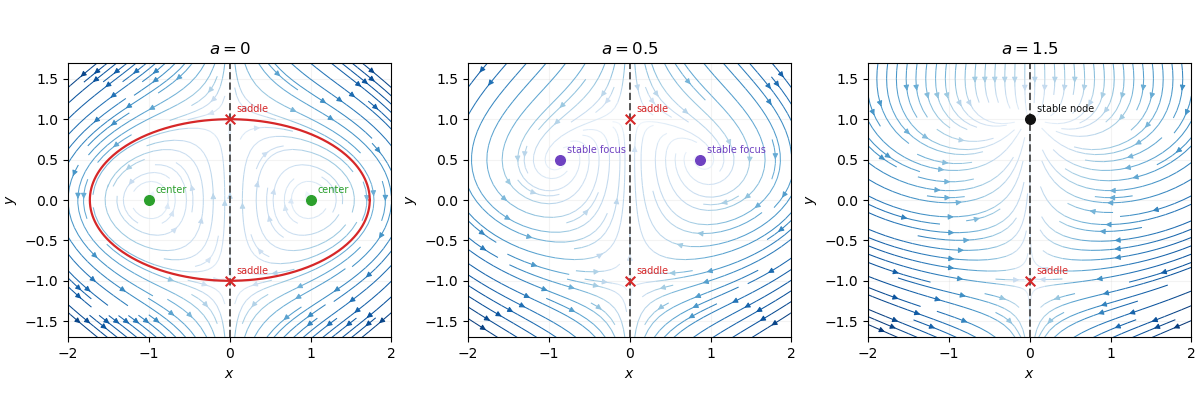
Phase portraits of the planar dynamical system
. Details. 
The arrows, fixed-point types, invariant axis, and the exact separatrix are shown in the three phase portraits.
Past exam of the mathematics course of the University of Cambridge 2018 ii Paper 1 31E a Solution Created 2026-09-24 Updated 2026-10-03
The stationary equations areThusalways exist, and for there are alsoThe Jacobian matrix isAt its eigenvalues are , so it is a saddle for , a stable node for , and nonhyperbolic at . At they are , so it is a saddle for , an unstable node for , and nonhyperbolic at .
At , for , the characteristic polynomial isThe equilibria are stable for and unstable for ; they are foci when and nodes when , with a repeated-eigenvalue transition at equality. For the eigenvalues are purely imaginary. In that case the system is Hamiltonian with first integralbecause and . The Hessian of is positive definite at and negative definite at , so nearby regular level sets are closed curves. Hence both nonhyperbolic equilibria are genuine nonlinear centers.
Finally,For this has a strict constant sign throughout the simply connected plane, so the Bendixson-Dulac criterion proves that there are no periodic orbits. These results comprise the phase portrait of x dot equals two x times y minus a.
Past exam of the mathematics course of the University of Cambridge 2018 ii Paper 1 30K d ii Created 2026-09-24 Updated 2026-09-24
There are unlisted articles, also show them or only show them.