
Past exam of the mathematics course of the University of Cambridge 2008 ii Paper 2 20G a Solution Created 2026-09-24 Updated 2026-10-14
Put . Since , the ring of integers is and its field discriminant is . All three primes ramify:For example and both ideals have norm , proving equality. The Minkowski bound for ideal classes is . Thus the ideal class group is generated by the classes of these prime ideals; an ideal of norm four contributes only the already principal .
The elements and have norms and . Their ideal factorizations give and . This also explains the printed hint: , a fraction, not the integer . Therefore and , leaving at most two ideal classes. The class of is nontrivial: a principal generator would have norm , but would require or , impossible. Hence
Past exam of the mathematics course of the University of Cambridge 2008 ii Paper 2 18H iii Solution Created 2026-09-24 Updated 2026-10-14
A primitive sixth root of unity satisfieswhich is irreducible over because its discriminant is . For the other polynomial choose , so and . Then , so this field already contains all six roots. The Eisenstein criterion at proves irreducible, giving a splitting field of degree six.
Put and . The first automorphism fixes and has order three. The second sends to its negative, so sends to ; hence and . These six distinct transformations exhaust the Galois group. ThereforeThe presence of sixth roots of unity inside the splitting field is why this particular binomial has degree six rather than a generic twelve-degree splitting field.
Past exam of the mathematics course of the University of Cambridge 2008 ii Paper 2 18H ii Solution Created 2026-09-24 Updated 2026-10-14
An automorphism of fixing fixes . Because is a normal extension, it preserves , so restriction gives a homomorphismIts kernel fixes both and , hence every element of their compositum. Therefore restriction is injective, proving the asserted subgroup identification. Normality is the key reason the restriction maps into automorphisms of rather than just embeddings into a larger field.
Past exam of the mathematics course of the University of Cambridge 2008 ii Paper 2 18H i Solution Created 2026-09-24 Updated 2026-10-14
If , the splitting field is and its Galois group is trivial, hence cyclic. Otherwise choose with . The roots are , so the splitting field is because . The roots are distinct since the characteristic does not divide , making this a Galois extension. Each automorphism satisfies with . Because that root-of-unity group is fixed by all automorphisms, . Thus is an injective homomorphism into a cyclic group. The splitting-field Galois group is cyclic, of order dividing .
Past exam of the mathematics course of the University of Cambridge 2008 ii Paper 2 16G iii Solution Created 2026-09-24 Updated 2026-10-14
The intended closed-term witness property for quantifier-free existential sentences needs at least one closed term. Under this hypothesis, suppose the set were consistent. By the Godel completeness theorem, it has a model . Take the substructure whose elements are the interpretations of closed terms. It is nonempty and closed under every function symbol. Atomic formulas and their negations have the same truth values in as in , and induction extends this to every quantifier-free formula.
The provable sentence is true in by soundness. Its witness is for some closed term , so , contradicting . Hence is inconsistent. The compactness theorem gives a finite inconsistent subset, so completeness and classical propositional reasoning yieldWithout a constant or nullary function, the printed assertion is false as written: in the equality-only language there are no closed terms, but is provable. Then is empty and consistent. One may repair the usual theorem by assuming a nonempty set of closed terms or adjoining a fresh constant; the latter proves a witness disjunction in the enlarged language, not the missing closed terms in the original one.
Past exam of the mathematics course of the University of Cambridge 2008 ii Paper 2 16G ii Solution Created 2026-09-24 Updated 2026-10-14
For each , let assert the existence of distinct elements. If a theory has arbitrarily large finite models, every finite subset of has a model. By the compactness theorem, this extended theory has a model, necessarily infinite. Since fields of size are arbitrarily large, no first-order theory can have exactly the finite fields of characteristic two as its models.
Suppose instead a finite conjunction axiomatized exactly the infinite fields of characteristic two. Let be the field axioms with . Then would have exactly the finite characteristic-two fields as models, contradicting the preceding conclusion. Equivalently, compactness of would force some finite size threshold, but arbitrarily large finite fields still fail . The infinite characteristic-two fields are not finitely axiomatizable.
Past exam of the mathematics course of the University of Cambridge 2008 ii Paper 2 16G i Solution Created 2026-09-24 Updated 2026-10-14
The Godel completeness theorem for first-order logic states that implies ; together with soundness, semantic consequence and derivability coincide. Equivalently, every syntactically consistent first-order theory has a model. The compactness theorem states that a set of first-order sentences has a model if and only if every finite subset has a model. These statements use nonempty first-order structures.
Past exam of the mathematics course of the University of Cambridge 2008 ii Paper 2 14C ii Solution Created 2026-09-24 Updated 2026-10-14
There is a branch-phase discrepancy in the printed identity. Set using the positive real base. Shrink the anticlockwise loop at . The outward interval carries phase and its return phase ; their difference gives . The clockwise loop at starts with phase and returns with , giving the same coefficient on . Small endpoint circles vanish for . Thus the branch phase in a figure-eight analytic continuation integral isIf the printed interval integral uses the prescribed argument , then , and the corrected formula is insteadFor example at , , and ; the printed right side without the phase would be the real number . Interpreting its interval integrand as restores the intended identity.
On the fixed contour away from its branch points, the continued logarithm is bounded and is entire in , uniformly on compact sets. Hence is an entire function. Division by the sine gives a meromorphic continuation of , and multiplication by gives the continuation of the specified . The only candidate singularities are integers, at most simple. All are removable because the interval integral is already holomorphic on .
The negative integers , , are genuine simple poles. At such a point the contour integrand is single-valued andThe first residue is times a rational number. The second is times a nonzero rational number: expand at , whose degree- coefficient has sign and nonzero magnitude. They cannot be equal because is irrational. Therefore , and the simple sine zero creates a simple pole. In particular .
A circle enclosing both branch points has total logarithmic change , rather than zero as for the figure eight. For a circle based at with initial real logarithm, shrinking it leaves a connector from to as well as the two banks of the interval. Explicitly its integral isThus it is not just a known sine factor times : an additional endpoint-singular integral remains. The figure-eight contour eliminates precisely that connector term. This explains why replacing it by the large circle does not give the same direct continuation method.
Past exam of the mathematics course of the University of Cambridge 2008 ii Paper 2 14C i Solution Created 2026-09-24 Updated 2026-10-14
Parametrize the continued branch by , . Then , givingThe apparent singularity at zero is removable, so is an entire function. The factor shows its dependence on the contour radius; for instance . The integrand is continued along the contour and generally returns on a different branch, so this is not an ordinary integral of a single-valued holomorphic function around a closed loop.
Past exam of the mathematics course of the University of Cambridge 2008 ii Paper 2 13B c Solution Created 2026-09-24 Updated 2026-10-14
A travelling wave obeys , so the mechanical potential in the requested form is , up to an additive constant. HereIts stationary points are maxima at and a minimum at . Since and , the two maxima have equal height at ; the maximum at is lower for and higher for .
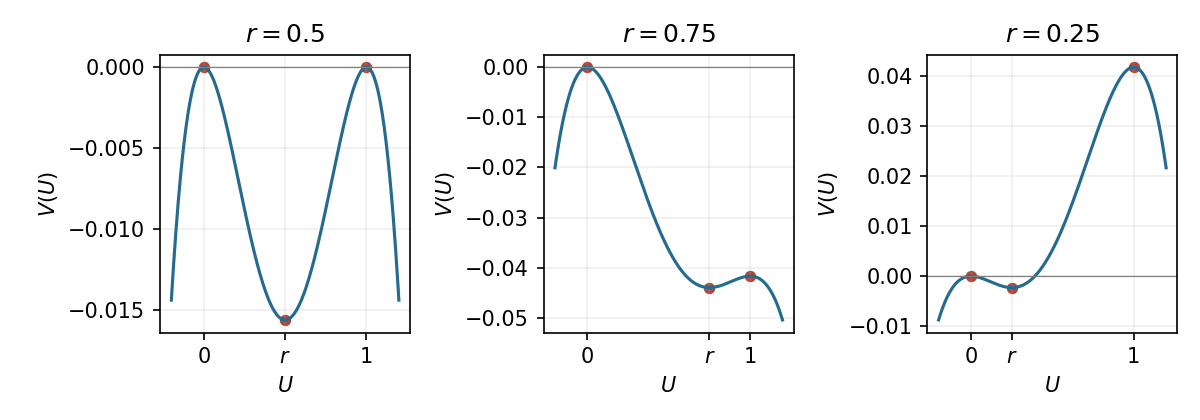

Multiply the wave equation by and integrate along the heteroclinic orbit. The endpoint derivatives vanish, and , , soConsequentlyThe integral is positive for a nonconstant front. In fact substitution of the same logistic shape from part (b) gives the exact velocity . Thus the phase invades rightwards when , the zero phase invades leftwards when , and the balanced front is stationary.
Past exam of the mathematics course of the University of Cambridge 2008 ii Paper 2 13B b Solution Created 2026-09-24 Updated 2026-10-14
At , write , so . Multiplying the stationary equation by gives . The endpoint values and vanishing endpoint derivatives make . For the decreasing connection,Separate variables and absorb the integration constant into a translation . The logistic front of a bistable cubic equation isIt approaches on the left and on the right and satisfies the stationary differential equation directly.
Past exam of the mathematics course of the University of Cambridge 2008 ii Paper 2 13B a Solution Created 2026-09-24 Updated 2026-10-14
For spatially homogeneous solutions, the bistable cubic reaction-diffusion equation reduces to . Its equilibria are , andThus and are asymptotically stable, while is unstable. Small spatial Fourier perturbations have growth rates , so diffusion also leaves the two outer uniform states linearly stable.
Past exam of the mathematics course of the University of Cambridge 2008 ii Paper 1 7A i Solution Created 2026-09-24 Updated 2026-10-14
For , the first integralhas . The equilibrium points are and . The linearization has eigenvalues at the origin and at . The origin is a center equilibrium: the sufficiently small positive level sets of are closed curves, since its Hessian matrix there is positive-definite. The other equilibrium is a saddle equilibrium.
At the saddle, , and the separatrix satisfiesIts two branches with form a homoclinic orbit through the saddle; its remaining branches extend to . Inside the loop, the closed trajectories run clockwise: above the horizontal axis . The saddle directions have slopes and . Outside the loop there are unbounded trajectories. The left panel shows the closed orbits and all saddle branches.
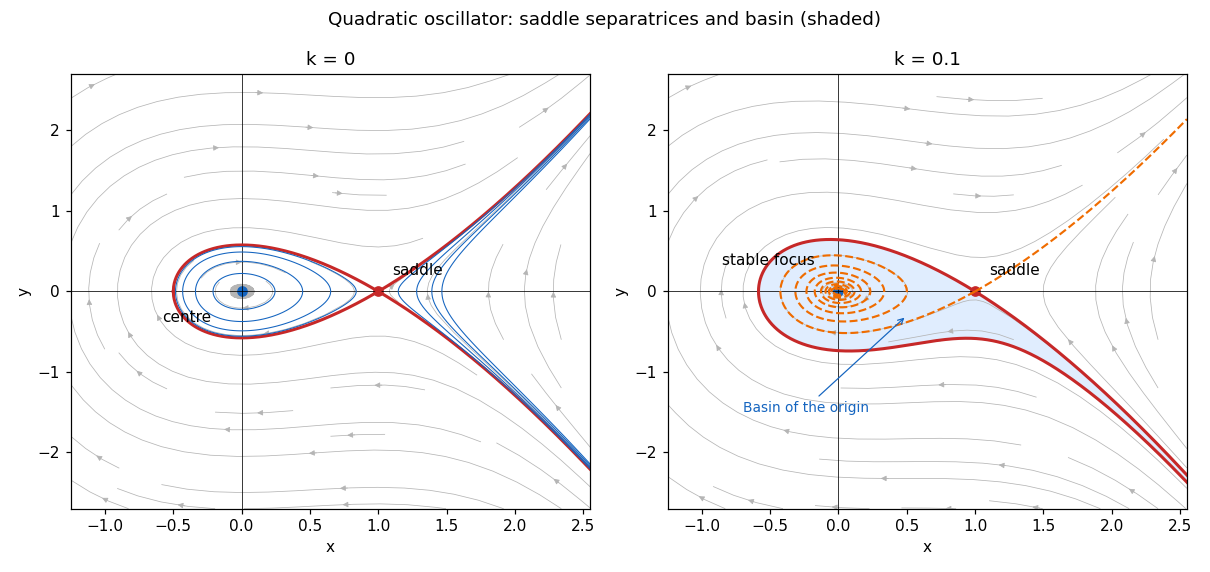
Conservative phase portrait and the attracting basin after adding weak damping
. Details. 
Past exam of the mathematics course of the University of Cambridge 2008 ii Paper 1 38C b Solution Created 2026-09-24 Updated 2026-10-14
For a linear system write , where is the diagonal. The Jacobi method iteratesHere , and has nonnegative off-diagonal entries with row sums at most one. Rows adjacent to the boundary have sum strictly less than one; those at purely interior stencil vertices have sum one. Thus .
To prove strict spectral radius below one, suppose with , and choose an index with . Inequality forces that row sum to equal one and every linked neighbor to attain the same maximum modulus. Propagate this along the connected axial grid to a boundary-adjacent row, whose row sum is strictly less than one, a contradiction. All eigenvalues therefore have modulus strictly below one. Hence and the Jacobi errors tend to zero from every initial vector. The unique solution exists by positive definiteness, so
Past exam of the mathematics course of the University of Cambridge 2008 ii Paper 1 38C a Solution Created 2026-09-24 Updated 2026-10-14
Number the interior grid vertices in any order. The diagonal of is , and off-diagonal weights are for axial neighbors and for diagonal neighbors. Each link weight is symmetric, so is symmetric. Extend the interior grid values by zero to the boundary. Since the eight stencil weights sum to , grouping links giveswhere or and each interior link is counted once. Every term is nonnegative. If the quadratic form vanishes, neighboring interior values agree, and every vertex linked to the boundary has value zero. The axial-link grid is connected and reaches the boundary, so all values are zero. Thus . Reordering vertices replaces by for a permutation matrix , preserving both properties.
Past exam of the mathematics course of the University of Cambridge 2008 ii Paper 1 36A b Solution Created 2026-09-24 Updated 2026-10-14
Integrating the velocity profiles over their respective half-channels gives volume flux per unit widthWith , the requested ratio isAt , both fluxes equal and the ratio is one. For , , and the ratio is asymptotic to , tending to zero. The lower fluid flows between the wall and an interface which becomes effectively stationary; the upper fluid carries vanishing flux despite finite limiting stress.
Past exam of the mathematics course of the University of Cambridge 2008 ii Paper 1 36A a Solution Created 2026-09-24 Updated 2026-10-14
The signed tangential stress component is . ThusWhen , these approach and , the usual symmetric plane Poiseuille flow stresses. When , they approach and . The upper fluid's velocity tends to zero, but its viscosity times velocity gradient has a finite limit. These are tensor components; traction on a chosen wall normal includes that normal's sign.
Past exam of the mathematics course of the University of Cambridge 2008 ii Paper 1 32D b Solution Created 2026-09-24 Updated 2026-10-14
The spatial translation operator is . From and the preceding central-commutator result,Thus , consistent with . Since , the translated wavefunction is .
For the quantum harmonic oscillator, the creation and annihilation operators give . Put . The central commutator of and is , soAs and ,Taking position wavefunctions provesThe coefficient squares sum to , checking normalization of this coherent state.
Past exam of the mathematics course of the University of Cambridge 2008 ii Paper 1 32D a Solution Created 2026-09-24 Updated 2026-10-14
Write , so . Repeated use of the product rule for the commutator gives . Summing the exponential series yieldsThese manipulations hold for bounded operators, or as identities on a common invariant domain where the series and derivatives are justified.
The same commutation relation implies : its derivative is and its initial value is . Put . ThenFor the specified , the operator commutes with . Indeed conjugation by sends to , and subsequent conjugation by restores . Thereforeso . At this proves the central-commutator case of the Baker--Campbell--Hausdorff formula:The last equality holds because commutes with .
Past exam of the mathematics course of the University of Cambridge 2008 ii Paper 1 29C iii Solution Created 2026-09-24 Updated 2026-10-14
Start a characteristic curve at with . The Characteristic curve equations give , , , so . Therefore the two branches areEach is on . The plus branch matches for , whereas the minus branch matches it for . Differentiating gives and , verifying wherever .
On the initial line, the normal Characteristic curve speed is , nonzero away from the origin. Thus the local existence theorem gives precisely these separate local branches near positive and negative initial points. At the branches merge and their derivatives become singular. There is no solution realizing the entire initial line in a neighborhood of the origin: the data force , while the equation and force . The failure at this Characteristic curve point is a genuine limitation of the printed global initial-data request.
There are unlisted articles, also show them or only show them.