
Past exam of the mathematics course of the University of Cambridge 2019 ia Paper 4 5E a Created 2026-09-24 Updated 2026-09-24
Past exam of the mathematics course of the University of Cambridge 2019 ia Paper 4 4A Solution Created 2026-09-24 Updated 2026-09-29
Measure displacement downward from the release point and take downward speed . Newton's second law with quadratic drag givesWritingseparation of variables gives the terminal velocity solutionThe distance fallen by time is thereforeSetting and solving for yields
Past exam of the mathematics course of the University of Cambridge 2019 ia Paper 4 3A Solution Created 2026-09-24 Updated 2026-09-29
During a short interval , let the rocket's mass change by and its speed by . The expelled mass has inertial-frame speed to first order. Conservation of linear momentum, including the impulse , givesDiscarding the second-order product leavesand hence the Tsiolkovsky rocket equation
Past exam of the mathematics course of the University of Cambridge 2019 ia Paper 4 2E Solution Created 2026-09-24 Updated 2026-09-29
The second series converges absolutely, for example by the ratio test, and is the odd part of the exponential series:This value is irrational. Indeed, if were algebraic, then would satisfymaking algebraic over the algebraic numbers and hence algebraic, contrary to the Hermite theorem on the transcendence of e. Thus the second sum is in fact transcendental.
Past exam of the mathematics course of the University of Cambridge 2019 ia Paper 4 1E Solution Created 2026-09-24 Updated 2026-09-29
Since and , the two linear congruences reduce toWrite . The second congruence becomesor after division by three. Since , . The Chinese remainder theorem therefore gives the complete familyThe modulus is because the compatibility condition modulo their greatest common divisor is satisfied.
Past exam of the mathematics course of the University of Cambridge 2019 ia Paper 4 12A a Created 2026-09-24 Updated 2026-09-29
Past exam of the mathematics course of the University of Cambridge 2019 ia Paper 4 12A b Created 2026-09-24 Updated 2026-09-29
Past exam of the mathematics course of the University of Cambridge 2019 ia Paper 4 11A c Created 2026-09-24 Updated 2026-09-24
Past exam of the mathematics course of the University of Cambridge 2019 ia Paper 4 11A b Created 2026-09-24 Updated 2026-09-24
Past exam of the mathematics course of the University of Cambridge 2019 ia Paper 4 11A a Created 2026-09-24 Updated 2026-09-24
Past exam of the mathematics course of the University of Cambridge 2019 ia Paper 4 10A b Created 2026-09-24 Updated 2026-09-24
Past exam of the mathematics course of the University of Cambridge 2019 ia Paper 4 10A a Created 2026-09-24 Updated 2026-09-24
Past exam of the mathematics course of the University of Cambridge 2019 ia Paper 3 9B Solution Created 2026-09-24 Updated 2026-10-14
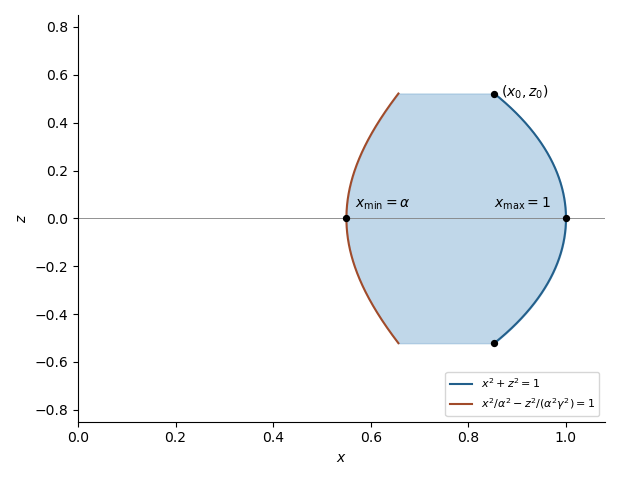
For the one-to-one transformation , the Jacobian determinant used in the stated formula isLocally, the derivative maps a small rectangular box of volume to a parallelepiped of volume . Partitioning the region into such boxes and passing to the Riemann integral gives the change of variables formula
In the plane , the region is inside the unit circle and on the right-hand side of the hyperbolaIt is nonempty exactly when ; it has positive area when . In , its boundaries are and . The minimum and maximum values are and , both at . The largest absolute occurs where the boundaries meet:

Past exam of the mathematics course of the University of Cambridge 2019 ia Paper 3 8D Solution Created 2026-09-24 Updated 2026-09-29
Represent a Möbius transformation by a matrix, with nonzero scalar multiples representing the same map. Matrix multiplication reproduces composition, so is a group homomorphism. Every Möbius map has a representing matrix ; multiplying by either square root of gives a matrix in representing the same map. Thus is surjective. A matrix in its kernel represents the identity and is therefore scalar; determinant one leaves
If a nonidentity Möbius map has two distinct fixed points, conjugate those points to and . The conjugated map fixes both and hence has the form with . If has one fixed point, conjugate it to . The resulting affine map has the form ; having no finite fixed point forces and , and conjugating by a scaling makes it .
Directly, the finite fixed points satisfyIncluding when appropriate, a nonidentity Möbius map consequently has one or two distinct fixed points.
Finally suppose has the unique fixed point . With the conjugacy above,Every finite point tends to on the Riemann sphere, while itself is fixed. Applying the continuous map shows thatfor every .
Past exam of the mathematics course of the University of Cambridge 2019 ia Paper 3 7D Solution Created 2026-09-24 Updated 2026-09-29
The first isomorphism theorem for groups states that for a group homomorphism ,The map is well defined because two representatives differ by an element of the kernel; it is a surjective homomorphism onto the image and is injective because exactly when .
For and , normality of givesand . Hence is a subgroup. Also , since conjugation by preserves both and , and because .
If , then is a normal subgroup: it is a subgroup by the calculation above, and . Without normality a product need not be a subgroup. In , take and . The set has four elements, so it cannot be a subgroup of the six-element group by Lagrange's theorem for finite groups.
Past exam of the mathematics course of the University of Cambridge 2019 ia Paper 3 6D d Created 2026-09-24 Updated 2026-09-24
Past exam of the mathematics course of the University of Cambridge 2019 ia Paper 3 6D c Created 2026-09-24 Updated 2026-09-24
Past exam of the mathematics course of the University of Cambridge 2019 ia Paper 3 6D b Created 2026-09-24 Updated 2026-09-24
Past exam of the mathematics course of the University of Cambridge 2019 ia Paper 3 6D a Created 2026-09-24 Updated 2026-09-24
Past exam of the mathematics course of the University of Cambridge 2019 ia Paper 3 5D ii Created 2026-09-24 Updated 2026-09-24
There are unlisted articles, also show them or only show them.