
Past exam of the mathematics course of the University of Cambridge 2019 ib Paper 3 10F Solution Created 2026-09-24 Updated 2026-10-03
The symmetric bilinear form associated with a quadratic form is obtained by polarization:To diagonalize it, argue by induction on . If for every , polarization gives , so every basis works. Otherwise choose with . Thenand diagonalize the restriction to inductively. Thus some basis gives a diagonal matrix with positive, negative, and zero entries. By Sylvester's law of inertia, their counts are basis-independent. In the convention relevant here, the signature of a quadratic form is
Suppose lies in the radical of a bilinear form, so for all . Then andHence is a well-defined quadratic form on the quotient vector space . In an adapted diagonal basis, quotienting by merely removes zero diagonal directions, so and , and therefore the signature, are unchanged.
Now let . Its Gram matrix iswhich has determinant . Thus is nondegenerate and has one positive and one negative square: it is a hyperbolic plane (quadratic form) and has signature zero. Nondegeneracy gives the orthogonal direct sumSignature is additive under orthogonal direct sums, so
Past exam of the mathematics course of the University of Cambridge 2019 ib Paper 2 9H Solution Created 2026-09-24 Updated 2026-09-29
The Lagrange sufficiency theorem for maximizing subject to and states that if a feasible point and multipliers satisfy complementary slackness and globally maximizes the Lagrangian function in constrained optimizationthen globally maximizes on the feasible set.
For the equality constraint, takeThe Lagrange multiplier equations giveso positivity and the constraint implyFor this multiplier, is a strictly concave function on the positive octant and its stationary point is its unique global maximum. The sufficiency theorem therefore proves that the constrained maximum is
For , use . The same point and multiplier satisfy feasibility, stationarity, , and complementary slackness, and they again globally maximize the Lagrangian. Hence the answer is unchanged. Equivalently, any point with strict inequality can be radially scaled outward, increasing all three positive coordinates and therefore increasing .
Past exam of the mathematics course of the University of Cambridge 2019 ib Paper 2 8H c Created 2026-09-24 Updated 2026-09-24
Past exam of the mathematics course of the University of Cambridge 2019 ib Paper 2 8H b Created 2026-09-24 Updated 2026-09-24
Past exam of the mathematics course of the University of Cambridge 2019 ib Paper 2 8H a Created 2026-09-24 Updated 2026-09-24
Past exam of the mathematics course of the University of Cambridge 2019 ib Paper 2 7C Solution Created 2026-09-24 Updated 2026-10-14
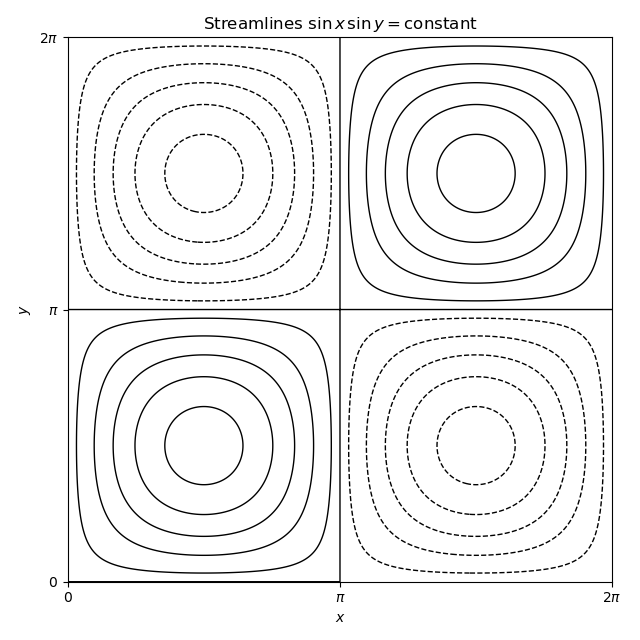
The velocity field is incompressible becauseWith the convention and , a stream function isThe vorticity is vertical:For a steady inviscid incompressible flow, the vorticity equation is . Here the right side is zero because the flow is independent of , while the left side is because velocity is tangent to the level sets of . Thus the equation is satisfied.
The streamlines are the level curves . The lines and , together with the boundary, are separatrices; each of the four cells contains closed nested curves around a centre at , , , or .

Past exam of the mathematics course of the University of Cambridge 2019 ib Paper 2 6A Solution Created 2026-09-24 Updated 2026-09-29
The free-space Green function of the Laplacian for the Poisson equation gives the electric potentialFor , its electric multipole expansion begins withDefine the total electric charge and electric dipole moment byThen
The analogous solution for the magnetic vector potential isIts apparent coefficient is . For each component, the supplied identity and the divergence-free vector field condition giveThe divergence theorem turns this into a surface integral outside the compact support of the current density, where . Hence , so the term vanishes.
Past exam of the mathematics course of the University of Cambridge 2019 ib Paper 2 5B Solution Created 2026-09-24 Updated 2026-09-29
For an axisymmetric separated solution of the Laplace equation whose angular factor is the Legendre polynomial , the radial ordinary differential equation has the two powers and . Thusfor constants .
Write . Since , only the spherical harmonics of degrees zero and two occur. The degree-zero radial coefficient satisfying its two Dirichlet boundary conditions is . For degree two, write ; thenso and . By linearity and uniqueness of this boundary value problem,Direct substitution at verifies both boundary values.
Past exam of the mathematics course of the University of Cambridge 2019 ib Paper 2 4G b Created 2026-09-24 Updated 2026-09-24
Past exam of the mathematics course of the University of Cambridge 2019 ib Paper 2 4G a Created 2026-09-24 Updated 2026-09-24
Past exam of the mathematics course of the University of Cambridge 2019 ib Paper 2 3E b Created 2026-09-24 Updated 2026-09-24
Past exam of the mathematics course of the University of Cambridge 2019 ib Paper 2 3E a Created 2026-09-24 Updated 2026-09-24
Past exam of the mathematics course of the University of Cambridge 2019 ib Paper 2 2G Solution Created 2026-09-24 Updated 2026-09-29
Let the torsion submodule of the module over a ring beThis is a submodule. Indeed, if and with , then because the scalar ring is an integral domain, and ; scalar multiples and additive inverses are handled similarly.
Take the quotient module and let be the quotient R-module homomorphism. It is torsion-free: if and , then , so for some . Since , this puts in and therefore .
Now let be torsion-free and let be an -module homomorphism. If and for , then , so torsion-freeness gives . Hence , and the universal property of a quotient module gives a unique homomorphismwith . Thus is the maximal torsion-free quotient of .
Past exam of the mathematics course of the University of Cambridge 2019 ib Paper 2 20H c Created 2026-09-24 Updated 2026-09-24
Past exam of the mathematics course of the University of Cambridge 2019 ib Paper 2 20H b Created 2026-09-24 Updated 2026-09-24
Past exam of the mathematics course of the University of Cambridge 2019 ib Paper 2 20H a Created 2026-09-24 Updated 2026-09-24
Past exam of the mathematics course of the University of Cambridge 2019 ib Paper 2 1F Solution Created 2026-09-24 Updated 2026-09-29
Let . Choose a basis of the intersection of vector subspaces, extend it to a basis of , and independently extend it to a basis of . The combined listspans the sum of vector subspaces . It is also linearly independent: a vanishing linear combination says that a combination of the belongs to , and its expression in the chosen basis of forces all its coefficients to vanish; the coefficients of the then vanish in the same way. This proves the dimension formula for a sum of subspaces
Parametrize the two linear subspaces asPutting a vector of in first forces its fourth coordinate to vanish; the remaining defining equation is then automatic. Thusand the dimension formula gives .
The linear functionalvanishes on each displayed generator of and . Its kernel is three-dimensional because , so the inclusion between two three-dimensional subspaces is equality.
Past exam of the mathematics course of the University of Cambridge 2019 ib Paper 2 19C Solution Created 2026-09-24 Updated 2026-09-29
The linear least-squares problem is to choose minimizing the Euclidean norm of the residual:For a QR decomposition , orthogonality of gives . If has full column rank and is in standard form with invertible upper-triangular , the minimizer solves .
Applying the Gram-Schmidt process to the columns of the given matrix yieldsIndeed, is an orthogonal matrix and . Moreover,Back substitution in the leading triangular system givesso the unique least-squares solution isThe unused final transformed residual component is , so the minimum residual norm is .
Past exam of the mathematics course of the University of Cambridge 2019 ib Paper 2 18A Solution Created 2026-09-24 Updated 2026-09-29
For a moving circuit, Faraday's law states that the electromotive forceequals , where is the magnetic flux through any spanning surface. Choose the upward normal. The horizontal square hasso Ohm's law gives the induced currentwith positive current taken counterclockwise from above.
On the edge , . The magnetic force on a current-carrying wire is , henceThe ratio of the horizontal to vertical magnitudes is , so the directed force makes angle with the vertical, with the sign fixing the horizontal side.
The horizontal forces on opposite edges cancel, while all four vertical contributions add:This is an electromagnetic drag force opposing the motion, as required by Lenz's law. Including gravity givesAt the terminal velocity, , and the constant downward speed has magnitude
Past exam of the mathematics course of the University of Cambridge 2019 ib Paper 2 17B Solution Created 2026-09-24 Updated 2026-09-29
The total angular momentum operator isUsing the cyclic orbital angular momentum commutation relations,while ; hence . In Cartesian coordinates,Because and it annihilates and every radial function,Replacing by gives eigenvalue .
The six-dimensional space splits into the five trace-free quadratic spherical harmonics with and one radial state with . A simultaneous eigenbasis for and iswhere the eigenvalue of was used. Every displayed state is a complex linear combination of the original six energy eigenstates, so it is still an energy eigenstate at the same level.
There are unlisted articles, also show them or only show them.