
Past exam of the mathematics course of the University of Cambridge 2009 ii Paper 3 17F c Created 2026-09-24 Updated 2026-09-24
Past exam of the mathematics course of the University of Cambridge 2009 ii Paper 3 17F b Created 2026-09-24 Updated 2026-09-24
Past exam of the mathematics course of the University of Cambridge 2009 ii Paper 3 17F a Created 2026-09-24 Updated 2026-09-24
Past exam of the mathematics course of the University of Cambridge 2009 ii Paper 3 16G Solution Created 2026-09-24 Updated 2026-10-14
The induced ordering on is a well-order. By transfinite recursion define for . Induction shows that each is an ordinal, that these values strictly increase, and that their range is the ordinal . The map is an order isomorphism from to this ordinal. Any order isomorphism between ordinals must fix their elements successively, so this ordinal is unique.
An increasing map between ordinals satisfies by induction: its predecessors include for all . Hence . Apply this to the inclusion , transported through their order isomorphisms, and then to . It follows that .
If each is an initial segment of later , uniqueness makes their ordinal enumerations compatible: the enumeration of restricts to that of . Their union is consequently an order isomorphism from to . This proves the asserted equality. Without the initial segment condition it fails: in , take . Then , whose union is , but .
For decreasing sets, is a nonincreasing sequence of ordinals. Its set of values has a least member, attained at some ; all later values must equal it. Hence the sequence is eventually constant. The intersection formula nevertheless fails: take . Every has order type , whereas their intersection is empty and has order type zero. Thus .
Past exam of the mathematics course of the University of Cambridge 2009 ii Paper 3 15D ii Created 2026-09-24 Updated 2026-09-24
Past exam of the mathematics course of the University of Cambridge 2009 ii Paper 3 15D i Created 2026-09-24 Updated 2026-09-24
Past exam of the mathematics course of the University of Cambridge 2009 ii Paper 3 14E iii Created 2026-09-24 Updated 2026-09-24
Past exam of the mathematics course of the University of Cambridge 2009 ii Paper 3 14E ii Created 2026-09-24 Updated 2026-09-24
Past exam of the mathematics course of the University of Cambridge 2009 ii Paper 3 14E i Created 2026-09-24 Updated 2026-09-24
Past exam of the mathematics course of the University of Cambridge 2009 ii Paper 3 13A Solution Created 2026-09-24 Updated 2026-10-14
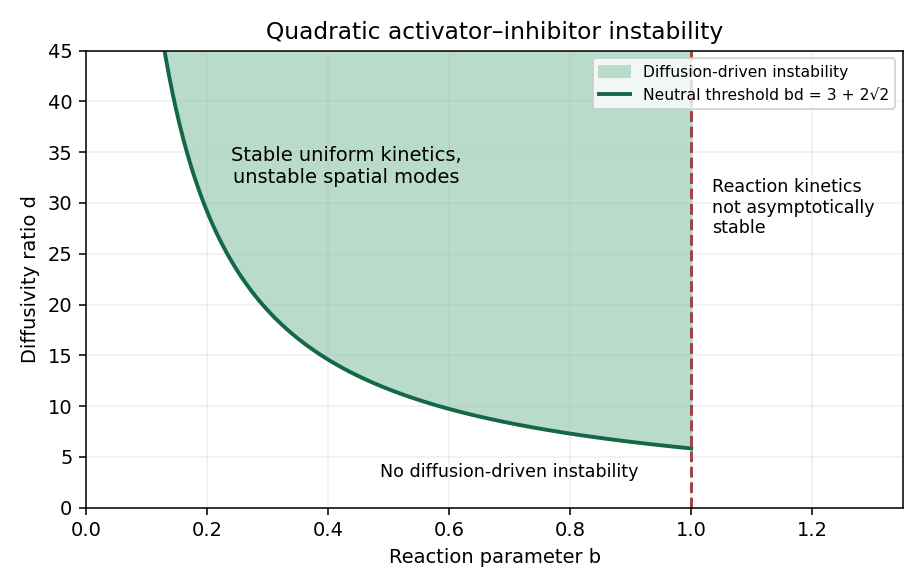
The species is the activator, since increasing increases its own production ; is the inhibitor, since increasing reduces that production. The unique positive uniform steady state solves and , giving .
The reaction Jacobian matrix at this state isIts eigenvalues solve . Since , both have negative real part precisely for . This proves stability of the spatially uniform reaction kinetics.
A perturbation proportional to replaces by . Put . Its trace is in the kinetically stable range, and its determinant isA growing spatial mode exists exactly when this determinant is negative for some . Its minimum occurs at , which is positive only if , and the minimum is negative precisely if . Together these conditions reduce to the Turing threshold of the quadratic activator-inhibitor model,The unstable band isAt the Turing instability threshold the band shrinks to its double root, yielding . On a bounded spatial interval, an allowed wavenumber must additionally lie in the unstable band; the displayed parameter condition assumes the continuous spatial spectrum.

Past exam of the mathematics course of the University of Cambridge 2009 ii Paper 3 12F c Created 2026-09-24 Updated 2026-09-24
Past exam of the mathematics course of the University of Cambridge 2009 ii Paper 3 12F b Created 2026-09-24 Updated 2026-09-24
Past exam of the mathematics course of the University of Cambridge 2009 ii Paper 3 12F a Created 2026-09-24 Updated 2026-09-24
Past exam of the mathematics course of the University of Cambridge 2009 ii Paper 3 11G Solution Created 2026-09-24 Updated 2026-10-14
In the multiplicative group , the squaring map is a group homomorphism with kernel , since is odd. Every nonzero square therefore has exactly two square roots. There are quadratic residues and the same number of nonresidues, and consequently .
For , direct multiplication gives . Multiplicativity of the Legendre symbol, including its value zero on multiples of , impliesInversion permutes , so runs through all residue classes except . Thus
Past exam of the mathematics course of the University of Cambridge 2009 ii Paper 3 10D b Created 2026-09-24 Updated 2026-09-24
Past exam of the mathematics course of the University of Cambridge 2009 ii Paper 3 10D a Created 2026-09-24 Updated 2026-09-24
Past exam of the mathematics course of the University of Cambridge 2009 ii Paper 2 9E Solution Created 2026-09-24 Updated 2026-11-05
For , the Euler-Lagrange equations giveIn components these are , and . A normal mode has and satisfies . For eigenvalue , the first and third rows give and , and the second row then agrees. HenceThe particle positions are recovered by adding the equilibrium offsets to the last two entries. Their displacements are in phase with amplitude ratio .
Past exam of the mathematics course of the University of Cambridge 2009 ii Paper 2 8B ii Created 2026-09-24 Updated 2026-09-24
Past exam of the mathematics course of the University of Cambridge 2009 ii Paper 2 8B i Created 2026-09-24 Updated 2026-09-24
Past exam of the mathematics course of the University of Cambridge 2009 ii Paper 2 7E ii Created 2026-09-24 Updated 2026-09-24
There are unlisted articles, also show them or only show them.