
Past exam of the mathematics course of the University of Cambridge 2009 ii Paper 2 20H i Created 2026-09-24 Updated 2026-09-24
Past exam of the mathematics course of the University of Cambridge 2009 ii Paper 2 1G Solution Created 2026-09-24 Updated 2026-10-14
For odd positive coprime integers, quadratic reciprocity for the Jacobi symbol isIf the integers are not coprime, both symbols vanish; equivalently the usual signed reciprocity identity still holds. To deduce it from quadratic reciprocity for the Legendre symbol, factor and . Multiplication of the prime reciprocity identities gives the sign exponentModulo two, each bracket is respectively and : for odd , . This proves the composite-denominator law, including repeated prime factors.
Now , and 9 contributes a square factor. Since , reciprocity and reduction of the numerator giveA second reciprocity step gives . Thus the requested Jacobi symbol is .
Past exam of the mathematics course of the University of Cambridge 2009 ii Paper 2 19F iii Created 2026-09-24 Updated 2026-09-24
Past exam of the mathematics course of the University of Cambridge 2009 ii Paper 2 19F ii Created 2026-09-24 Updated 2026-09-24
Past exam of the mathematics course of the University of Cambridge 2009 ii Paper 2 19F i Created 2026-09-24 Updated 2026-09-24
Past exam of the mathematics course of the University of Cambridge 2009 ii Paper 2 18H Solution Created 2026-09-24 Updated 2026-10-14
For the first polynomial, put and , so that . The roots are , andTo justify the degree, a rational quadratic factorization would have the form . The vanishing linear coefficient implies either or . The former requires , not rational, while the latter requires , also impossible over . There is no rational root, since its square would have to be , so the polynomial is irreducible. The real field has degree four and does not contain , giving degree eight after adjoining it. The group acts transitively on the four roots while preserving their two opposite pairs, so is contained in the square's dihedral group of order eight; the degree makes it the full group.
For the second polynomial, choose and . Then , and . Its four roots generateIndeed and recover both generators. The real quadratic field cannot contain , so the degree is four. Independent changes of the two square-root signs give all four automorphisms.
Past exam of the mathematics course of the University of Cambridge 2009 ii Paper 2 17F ii Created 2026-09-24 Updated 2026-09-24
Past exam of the mathematics course of the University of Cambridge 2009 ii Paper 2 17F i Created 2026-09-24 Updated 2026-09-24
Past exam of the mathematics course of the University of Cambridge 2009 ii Paper 2 16G ii Created 2026-09-24 Updated 2026-09-24
Past exam of the mathematics course of the University of Cambridge 2009 ii Paper 2 16G i Created 2026-09-24 Updated 2026-09-24
Past exam of the mathematics course of the University of Cambridge 2009 ii Paper 2 15E ii Created 2026-09-24 Updated 2026-09-24
Past exam of the mathematics course of the University of Cambridge 2009 ii Paper 2 15E i Created 2026-09-24 Updated 2026-10-14
Past exam of the mathematics course of the University of Cambridge 2009 ii Paper 2 14C ii Created 2026-09-24 Updated 2026-09-24
Past exam of the mathematics course of the University of Cambridge 2009 ii Paper 2 14C i Created 2026-09-24 Updated 2026-09-24
Past exam of the mathematics course of the University of Cambridge 2009 ii Paper 2 13A Solution Created 2026-09-24 Updated 2026-10-14
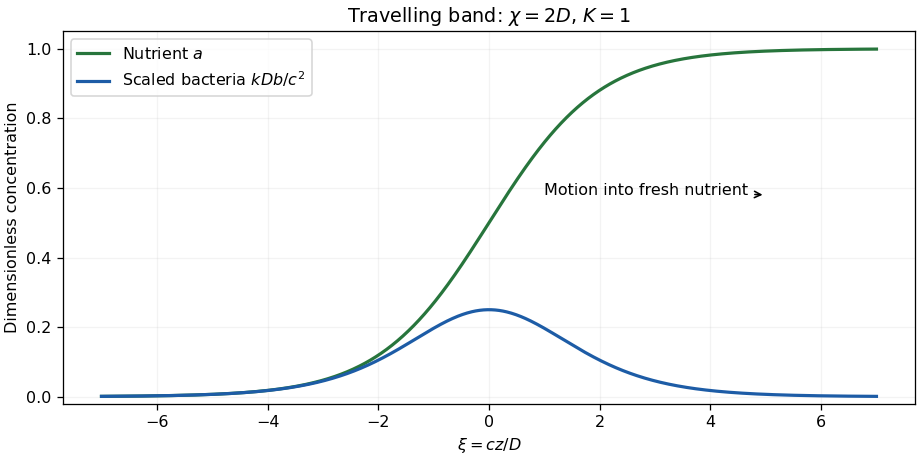
For a positive-speed travelling wave, the nutrient equation gives . Integrating the bacterial equation once, with zero flux in the uncolonized limit, givesHenceIn the region where , divide the two equations. With ,The condition fixes the integration constant, givingAt the limiting expression is . These formulas are positive between zero and one. For the nutrient reaches zero at a finite rear coordinate, so the strictly positive smooth whole-line ansatz with logarithmic chemotactic sensitivity needs a separate zero-nutrient interpretation there; for it reaches zero only as .
For , the nutrient equation reduces to and integration givesThe factor in the bacterial numerator is required by ; it is absent in the printed expression unless . A translation of sets , which is the version plotted below. The nutrient rises monotonically from zero behind the band to one ahead, while bacteria form a localized pulse with maximum at the nutrient half-height. Its total population is . The band advances into fresh nutrient, consumes it and leaves a depleted region behind; chemotaxis draws bacteria up the nutrient gradient while diffusion spreads them.

Past exam of the mathematics course of the University of Cambridge 2009 ii Paper 2 12H Solution Created 2026-09-24 Updated 2026-10-14
The standard name is the Reed-Muller code. For , evaluate all multilinear polynomials over of total degree at most at every point of . These evaluation vectors form , of length . Distinct multilinear polynomials have distinct evaluations: induct on the variables using and the two restrictions . Thus the monomials of degree at most are independent andFor minimum weight, use the same splitting. A nonzero has weight at least by induction, and . If , the two identical halves give the same lower bound by induction on . The endpoint has minimum weight one, and is the repetition code. A product of distinct variables has exactly nonzero evaluations, soHere distance equals minimum nonzero weight because the code is linear.
Every monomial of degree at most in variables has an even number of ones, and parity is additive over . Thus every word of has even weight. If and , their coordinatewise product is an evaluation of degree at most , even after reducing . Its weight is therefore even, so . This proves the asserted inclusion in the dual code. Finallyby binomial symmetry. The dimensions agree with that of the orthogonal complement, proving for .
Past exam of the mathematics course of the University of Cambridge 2009 ii Paper 2 11F c Created 2026-09-24 Updated 2026-09-24
Past exam of the mathematics course of the University of Cambridge 2009 ii Paper 2 11F b Created 2026-09-24 Updated 2026-09-24
Past exam of the mathematics course of the University of Cambridge 2009 ii Paper 2 11F a Created 2026-09-24 Updated 2026-09-24
Past exam of the mathematics course of the University of Cambridge 2009 ii Paper 2 10D b Created 2026-09-24 Updated 2026-09-24
There are unlisted articles, also show them or only show them.