
VC dimension of intervals and their complements Created 2026-09-24 Updated 2026-09-24
Intervals together with their label complements shatter three ordered points, but cannot realize an alternating labeling on four, so their VC dimension is three.
VC dimension of interval indicators Created 2026-09-24 Updated 2026-09-24
Indicators of real intervals have VC dimension two: two ordered points can be labeled arbitrarily, while an interval containing the two outer points of a triple must contain the middle point.
VC dimension bound for lower orthants Created 2026-09-24 Updated 2026-09-24
The class of lower orthants in has VC dimension at most . Among any points, choose a coordinate maximizer for each of the coordinates. A remaining point cannot be excluded while all those maximizers are included.
Sauer-Shelah lemma Created 2026-09-24 Updated 2026-11-05
If a binary hypothesis class has finite VC dimension , then its shattering coefficient satisfiesThe binomial coefficients bound how many different label patterns the class can realize. For fixed , their sum grows polynomially in , although the number of unrestricted binary patterns is .
Here is an inductive counting proof on a fixed sample. Partition the realized patterns according to their last label, and let be the corresponding sets of patterns on the first points. Put and . The original number of patterns is .
The class has VC dimension at most . The class has VC dimension at most : if shattered earlier points, both last labels would extend every pattern there, so the original class would have a shattered set of points. Applying mathematical induction and Pascal's identity gives the displayed sum. The base cases are , with at most one empty pattern, and , with at most one realized pattern.
First variation Created 2026-09-24 Updated 2026-10-14
Covariance Created 2026-09-24 Updated 2026-10-14
The covariance measures the average product of two centered deviations. For real square-integrable random variables and ,Deviations with the same sign contribute positively; deviations with opposite signs contribute negatively. Their magnitudes and probabilities determine the net result. Taking recovers the variance. The definitions and algebraic properties are presented in Orloff and Bloom, MIT 18.05, Covariance and Correlation, sections 2–2.1.
For a worked example, let be independent random variables, each equally likely to be , or , and put . All nine pairs have probability . The expected values are zero, while linearity of covariance and the vanishing covariance of independent random variables giveThe shared term makes large accompany large on average. Replacing by reverses the covariance to without changing either variance.
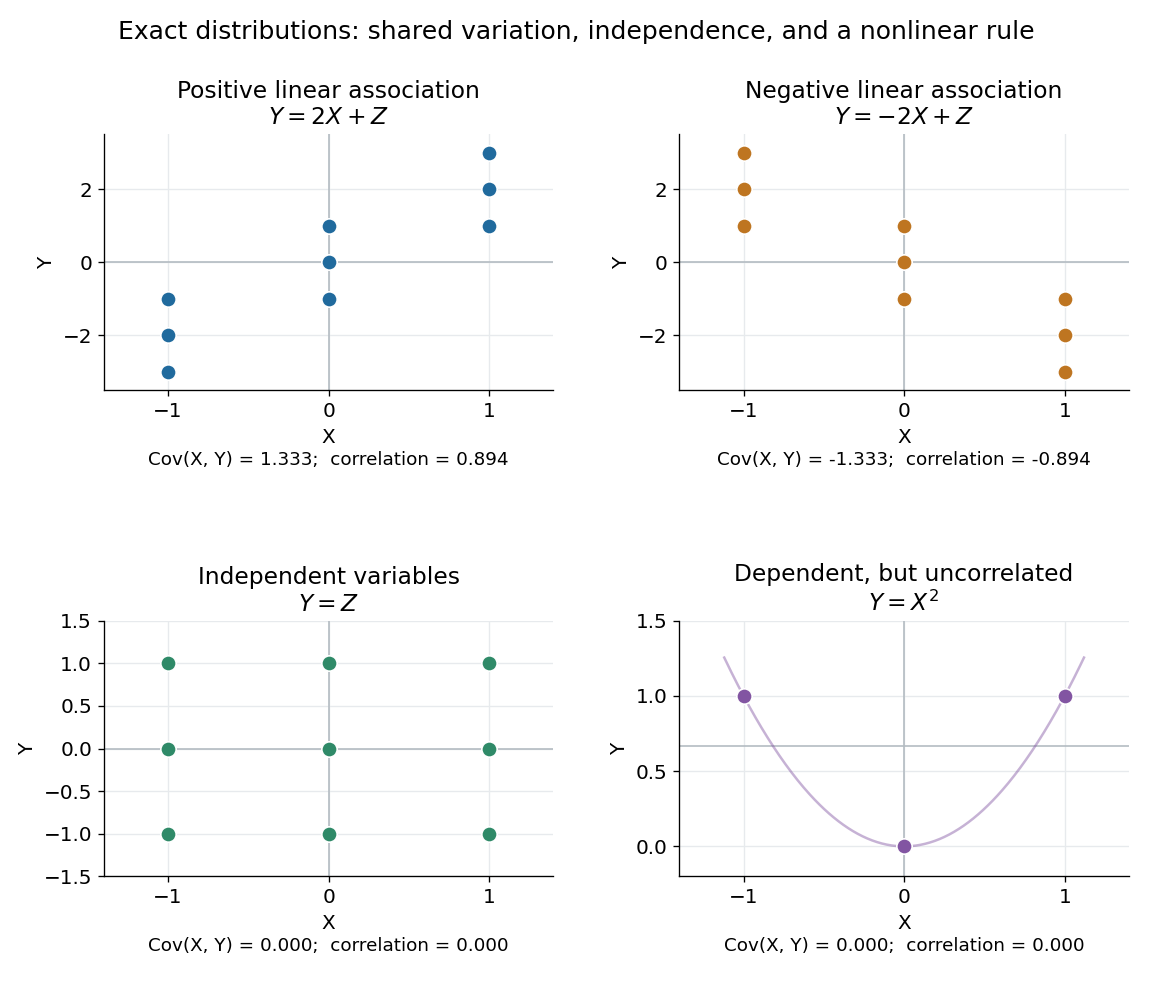
Positive, negative, independent, and nonlinear relationships have different covariance behavior
. In the first three panels, and independently take , and with equal probabilities; each point has probability . In the last panel, , and the three marked outcomes each have probability . The thin curve shows that quadratic function. Its zero covariance leaves strong nonlinear statistical dependence visible. Details.
The covariance is useful whenever deviations are added or subtracted. Expanding the square givesFor the worked model, these are and . Positive covariance increases variation in the sum while reducing variation in the difference: the same shared fluctuation reinforces one combination and partly cancels in the other. The identity applies beyond independent random variables.
The size of a covariance depends on the measurement scale. For constants , linearity of covariance gives . Adding offsets has no effect; rescaling either measurement rescales the covariance. The Pearson correlation coefficient divides by both standard deviations to describe the standardized linear relationship.
Standard deviation Created 2026-09-24 Updated 2026-11-05
Variance additivity for independent random variables Created 2026-09-24 Updated 2026-11-05
Concatenation grammar Created 2026-09-24 Updated 2026-11-05
For context-free grammars and with disjoint nonterminal symbol sets, introduce a fresh nonterminal symbol and putThen , the concatenation of the two formal languages. After the first production, every production rule acts within one of the two component parse trees. Their terminal words form one word from followed by one from . Conversely, any pair of component derivations can be performed after .
The construction does not work for arbitrary variable-based grammars. Let have production rules and , and let have the single production rule . Here is empty and , but the combined formal grammar derives . The production rule consumes a terminal symbol supplied by the other component, crossing the boundary that context-free grammar rules preserve.
Regular grammar Created 2026-09-24 Updated 2026-09-24
A right-linear regular grammar has productions of the forms and , where are variables and is a terminal word.
Nonproductive nonterminal Created 2026-09-24 Updated 2026-11-05
A nonterminal symbol of a formal grammar is productive if for some word consisting only of terminal symbols; otherwise it is nonproductive. In a context-free grammar, a sentential form containing a nonproductive nonterminal symbol cannot derive a terminal word: the descendants of that occurrence would have to provide a terminal derivation from the nonterminal symbol. Consequently productions involving nonproductive nonterminal symbols can be discarded when simplifying a context-free grammar.
The context-free hypothesis matters. A general variable-based grammar can have a production rule while neither nor alone derives a terminal word. A terminal derivation from a larger context therefore need not demonstrate productivity of each individual nonterminal symbol.
Unreachable nonterminal Created 2026-09-24 Updated 2026-09-24
A nonterminal is unreachable when no word derivable from the start symbol contains it. Productions whose left sides are unreachable do not affect the generated language.
Discrete valuation ring Created 2026-09-24 Updated 2026-11-05
A discrete valuation ring is a principal ideal domain with exactly one nonzero maximal ideal. Every nonzero element of its fraction field is a unit times a unique integer power of a uniformizer.
Degree-sized invariant separates finite-group orbits Created 2026-09-24 Updated 2026-11-05
Let a finite group of order have a faithful group action by holomorphic maps with holomorphic inverses on a compact Riemann surface, and let an invariant holomorphic map have degree . At a point with stabilizer of order , invariance forces the local multiplicity of to be at least : the stabilizer acts by local rotations, so an invariant local power series has only powers divisible by . The orbit-stabilizer theorem gives points in its orbit, which already contribute at least to the fibre multiplicity. The valency theorem forces equality and shows that every fibre is exactly one orbit.
The faithful group action hypothesis matters: a group of order two acting trivially on the Riemann sphere leaves invariant, but a generic two-point fibre is not a single trivial orbit.
Octahedral rotation orbits on the Riemann sphere Created 2026-09-24 Updated 2026-09-24
Degree of an elliptic function Created 2026-09-24 Updated 2026-09-24
The degree of a nonconstant elliptic function is the sum of the orders of its poles in a fundamental parallelogram. Equivalently, it is the degree of the induced holomorphic map from its complex torus to the Riemann sphere.
Degree of a rational map of the Riemann sphere Created 2026-09-24 Updated 2026-09-24
After cancelling common factors, the rational map on the Riemann sphere has degree . It is an analytic isomorphism exactly when this degree is one, equivalently when it is a Möbius transformation.
Degree of a holomorphic map Created 2026-09-24 Updated 2026-09-24
For a nonconstant holomorphic map between compact connected Riemann surfaces, its degree isThe valency theorem says that this integer is independent of .
Local degree of a holomorphic map Created 2026-09-24 Updated 2026-10-14
If a nonconstant holomorphic map has local-coordinate expressionthen is its local degree, multiplicity, or ramification index at .
Bosonic Fock space Created 2026-09-24 Updated 2026-11-05
This is the symmetric-particle construction of Fock space.
For one-particle Hilbert space , the bosonic Fock space isCreation operators add one symmetrized particle and annihilation operators remove one.
There are unlisted articles, also show them or only show them.