
Symmetric square Created 2026-09-24 Updated 2026-10-06
Exterior square Created 2026-09-24 Updated 2026-11-05
Einstein notation Created 2026-09-24 Updated 2026-10-03
Einstein notation sums automatically over an index repeated once up and once down, or twice in Euclidean coordinates.
Isotropic tensor Created 2026-09-24 Updated 2026-10-14
An isotropic tensor is invariant under every proper orthogonal change of basis. A rank-four isotropic tensor has the formRank-five isotropic pseudotensors are formed by multiplying one Kronecker delta by one Levi-Civita symbol and permuting the five indices.
Totally antisymmetric tensor Created 2026-09-24 Updated 2026-10-18
A tensor changes sign whenever two indices are interchanged. In three dimensions, a rank-two antisymmetric tensor is , a rank-three one is , and every totally antisymmetric tensor of rank greater than three vanishes.
Antisymmetric second-rank tensor Created 2026-09-24 Updated 2026-10-06
A second-rank Cartesian tensor is antisymmetric when its components form a skew-symmetric matrix, . Orthogonal coordinate changes preserve this property because implies .
Covariant tensor Created 2026-09-24 Updated 2026-10-03
A covariant tensor is multilinear in vector arguments and transforms with one covariant index for each argument.
Positive distribution Created 2026-09-24 Updated 2026-10-05
A real distribution is positive when for every nonnegative test function . Every positive distribution has order zero and is represented locally by a positive measure.
Taylor series Created 2026-09-24 Updated 2026-10-14
For a function with derivatives of every order at , its Taylor series is the power seriesIts partial sums are Taylor polynomials. At it is called a Maclaurin series. Forming the coefficients, proving that its partial sums form a convergent sequence, and proving that their limit equals are separate tasks. A smooth function provides all the coefficients, but a real analytic function is additionally represented locally by the resulting power series.
For the exponential function, every derivative of at zero equals one, givingHere equality holds for every real : the Taylor remainder is bounded by , which tends to zero for each fixed . At , the degree-five Taylor polynomial is , and the absolute difference from is less than . The factorial denominator eventually overwhelms every fixed power, allowing local derivative information to reconstruct this function throughout the real line.
The geometric series shows why the region of validity matters. For , the Taylor series at zero is , with radius of convergence one. For , its finite Taylor polynomial satisfies the exact identityAt and , the remainder is . At , the same degree-five polynomial has value and remainder , although the Taylor series still converges to there. Convergence of the infinite expression does not guarantee accuracy from a particular small number of terms. For , even the terms fail to tend to zero, so this power series cannot represent the function. The standard expansions and the conditions for convergent series are discussed in OpenStax, working with Taylor series.
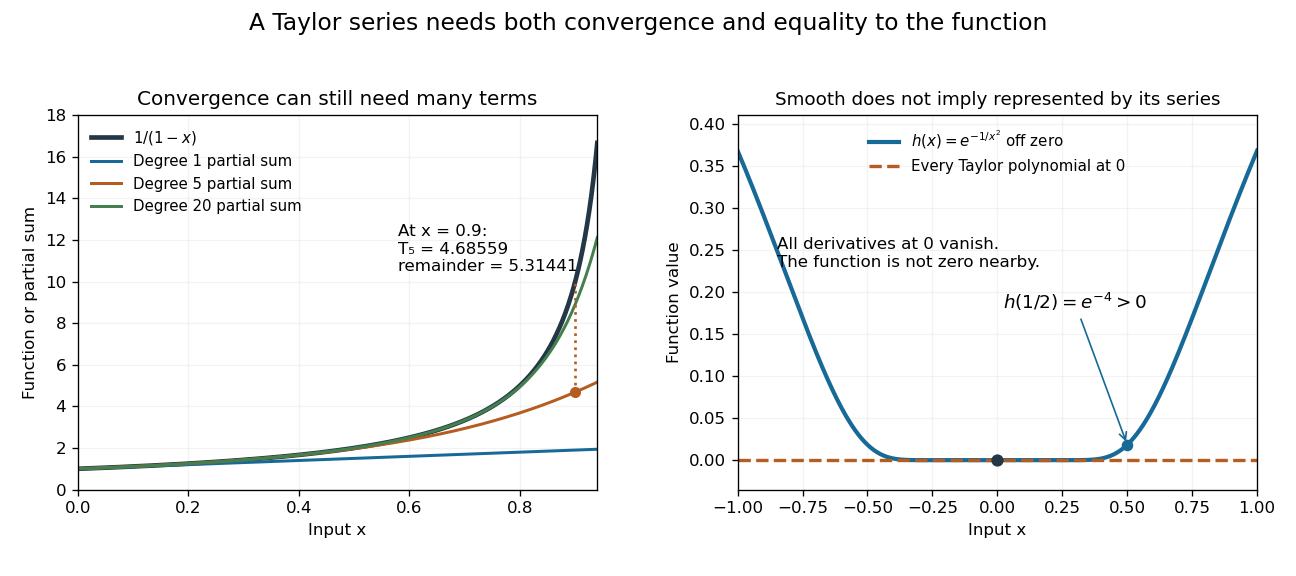
Geometric partial sums converge slowly near their convergence boundary, while a smooth flat function has an identically zero Taylor series
. Details. 
A stronger caution comes from the flat functionIt is a smooth function with for every , so every Taylor polynomial at zero is zero and its Taylor series converges everywhere to zero. Nevertheless . Off zero, repeated differentiation produces a polynomial in times ; the exponential decay makes each required limit at zero vanish. This explains how all the local coefficients can miss a positive function arbitrarily close to the centre. Real analyticity supplies the additional condition that rules out this behavior.
Taylor remainder Created 2026-09-24 Updated 2026-10-14
The Taylor remainder is the difference between a function and a finite Taylor polynomial. Bounds on higher derivatives or their Hölder continuity control this error.
Taylor theorem with Lagrange remainder Created 2026-09-24 Updated 2026-11-05
Let . Suppose has continuous derivatives on the closed interval joining distinct real points , and its th derivative exists in the interior. Then some interior point satisfiesEndpoint derivatives in the polynomial are one-sided restrictions of the continuous derivatives. When , the assumptions mean endpoint continuity and interior differentiability, and the result is the mean value theorem.[ref]
For a proof, subtract the degree- Taylor polynomial and a multiple chosen so that the resulting function also vanishes at . It and its first derivatives vanish at . Repeated applications of Rolle theorem give a point where its th derivative vanishes, yielding . If , the Lagrange remainder is bounded by without knowing .
Multivariate Taylor polynomial Created 2026-09-24 Updated 2026-10-31
Tail event Created 2026-09-24 Updated 2026-10-14
A tail event is an event , where is the tail sigma-algebra of the chosen sequence of random variables. It concerns information available arbitrarily far along the sequence. In the measurable coordinate models described in finite-prefix invariance of tail events, any finite edit preserves whether it occurs.
This is stronger than merely needing a long waiting time. On , with denoting heads, let , taking if there is no head. The eventis not a tail event: changing only from zero to one changes membership. Under fair independent Bernoulli trials its probability is . Even the event , of probability one in this model, is not a tail event as a literal set: the all-zero sequence and the sequence with just one initial head differ in one coordinate. A probability of zero or one does not characterize tail events.
Cosmological Euler equation in synchronous gauge Created 2026-09-24 Updated 2026-11-05
For scalar perturbations in cosmic time with , define the covariant fluid velocity potential by . The linear momentum density is . Normalize scalar anisotropic stress bywhere derivatives inside these parentheses are Cartesian comoving derivatives. Then . Spatial stress-energy conservation gives, for nonzero scalar Fourier modes,Writing reproduces the form with ; the coefficient depends on that stress normalization. The time derivative acts on the entire momentum-density product, not only on .
For pressureless matter with zero scalar stress, background reduces the equation to . The physical peculiar velocity is and therefore decays as . This checks the difference between covariant velocity potential and physical velocity and the expansion factor in the conservative equation.
Similarity variable Created 2026-09-24 Updated 2026-09-24
A similarity variable is constant along symmetry-group orbits and parametrizes group-invariant solutions.
Projective Lie symmetry of the potential Burgers equation Created 2026-09-24 Updated 2026-09-24
The vector fieldgenerates the local transformationsIts second prolongation sends to times that expression, so it is a Lie point symmetry of the potential Burgers equation.
Group-invariant solution Created 2026-09-24 Updated 2026-11-05
A group-invariant solution has a graph preserved by the chosen Lie point symmetry. For a one-parameter infinitesimal generator of a Lie point symmetrya differentiable scalar solution is invariant when is tangent to its graph, equivalentlyThis is a first-order constraint in addition to the original partial differential equation. The values of need not be constant along the projected orbits if the symmetry also changes the dependent variable.
For , the invariance condition is . Its solutions on have the similarity ansatz . The graph is invariant under even though changes along that orbit. For a symmetry fixing the dependent variable, , the simpler statement that is constant along projected orbits is valid.
Inclusion map between subset permutation modules Created 2026-09-24 Updated 2026-09-24
Sign of a permutation Created 2026-09-24 Updated 2026-11-05
The sign homomorphism is the determinant of the corresponding permutation matrix. A transposition has sign , so this also proves that the parity of any transposition decomposition is well-defined.
Support of a permutation Created 2026-09-24 Updated 2026-11-05
The support of a permutation is the set of elements it does not fix. A permutation has finite support when this set is finite.
There are unlisted articles, also show them or only show them.