
The complex modulus is a nonnegative real number. Equality therefore requires itself to be real and nonnegative. Its imaginary part gives , and its real part then gives . Conversely every such point satisfies the equality. Hence the complete solution set isGeometrically this is the closed ray on the real axis starting at .
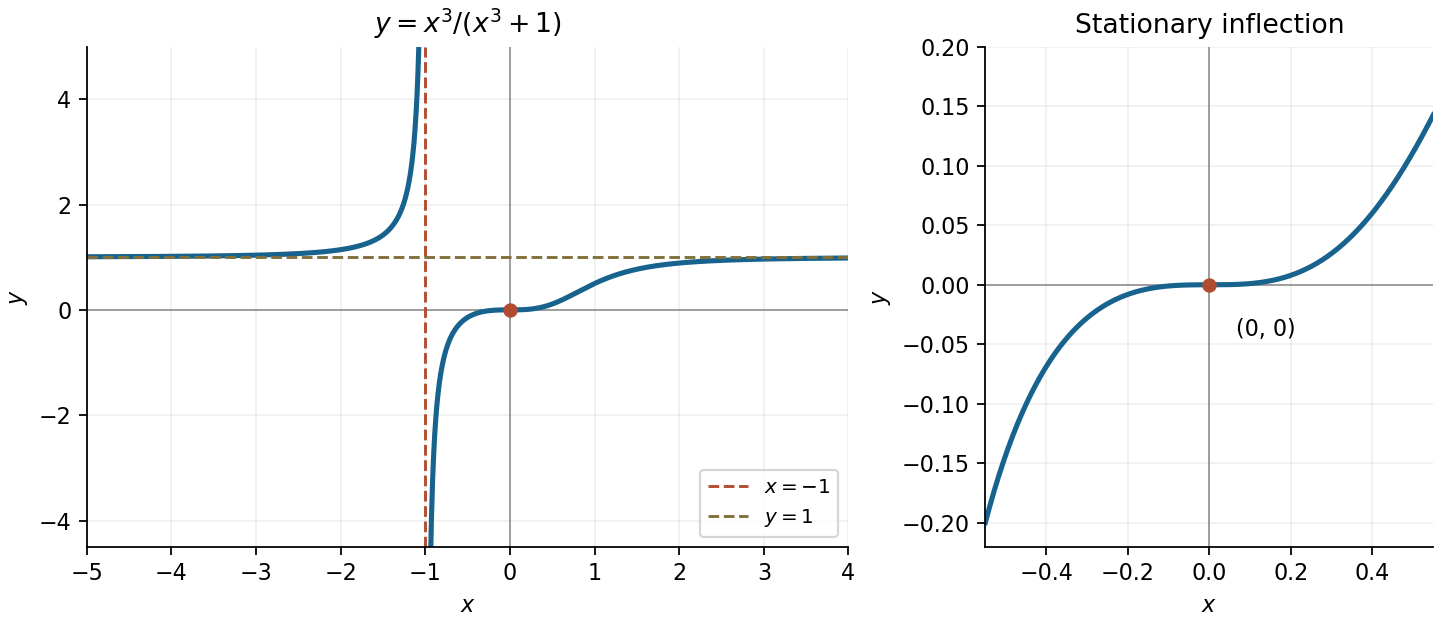
Rewrite the rational function as . It is undefined at , with the vertical asymptote , and tends to the horizontal asymptote as . At the pole, from the left and from the right.
Its derivative isvanishing only at . Since and near zero, this is a stationary inflection point, not an extremum. ThusThe graph increases on each side of the vertical asymptote. The left branch lies above , while the right branch lies below it and crosses the origin horizontally.

Separate variables near the nonzero initial condition: . Integration gives , and fixes . ThereforeThis is the maximal connected interval containing the initial point. Direct differentiation gives ; the pole at prevents continuation as a finite classical solution of a differential equation through that point.
There are unlisted articles, also show them or only show them.