
Put . The two roots areSince , their moduli are and . Thus exactly one root is inside the unit circle, and neither lies on it.
For the real integral use , so and . The change of variables givesThe contour is counterclockwise. At its single interior simple pole, the residue isBy the residue theorem, the reciprocal affine sine integral is thereforeThe condition also makes the real denominator strictly positive, consistent with the positive answer and the absence of contour poles on the unit circle.
Fix the evaluation point inside and put in Green's second identity. The two terms cancel because and . The remaining volume integral is . ThusThe Dirac delta has a positive sign in this problem's Green-function equation, fixing the order of the two terms. All boundary derivatives act on the integration variable .
For the vector field , the product rule givesThe mixed dot products cancel. The divergence theorem therefore yields Green's second identity,The fields and boundary are assumed sufficiently regular. A singular Green function can be treated by excising a small ball around its source and taking the radius to zero, or using distributions.
Resolve the angular surface charge density into Legendre polynomials:For a single degree , write the common surface potential as . Regularity and decay require radial factors inside and outside. Their exterior-minus-interior radial derivative at is . Thus spherical harmonic matching with a derivative jump gives .
Only degrees zero and two occur, yieldingBoth expressions have surface value , and their derivative difference is , checking both interface conditions. The interior quadratic is regular at the origin, and the exterior potential tends to zero.
The leading far-field term is the monopole term. Indeed the total charge is , and the normalization of the specified jump gives . No extra permittivity factor is inserted into the supplied normalization. Regularity here means finite piecewise smooth potential; its normal derivative necessarily jumps at the charged surface.
Use separation of variables, writing . After multiplication by , the radial and angular terms are functions of independent variables, so setWith , the angular equation isRegularity at both poles selects , , and the Legendre polynomials ; the other angular branch is singular at a pole. The radial Euler-Cauchy equation is . A power gives , hence .
Superposing these axisymmetric spherical harmonics givesThe coefficients must give convergence appropriate to the domain. In a region containing the origin, regularity removes the negative powers; in an exterior region with zero potential at infinity, it removes the growing powers and the constant. No such radial restriction is needed for a general annular region.
Write the lower block of as . ThenA representation of must satisfy its defining relation , so . For real , this means or ; it also ensures invertibility.
If , then while . The image of the generator has order four, so its four powers are distinct and the representation is faithful. If , then but , since the lower block has zero diagonal. The image has order two and the kernel is . HenceFor other values there is no representation of , rather than an additional unfaithful case; in particular would make the assigned matrix singular. These conclusions are the faithfulness criterion for a block representation of the cyclic group of order four. There is no requirement that the proposed representation be orthogonal, so no separate conditions should be imposed.
The matrices are listed in the order . In the first representation, is the clockwise quarter-turn matrix and . In the second, , whose successive powers give the listed scalar matrices. Both therefore obey the group table and distinguish all four elements.
Taking traces gives the characters of a representation:In particular but . Since trace is invariant under similarity, the representations are inequivalent, even after allowing complex changes of basis for the real matrices of .
One can also see the obstruction directly: conjugating the scalar matrix leaves it unchanged, whereas is not scalar. Over the complex numbers, has eigenvalues , while has ; those different multiplicities cannot be removed by changing basis.
Since , multiplication adds exponents modulo four: . Hence the Cayley table of the cyclic group of order four, with the left factor indexing rows, isThe table is symmetric because the group is Abelian. Its row for each element permutes all four members, as cancellation requires.
A group representation assigns each an invertible linear map on a fixed vector space, preserving multiplication:Choosing a basis turns those maps into matrices. A faithful representation is injective, equivalently its kernel is , so distinct elements have distinct matrices.
Two group representations on spaces of the same dimension are called equivalent representations if one fixed invertible change of basis conjugates every representing matrix: for all . Choosing a different separately for each element does not establish equivalence.
The character of a representation isThe cyclic property of the trace makes it invariant under a change of basis and constant on conjugacy classes. Thus different characters at even one group element prove inequivalence.
The useful coordinate for this scale-dependent differential operator is . With , the chain rule givesThe interval becomes , and the endpoint values become . This logarithmic change of variable in a Sturm-Liouville problem reduces the calculation to a constant-coefficient Dirichlet problem. Also , so the transformation preserves the appropriate weighted inner product.
For the weighted inner product, the factor cancels the in the Sturm-Liouville operator. Assuming the coefficients are real, two applications of integration by parts giveThis is the boundary form in the Lagrange identity for a Sturm-Liouville operator. The potential terms cancel; if were complex, an additional integral of would remain, so suitable real coefficients are part of formal self-adjointness. The endpoint restrictions in part (a) eliminate the displayed form for every pair of functions in the domain.
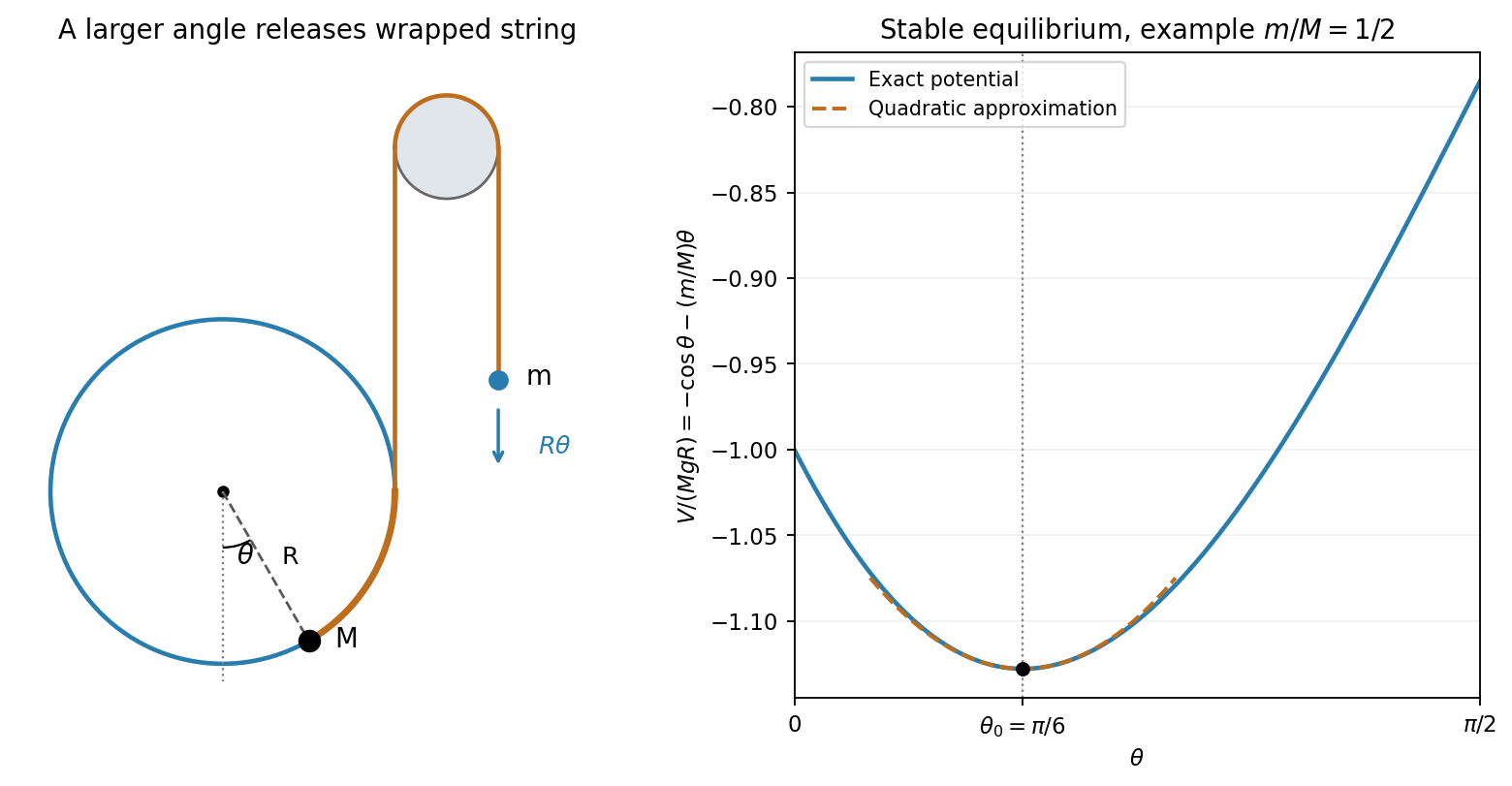
Use the angle orientation in the PDF: has coordinates relative to the hoop centre. The wrapped string segment has length . As increases, it releases length , so the suspended mass moves down by . Both speeds have magnitude .
Thus the hoop with a suspended counterweight hasand . The Euler-Lagrange equation givesAt equilibrium,The positive curvature establishes stability. Put and linearize. The equilibrium force cancels, leavingHenceFor , and , the small-oscillation frequency of a simple pendulum of length . The linearization assumes an amplitude small enough to remain inside the stated angular range and a taut string throughout.

For a variation with , the first variation isThe endpoint term vanishes. Since the interior variation is arbitrary, the fundamental lemma of the calculus of variations gives the Euler-Lagrange equationAlong such a trajectory,If has no explicit time dependence, the first integral is thereforeIts negative is the equivalent Beltrami form. For the usual time-independent mechanical Lagrangian with quadratic velocity dependence, this conserved quantity is the total mechanical energy .
There are unlisted articles, also show them or only show them.