
Past exam of the mathematics course of the year 1 of the natural sciences course of the University of Cambridge 2005 Paper 1 12 c Solution Created 2026-10-18 Updated 2026-10-20
Evaluate the Fourier cosine series of a triangular wave at its continuous peak , where . Every cosine is one, soThe convergence established above justifies substituting this point into the series.
Past exam of the mathematics course of the year 1 of the natural sciences course of the University of Cambridge 2005 Paper 1 12 b Solution Created 2026-10-18 Updated 2026-10-20
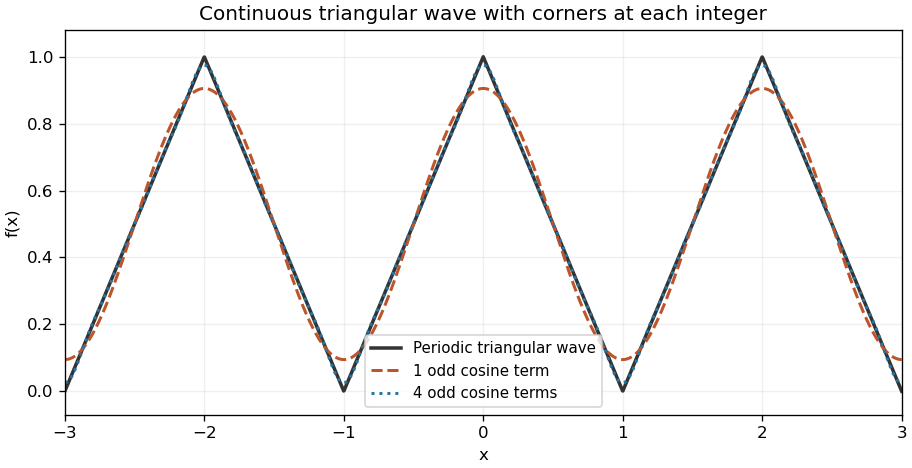
Evenness removes every sine coefficient. In the period-two Fourier cosine series convention , the constant coefficient is . Integration by parts givesThus the Fourier cosine series of a triangular wave isThe periodic function is continuous and piecewise smooth, so the Dirichlet-Jordan convergence theorem gives its value at every point. The summable absolute coefficient bound also gives uniform convergence by the Weierstrass M-test.
Past exam of the mathematics course of the year 1 of the natural sciences course of the University of Cambridge 2005 Paper 1 12 a Solution Created 2026-10-18 Updated 2026-10-20
The periodic extension is an even triangular wave: peaks of height one occur at the even integers and valleys of height zero at the odd integers . Adjacent peaks and valleys are joined by straight segments of slopes . The function is continuous and has corners at every integer.

Past exam of the mathematics course of the year 1 of the natural sciences course of the University of Cambridge 2005 Paper 1 11 c Solution Created 2026-10-18 Updated 2026-10-20
The chain rule gives . Both and vanish, so the fundamental theorem of calculus givesThe positive contribution while rises is cancelled by the negative contribution while it falls.
Past exam of the mathematics course of the year 1 of the natural sciences course of the University of Cambridge 2005 Paper 1 11 b Solution Created 2026-10-18 Updated 2026-10-20
Put , so . Then integration by substitution givesThe last two integrals are elementary exponential moments, or values of the Gamma function.
Past exam of the mathematics course of the year 1 of the natural sciences course of the University of Cambridge 2005 Paper 1 11 a Solution Created 2026-10-18 Updated 2026-10-20
Since is odd and absolutely integrable, the two signed half-line integrals cancel:Absolute integrability follows from Gaussian decay dominating the polynomial factor; no principal-value interpretation is needed.
Past exam of the mathematics course of the year 1 of the natural sciences course of the University of Cambridge 2005 Paper 1 10 b Solution Created 2026-10-18 Updated 2026-10-20
Now , so the forcing coincides with a homogeneous exponential and requires a resonant exponential particular solution. With as above, and give . ThereforeIntegrating from zero yieldsIts numerator starts at order , ensuring both initial conditions. It is also the finite coalescing-rate limit of the nonresonant exponential forcing response with zero initial data.
Past exam of the mathematics course of the year 1 of the natural sciences course of the University of Cambridge 2005 Paper 1 10 a Solution Created 2026-10-18 Updated 2026-10-20
Factor the differential operator as , where . Its homogeneous solutions are , while a nonresonant particular solution is . Imposing the two zero initial conditions gives the exponential forcing response with zero initial dataOne direct derivation avoids a large simultaneous system. Set , so and . The integrating factor gives ; solving with produces the displayed expression. This also verifies the zero derivative at the origin, since .
Past exam of the mathematics course of the year 1 of the natural sciences course of the University of Cambridge 2005 Paper 1 1 c Solution Created 2026-10-18 Updated 2026-10-20
Past exam of the mathematics course of the year 1 of the natural sciences course of the University of Cambridge 2005 Paper 1 1 b Solution Created 2026-10-18 Updated 2026-10-20
The Taylor series of the sine and arctangent give , while . Dividing the two series givesThe first nonzero term after cancellation is the constant .
Past exam of the mathematics course of the year 1 of the natural sciences course of the University of Cambridge 2005 Paper 1 1 a Solution Created 2026-10-18 Updated 2026-10-20
The Taylor series gives . Taking its reciprocal and cancelling the singular term givesThus the apparent singularity at zero is removable, and the first nonzero term is the constant .
Past exam of the mathematics course of the year 1 of the natural sciences course of the University of Cambridge 2004 Paper 2 5 ii Solution Created 2026-10-18 Updated 2026-10-20
Each additional pair of independent shots resolves the tie with probability , since exactly one team must score. It preserves the tie with probability . Finishing after shots means an initial tie, then tied pairs, then a decisive pair. Independence and geometric continuation after an initial tie giveBecause , and . The total eventual winning probability is the sum of winning in the first ten shots and winning later:Equivalently, conditional on the initial tie, the probability of still being tied after further pairs is .
Past exam of the mathematics course of the year 1 of the natural sciences course of the University of Cambridge 2004 Paper 2 5 i Solution Created 2026-10-18 Updated 2026-10-20
Use the intended model of independent Bernoulli trials, with the same scoring probability for every shot. Equal marginal scoring probabilities alone would not establish the stated formula without independence. Let count misses in the two groups of five. They are independent random variables with binomial distribution . A tie occurs precisely when for one of the mutually exclusive possibilities . Therefore the tie probability for independent binomial counts isAt , Vandermonde's identity gives , soExchanging the two teams preserves the distribution and interchanges the two winning events. Their total probability is , so the first team wins at the end of the initial period with probability . In this model the shooting order gives no advantage.
Past exam of the mathematics course of the year 1 of the natural sciences course of the University of Cambridge 2004 Paper 2 1 b Solution Created 2026-10-18 Updated 2026-10-20
Let be the interior of the tetrahedron, and take any constant vector field . Its divergence is zero, so the divergence theorem givesChoosing to be each Cartesian basis vector proves . This is the general fact that vector areas of a closed polyhedron sum to zero, specialized to four faces. The outward orientations are essential: the scalar face areas are all positive and do not sum to zero.
Past exam of the mathematics course of the year 1 of the natural sciences course of the University of Cambridge 2004 Paper 1 1 ii Solution Created 2026-10-18 Updated 2026-10-20
The volume of a parallelepiped is the absolute scalar triple product of its edge vectors. HereThe absolute value removes the orientation of the chosen edge ordering.
There are unlisted articles, also show them or only show them.