
A cross-section perpendicular to the rotation axis is a disk of radius . Disc integration therefore givesThe result is in cubic coordinate units; the full rotation is already accounted for by the disk area.
Use completing the square after taking out the leading coefficient:Thus , and . Since a real square is nonnegative, the global minimum is , attained at .
The derivative is , giving slope twelve at . The point on the curve is . The point-slope equation of the tangent line is consequently
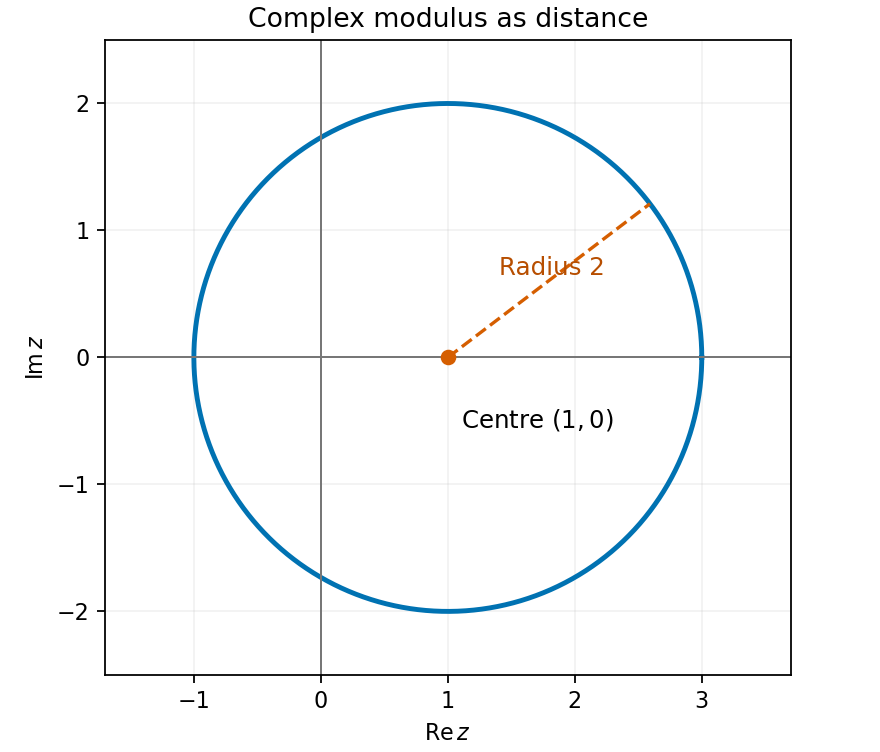
Write . The complex modulus condition is equivalent to . Thus the locus is a circle of radius two centred at in the complex plane. Its extreme points are , , and .

This is a separable differential equation. Multiply by and integrate:The initial condition gives . HenceFor a real solution the outer logarithm requires a positive argument. The maximal interval containing the initial point is therefore . At either endpoint diverges, so the real solution cannot continue through it with a finite value.
For , the first two derivatives at one are and . The Taylor expansion beginsAll three displayed terms are nonzero terms of the expansion about one.
There are unlisted articles, also show them or only show them.