
Past exam of the mathematics course of the University of Cambridge 2006 iii Paper 32 4 Solution Created 2026-10-03 Updated 2026-10-14
For standard Brownian motion and , let be its first hitting time of . Define the reflected path byleaving a path unchanged if . The Brownian reflection principle says that has the same path probability distribution as . In its endpoint form, for and every Borel set ,Here is a direct proof of preservation of the path law. For a fixed integer horizon , let , with an infinite first term interpreted as infinity. This is a stopping time taking finitely many deterministic grid values. On , the history determining that event is measurable at , and subsequent Brownian motion increments are independent of that history. Those increments and their negatives have the same joint law, by symmetry of centered normal distributions and independent increments. Thus reflecting after around preserves the full path law. For any fixed horizon , the reflected paths converge uniformly on to the displayed reflected path, by continuity as decreases to . This includes , since reflection after has no effect before . Passing to all finite-dimensional probability distributions proves the assertion; no prior recurrence claim is needed. Equivalently, the Strong Markov property gives the same proof by symmetry of the fresh increments after the hit. Reflection is an involution preserving the hitting event and mapping the indicated endpoint to . An endpoint above forces a hit by continuity; this proves the endpoint identity, rather than assuming it.
For , split according to whether is above or below . Since has no atom at , reflection givesBoth variables are nonnegative, so their positive tails identify the law:For this is the half-normal distribution of scale ; at both variables vanish.
For the two separated intervals, putHere is measurable for , has the normal distribution , and is a function of increments after . The independent increments make these three objects mutually independent. The later absolute maximum is , so equality of the two maxima means . Conditional on , this specifies a single value of the nondegenerate normal distribution , and hence has probability zero. ThereforeThis proves the atomless maxima on separated Brownian intervals without incorrectly treating the two absolute maxima as independent.
Past exam of the mathematics course of the University of Cambridge 2006 iii Paper 31 2 Solution Created 2026-10-03 Updated 2026-10-14
In the truncated tensor algebra , multiplication isLet be the Lie algebra generated by the degree-one space, with commutator and every term of degree greater than set to zero. The free step-N nilpotent Lie group isIts operation is the truncated tensor product, its identity is , and . Truncated multiplication is associative; the finite Lie exponential and logarithm identify this group with the free nilpotent Lie algebra as a manifold.
The Chow theorem says that on a connected manifold a smooth bracket-generating family of vector fields joins every pair of points by a piecewise smooth horizontal path. Applied to the degree-one left-invariant fields on this group, it says that every is for a piecewise smooth, and hence suitably parametrized Lipschitz continuous, control path starting at zero.
For , every Lie element is , with and . The step-2 planar group coordinates giveWe realize this element explicitly. First traverse the rectangleIf , omit the loop. Its displacement is zero, and its second-level entries areThus the loop signature is . Follow it by the straight segment from zero to , whose signature is . By the Chen identity, concatenation has signaturebecause the commutator lies in the central second layer. Every group element has therefore been realized, proving this case of Chow's theorem.
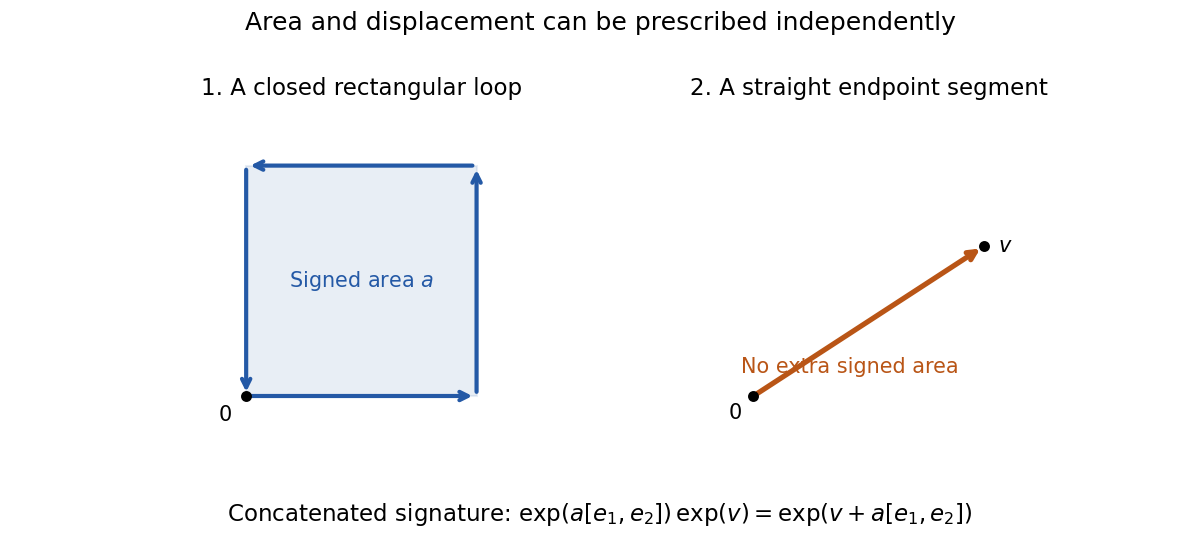

The Carnot-Carathéodory distance is the infimum of lengths of horizontal controls realizing the relative group element. The construction gives the upper bound . Conversely, a control of length has displacement at most , and its antisymmetric area satisfiesHere the control starts at zero, so its maximum Euclidean distance from zero is at most . These estimates show that the homogeneous group norm is comparable to .
The given path is the pure-area rough path . Centrality givesThe graded dilations scale horizontal lengths by . Inversion preserves the norm. Hence, with ,Thus the path is exactly -Hölder continuous: on a compact time interval it has every exponent at most , and none greater.
Its p-variation is finite precisely when . Indeed, the th power of the variation sum is . For it is bounded by ; for , the partition into equal intervals gives . In the usual step-two rough-path range it is weak geometric for , including . For , the same formula in gives the additional levels and a weak geometric -rough path there. The original data alone are a truncated object when those additional levels are required.
Past exam of the mathematics course of the University of Cambridge 2006 iii Paper 30 4 Solution Created 2026-10-03 Updated 2026-10-14
Work over the finite field . The given factorization shows that divides , so it generates a length- cyclic code . Since , the vectors represented byform a basis: their distinct leading degrees prove their linear independence, and every multiple of representing a polynomial of degree below has a multiplier of degree at most . Hence is a binary linear code of dimension , containing codewords. The generator has Hamming weight seven, so the minimum Hamming distance of a linear code satisfies .
The BCH bound used here is the following consecutive-root theorem. If a length- cyclic code over , with relatively prime to , has a generator polynomial of a cyclic code vanishing at for a primitive th root , then its minimum Hamming distance is at least .
Choose a root of in an algebraic closure of . The factorization implies , while in , so . As is prime, has order . The Frobenius endomorphism preserves the roots of a polynomial with coefficients in : . Thus every is a root. In particular, shows thatare roots of . These four consecutive roots give by the BCH bound. A further argument is needed to exclude weights five and six.
Put . Cancelling in the supplied factorization gives . In the quotient ring , is invertible and every cyclic shift of equals . Since ,The coefficient of in this circular product is , the binary inner product of the coefficient vector of with a cyclic shift of itself. Every coefficient of is one. The circular autocorrelation of the binary Golay generator therefore implies that all pairs of basis rows , including equal rows, satisfy
Each has Hamming weight seven. Append its parity bit, which is one, and write . The extended rows have Hamming weight eight and satisfy . Their linear span is precisely the parity extension of , because the appended coordinate is the linear functional equal to the sum of all coordinates.
These extended generators produce a doubly even code. To prove this rather than assume it, useAll the extended generators have weights divisible by four. A sum of previous generators is orthogonal to the next generator, so the intersection size in this identity is even. Induction proves that every word in has Hamming weight divisible by four; this is the orthogonal generators of doubly even codes argument.
An original word of weight five acquires a parity bit and has extended weight six, while a word of weight six acquires a zero parity bit and still has extended weight six. Both contradict divisibility by four. Together with the BCH bound and the weight-seven generator, this completes the BCH and parity-extension proof of the binary Golay distance:
There are unlisted articles, also show them or only show them.