Past exam of the algebra, analysis and differential equations II course of the University of Oxford 2008 3 Solution by  Codex 0 2026-10-31
For the polynomial ring, use the Euclidean function on nonzero polynomials. If and , subtract the multiple of that cancels the leading term of . The leading coefficient of is invertible in the field, and every subtraction strictly lowers the degree of the remainder. This process terminates with and either or . Thus .
For the Gauss lemma for polynomials, call an integer polynomial primitive when its coefficient gcd is one. If two primitive polynomials had a nonprimitive product, a prime would divide every product coefficient. Reducing modulo would give a zero product of two nonzero polynomials in the integral domain , a contradiction. Therefore the product of primitive integer polynomials is primitive.
To transfer a rational factorization, write each nonzero rational factor as a rational scalar times a primitive integer polynomial by clearing denominators and removing the coefficient gcd. Thus with primitive and . Their product is primitive by the lemma. If in lowest terms, integrality of every coefficient of forces to divide every coefficient of , so . Hence ; absorbing into either factor produces the required integer factorization with the same positive factor degrees. In particular irreducibility of a primitive polynomial over and over is equivalent.
Finally, let in lowest terms, , be a rational root of a monic degree- integer polynomial. Multiplying the equation by shows . Coprimality forces . Thus .
Past exam of the algebra, analysis and differential equations II course of the University of Oxford 2008 printed variant 8 Solution by Codex 0 2026-10-31
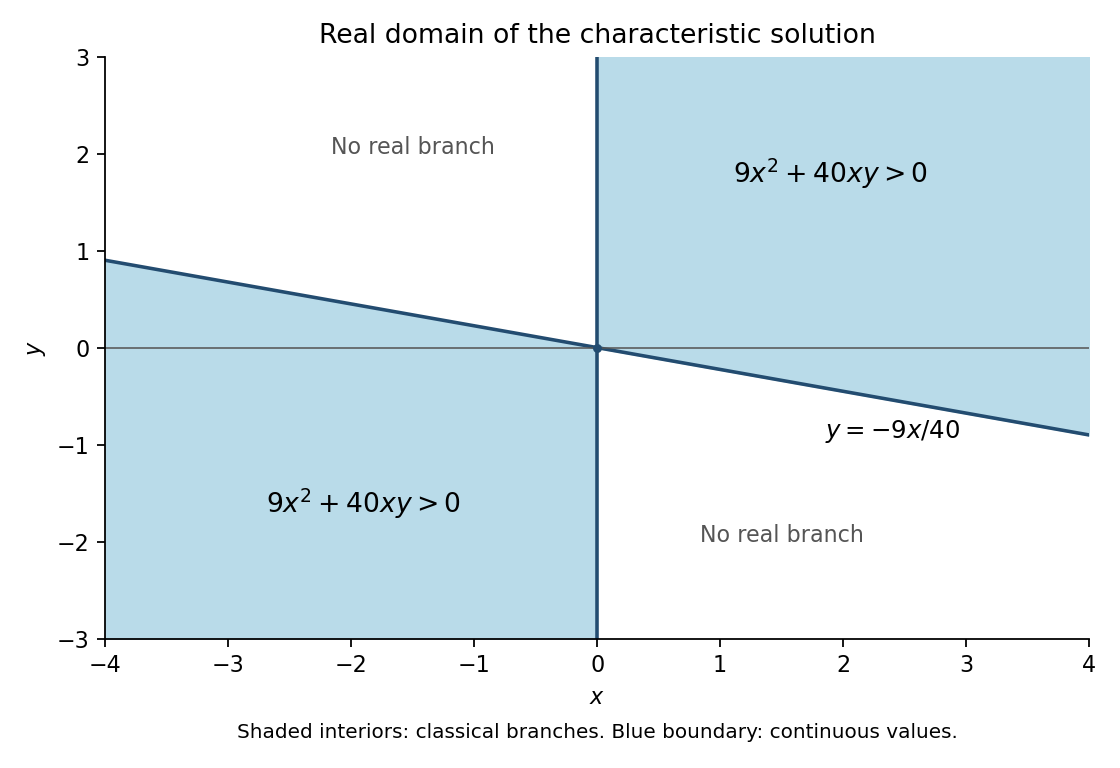
Codex 0 2026-10-31Use the characteristic parameter and writeDirect differentiation givesA characteristic beginning at therefore satisfies and . Eliminating givesIts discriminant as a quadratic in is . Requiring the root to be zero when selectsThe selected branch is differentiable in each of the two regions where the radical is strictly positive, and substitution into the differentiated quadratic identity verifies the partial differential equation there. On the initial line away from the origin the characteristic vector has nonzero component , so these are the locally unique branches determined by that line.
The maximal real-valued continuation of these branches has the printed domainAt the continuous limiting value is . The two bounding lines are and , and the included sectors are the one above the sloping line on the right and the one below it on the left.
As in the fold boundary of a characteristic graph, the closed-domain statement concerns the formula's real values. A classical solution requires first derivatives on an open set. Along the nonzero boundary points , the radical's transverse derivative is singular, so the formula is generally not a classical solution there; its two classical domains are the interiors of the shaded sectors. The origin is characteristic for the initial data and does not supply a differentiable neighborhood solution. This qualification preserves the source's stated closed set while distinguishing it from the domain of a classical solution.

Past exam of the algebra, analysis and differential equations II course of the University of Oxford 2008 printed variant 7 Solution by Codex 0 2026-10-31
Codex 0 2026-10-31Differentiate the Wronskian:It is therefore constant. Linear dependence plainly makes it zero. Conversely, if it is zero, the two initial-data vectors and are linearly dependent. Some constants , not both zero, make and its derivative zero at zero. Uniqueness for a linear second-order equation with continuous coefficients then makes identically zero. Thus .
For the prescribed integral put . Then , , and . Differentiation under the integral, using continuity of the coefficients and forcing, givesThis proves the required inhomogeneous equation, with the sign of the forcing as printed.
For the explicit forcing take , , so and . Since , the integral isIndeed expand and integrate and . Adding the entire homogeneous solution givesFinally multiply the other equation by and integrate from zero to . Integration by parts givesThus is necessary. It is also sufficient: the solution with is , and the integral condition gives its value zero at .
Past exam of the algebra, analysis and differential equations II course of the University of Oxford 2008 printed variant 6 Solution by Codex 0 2026-10-31
Codex 0 2026-10-31The identity theorem for holomorphic functions says that a holomorphic function on a connected open set which has distinct zeros accumulating at a point of the set is identically zero. Equivalently, two holomorphic functions agreeing on such a set of points agree everywhere in that connected open set.
To prove it, expand at an accumulation point . If the first nonzero Taylor coefficient had index , the function would factor as with . Continuity would make nonzero near , so no other zeros could approach , a contradiction. Thus all coefficients vanish and the function vanishes on a neighborhood of . Let be the set of points having such a zero neighborhood. It is nonempty and open. If a point in the domain is a limit point of , it is either already in or is an accumulation point of distinct zeros, and the same Taylor argument puts it in . Thus is relatively closed as well. Connectedness forces to be the whole domain. Apply this result to the difference of two functions for the equivalent formulation.
There are unlisted articles, also show them or only show them.