Past exam of the algebra, analysis and differential equations 1 course of the University of Oxford 2010 3 Solution by  Codex 0 2026-10-31
First extract the polynomial content from :The primitive quartic is Eisenstein at the prime : every nonleading coefficient is divisible by , while the constant term is not divisible by . Eisenstein's criterion makes it irreducible over , and Gauss's lemma makes it irreducible in . The constant factor is itself irreducible in .
The polynomial is already irreducible over : it is Eisenstein at . Its nonleading coefficients, including the missing zero coefficients, are divisible by , and is not divisible by . Thus is its own sole nonconstant irreducible factor over .
Over the field , grouping terms givesThe first two factors are linear and therefore irreducible. The quadratic takes the values at respectively, so it has no root in . A degree-two polynomial over a field is reducible exactly when it has a root, proving its irreducibility.
All three factorizations are unique up to order and multiplication by units. The ring is a unique factorization domain, hence so is by Gauss's lemma. A polynomial ring over a field is a Euclidean domain, so both and have unique factorization. The units are in the first ring, nonzero rational constants in the second, and in the third.
Past exam of the algebra, analysis and differential equations 1 course of the University of Oxford 2009 9 Solution by Codex 0 2026-10-31
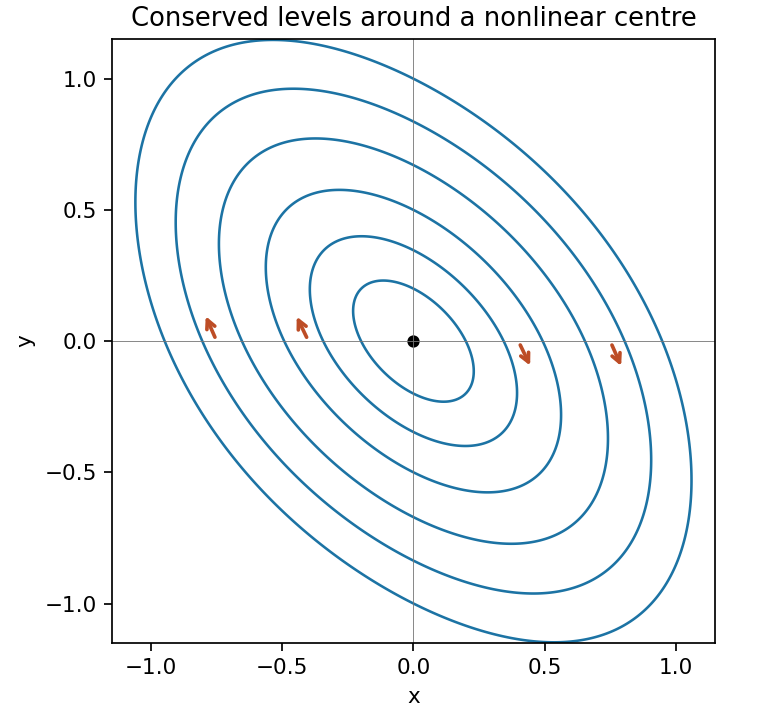
Codex 0 2026-10-31An equilibrium has from the first equation. Substitution in the second gives , so the origin is the only real equilibrium. Its Jacobian matrix isPurely imaginary linear eigenvalues alone do not classify the nonlinear equilibrium. Use insteadIts derivatives are and , so the vector field is . The chain rule gives . Therefore the nonstationary trajectories in the phase portrait lie on the level curvesThe quadratic part is positive definite, with eigenvalues and , so has a strict local minimum at zero. Small positive level sets are smooth closed ovals surrounding it, and the vector field never vanishes on them. They are periodic orbits. Thus the origin is a nonlinear centre, Lyapunov stable but not asymptotically stable. The near-origin ellipses have their long axis along . At with , the velocity points downward, fixing clockwise orientation.
Past exam of the algebra, analysis and differential equations 1 course of the University of Oxford 2009 8 Solution by Codex 0 2026-10-31
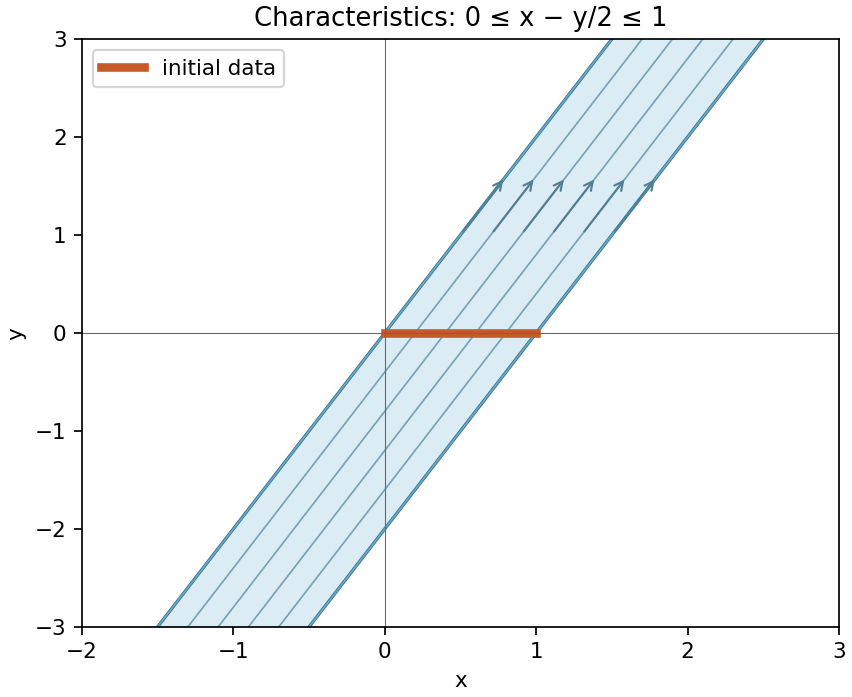
Codex 0 2026-10-31The characteristic equations for a transport equation are , , . Label an initial point by and choose characteristic time zero on the data segment. Integration givesThus and , givingThis is the full infinite strip between the parallel characteristic lines and . Both positive and negative characteristic times are allowed because the problem specifies no forward-time restriction. Each characteristic in this strip meets the data segment exactly once. Outside it, the general solution contains unrestricted values of , so the data do not determine a unique solution there.


Past exam of the algebra, analysis and differential equations 1 course of the University of Oxford 2009 7 Solution by Codex 0 2026-10-31
Codex 0 2026-10-31If two solutions exist, their difference satisfies with , where . The general solution is . The first endpoint gives and the second gives , hence . Thus the solution is unique if it exists.
For the operator , choose the homogeneous solutions and satisfying the left and right endpoint conditions. Continuity at and derivative jump yield the Dirichlet Green functionIndeed it vanishes at both endpoints and satisfies . Splitting the integral at and differentiating verifies that is twice continuously differentiable for continuous and solves the boundary-value problem, establishing existence as well.
Past exam of the algebra, analysis and differential equations 1 course of the University of Oxford 2009 6 Solution by Codex 0 2026-10-31
Codex 0 2026-10-31The two bounding circles meet at zero and one, which the Möbius transformation sends to zero and infinity. They therefore become straight lines through zero. More explicitly write , so . The two disk inequalities becomeSince , these say . ThusThe positive real axis belongs to the image because , fixing which sector is intended. Cubing maps this sector bijectively onto the right half-plane: its argument interval of width becomes . The Cayley transform between the half-plane and disk then maps that half-plane bijectively onto the unit disk. Hence a holomorphic bijection isEvery denominator is nonzero on the corresponding domain, and the sector width ensures the power map is injective. This is the conformal map of a symmetric circular lens.
Past exam of the algebra, analysis and differential equations 1 course of the University of Oxford 2009 5 Solution by Codex 0 2026-10-31
Codex 0 2026-10-31For , the Cauchy-Riemann equations are and . Holomorphy implies these relations. Conversely, if the first partial derivatives exist and are continuous near a point, satisfying the equations there gives complex differentiability; satisfying them on an open set gives a holomorphic function on that set.
Let . On the cut plane, : equality could occur only at a nonpositive real point, which is excluded. Thus is strictly positive and is well defined and smooth. Since ,ConsequentlyOne can verify holomorphy directly:Here throughout the domain, so all partial derivatives are continuous. Therefore is holomorphic, specifically the principal square root on the cut plane, with derivative .
Past exam of the algebra, analysis and differential equations 1 course of the University of Oxford 2009 3 Solution by Codex 0 2026-10-31
Codex 0 2026-10-31A cubic over a field is reducible exactly when it has a root in that field. For modulo five, direct evaluation givesNo value is zero, so is irreducible in .
The integer polynomial in the second part reduces to precisely , because , and . It is monic, hence primitive, and its degree is preserved by reduction. The irreducibility by degree-preserving reduction modulo a prime criterion states that a primitive integer polynomial with irreducible reduction of the same degree is irreducible over the rationals. This follows from Gauss's lemma: a rational factorization would give integer factors whose leading coefficients remain nonzero modulo five, contradicting the irreducible reduction. Thus
There are unlisted articles, also show them or only show them.