Past exam of the chemistry course of the year 4 of the natural sciences course of the University of Cambridge 2022 Paper 2 Section H 33 c Solution by  Codex 0 2026-10-20
A is the Ru triangle capped by -AlEt, with three edge-bridging hydrides and one Cp* ligand at each Ru: . The 45-proton singlet accounts for three equivalent Cp* ligands, the three-proton upfield singlet for the equivalent bridging hydrides, and the two-proton quartet plus three-proton triplet for one ethyl group.
The revised source has two face-bridging hydrides in the precursor. Substituting the AlEt cap then balances asThus the gas is ethane. Multicentre Ru–H–Ru and Ru–Al bonding stabilizes the capped cluster; describing the AlEt unit as a face-bound low-valent aluminium fragment is more informative than drawing three unrelated localized donor bonds. The canonical precursor formula lacks the second face hydride and would not balance to this product plus two ethanes. The revised formula explicitly repairs that discrepancy.[ref]
Revised question 33 of the 2022 Cambridge Part III Chemistry Paper 2. physical page 81, part c
Past exam of the chemistry course of the year 4 of the natural sciences course of the University of Cambridge 2022 Paper 2 Section H 33 a Solution by Codex 0 2026-10-20
Codex 0 2026-10-20Each fragment leaves two electrons after allocating one aluminium valence electron to its monovalent cyclopentadienyl ligand. Four fragments therefore give eight cluster electrons. In the tetrahedral arrangement, fragment lone-pair/donor and vacant acceptor orbitals combine into delocalized cluster orbitals. The occupied low-energy set has symmetry, analogous to a filled 1S and 1P shell; higher combinations remain empty. This is a multicentre description, not six independent two-electron Al–Al bonds, which would require twelve electrons.
A schematic molecular-orbital diagram should show the occupied nondegenerate level below the occupied triply degenerate set, separated from the empty higher levels. Detailed energies and ordering of the empty levels require an orbital calculation. On descending Group 13, stabilization of the pair and reduced favourable – mixing can weaken the tendency towards the same compact Al-like bonding pattern; metal–metal distances and preferred aggregation change. Ligand size, donor/acceptor properties and hapticity also tune fragment orbital energies and steric access, so neither substitution of the metal nor of Cp* is electronically innocent.
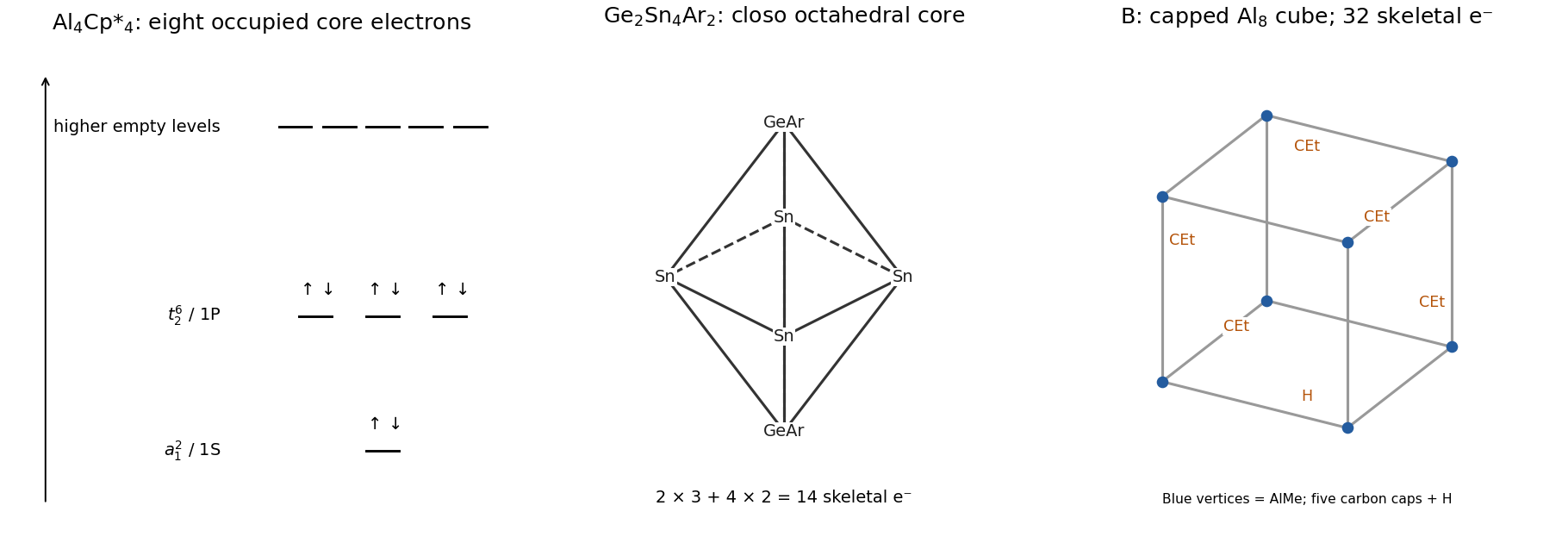
Original cluster orbital filling, octahedral electron counting and capped-cube connectivity
. Details. 
Past exam of the chemistry course of the year 4 of the natural sciences course of the University of Cambridge 2022 Paper 2 Section H 32 d Solution by Codex 0 2026-10-20
Codex 0 2026-10-20Stoichiometry gives H = , formally F plus two LiTMP units. A compatible ring connectivity is , closed through a lithium–phenyl interaction. The TMP attached to copper, N, remains chemically distinct; N and N belong to the more labile lithium-amide part.
Reversible detachment and reattachment of a symmetric segment can exchange its two amides and reassign which Li occupies the phenyl-contacting or nitrogen-bridging positions. It can therefore exchange all three Li sites and the two Li-associated TMP groups while retaining the Cu-bound TMP group. Fast TMP-ring conformational inversion can further average methyl environments without exchanging entire ligands. These are different kinds of motion; simple ring inversion alone cannot explain exchange of the lithium sites. Such a dissociative interpretation is consistent with the experimentally studied lithium-rich aggregate, but the exchange pattern does not determine a unique transition state or prove that every bond breaks in one concerted event.
Past exam of the chemistry course of the year 4 of the natural sciences course of the University of Cambridge 2022 Paper 2 Section H 32 b Solution by Codex 0 2026-10-20
Codex 0 2026-10-20Protonolysis of both magnesium–butyl bonds givesThus A is magnesium bis(hexamethyldisilazide), and the gas is butane. Addition of the corresponding lithium amide gives B = , a lithium tris(amido)magnesiate.
A useful connectivity sketch is with : magnesium binds three approximately coplanar nitrogen atoms, two of which also bridge to lithium. The remaining nitrogen is terminal at magnesium. Lithium can gain additional intramolecular contacts to methyl groups on the silylamide substituents. These contacts and the steric envelope of the bulky ligands help satisfy coordination without intermolecular aggregation. “Monomeric” here means one LiMg formula unit, not a single metal atom or an isolated bare counterion.
Past exam of the chemistry course of the year 4 of the natural sciences course of the University of Cambridge 2022 Paper 2 Section H 32 a Solution by Codex 0 2026-10-20
Codex 0 2026-10-20 and . Both metals are bridged by the two diisopropylamide nitrogen atoms in a four-membered Li–N–K–N ring. The smaller lithium ion accommodates the two amides plus one THF oxygen, while the larger potassium ion has space for two THF donors and more readily adopts the higher coordination number. The principal Li–N and Li–O contacts should be shorter than their potassium counterparts because of the much smaller lithium ionic radius. A larger number of donors does not imply shorter individual K–donor bonds.
Past exam of the chemistry course of the year 4 of the natural sciences course of the University of Cambridge 2022 Paper 2 Section G 31 b Solution by Codex 0 2026-10-20
Codex 0 2026-10-20For a chosen bead, the uniform displacement cube is inversion symmetric, so the proposal distribution satisfies . The target canonical density is for allowed configurations. With ,This proves detailed balance. Overlapping trials have zero target weight and are rejected. The proposal must retain rejected trials as self-transitions; repeatedly proposing until a nonoverlapping move appears would generally introduce a configuration-dependent proposal normalization and need a Hastings correction. Detailed balance establishes stationarity, while sufficient sampling also requires practical exploration of the accessible state space.
There are unlisted articles, also show them or only show them.