Past exam of the chemistry course of the year 4 of the natural sciences course of the University of Cambridge 2022 Paper 2 Section G 31 a Solution by  Codex 0 2026-10-20
Use symmetric single-bead displacements with the Metropolis acceptance rule, discard equilibration, and record the end-to-end distance after complete sweeps, including sweeps with rejected moves. One sweep is attempted bead moves; it is a sampling index, not physical time.
INITIALIZE(N, sigma):
    for i = 1,...,N:
        r[i] = ((i-1)*sigma, 0, 0)
    return r

ENERGY(r):
    for each pair i < j:
        if norm(r[i]-r[j]) < sigma:
            return infinity
    U = 0
    for i = 1,...,N-1:
        U += k/2 * (norm(r[i+1]-r[i])-sigma)^2
    return U

TRIAL(r):
    choose i uniformly from 1,...,N
    choose delta uniformly from [-a,a]^3
    r_trial = copy(r)
    r_trial[i] += delta
    return r_trial

ACCEPT(U, U_trial, beta):
    if U_trial == infinity:
        return false
    return log(uniform(0,1)) < min(0, -beta*(U_trial-U))

MAIN:
    r = INITIALIZE(N, sigma)
    U = ENERGY(r)
    for sweep = 1,...,n_equilibrate+n_produce:
        repeat N times:
            r_trial = TRIAL(r)
            U_trial = ENERGY(r_trial)
            if ACCEPT(U, U_trial, 1/(k_B*T)):
                r = r_trial
                U = U_trial
        if sweep > n_equilibrate:
            d_ETE = norm(r[N]-r[1])
            store d_ETE and update its histogram
    estimate autocorrelation and block uncertainties
The straight initial chain is nonoverlapping and has zero bond-stretching energy, but is not presumed to be an equilibrium configuration. Check relaxation from contrasting initial configurations and stationarity before production. The displacement scale may be tuned during equilibration and then held fixed. Every sweep may be recorded; correlations are handled in uncertainty estimates rather than pretending adjacent records are independent. If thinning is used, choose its spacing with reference to the measured autocorrelation time. Rejected states must still be sampled to retain their correct equilibrium residence weight.
Past exam of the chemistry course of the year 4 of the natural sciences course of the University of Cambridge 2022 Paper 2 Section G 30 d Solution by Codex 0 2026-10-20
Codex 0 2026-10-20 Past exam of the chemistry course of the year 4 of the natural sciences course of the University of Cambridge 2022 Paper 2 Section G 30 c Solution by Codex 0 2026-10-20
Codex 0 2026-10-20 Past exam of the chemistry course of the year 4 of the natural sciences course of the University of Cambridge 2022 Paper 2 Section G 30 b Solution by Codex 0 2026-10-20
Codex 0 2026-10-20 Past exam of the chemistry course of the year 4 of the natural sciences course of the University of Cambridge 2022 Paper 2 Section F 29 c Solution by Codex 0 2026-10-20
Codex 0 2026-10-20A consistent proposed sequence is desilylation, five-membered hemiketal formation, retro hetero-Diels–Alder opening, intramolecular aldol addition and hemiacetal closure. The essential carbon rearrangement is loss of the original ketone–side-chain bond and formation of a bond between its two neighbouring carbons; it is not a simple Michael addition.
For an explicit atom map, label the starting six-membered ring , with the ketone at , methyl substituents at and , the hydroxy group at , and the side chain . Here is the methylene and is the carbon bearing the protected alcohol. Let be the original ketone oxygen and the protected alcohol oxygen. These labels identify atoms, not new substituents.
First, Fluoride removes the silyl protecting group from . The resulting alcohol attacks the protonated ketone at , forming the five-membered hemiketal . The original oxygen is now a hydroxy group; the original pyran ring remains intact at this stage.
Next, The original pyran ring can undergo a retro hetero-Diels-Alder reaction. The three electron-pair movements are , and : break and , and form the three indicated double bonds. The result is the tethered aldehyde/dienol esterThe temporary bond keeps both reacting ends within the same molecule. At , both oxygen substituents remain attached, and the new tether prevents separation into independent fragments.
Then The enol attacks the tethered aldehyde at . Formation of , restoration of , and proton transfer give the six-membered lactone ring , with . This is an intramolecular aldol reaction, and it supplies the crucial new carbon–carbon bond without losing any carbon atom.
Finally, Keto-enol tautomerism at gives the methyl ketone at and introduces the hydrogen at . The alcohol then attacks that ketone, closing the five-membered hemiacetal ring . The resulting fused rings have exactly the product's connectivity: is the lactone carbonyl, is its ring oxygen, and is the five-membered-ring oxygen.
The stereocentre at survives throughout this sequence. The configuration initially at is erased at the aldehyde stage, and those at , , and arise during the later cyclization and proton-transfer steps. A folded intramolecular aldol reaction followed by reversible hemiacetal formation is consistent with the drawn cis ring junction, but connectivity and orbital bookkeeping alone do not prove that it is the unique selected diastereomer. In particular, a claim of simple retention at would contradict this atom map.
A related pyranone-to-fused-lactone rearrangement under aqueous hydrogen fluoride is experimentally reported; that account also explicitly qualifies the relative stereochemistry as assigned on mechanistic grounds. The sequence above is a proposed explanation of the examination structure, rather than a mechanism claimed to have been experimentally established in that paper.[ref]
Total synthesis of (±)-tirandamycin A by Philip DeShong and others. Pages 5220–5221, Schemes II–III and the discussion of pyranones 10 and 13 giving lactone 12
Past exam of the chemistry course of the year 4 of the natural sciences course of the University of Cambridge 2022 Paper 2 Section F 29 b Solution by Codex 0 2026-10-20
Codex 0 2026-10-20The first two operations invert the allylic hydroxyl group. Triphenylphosphine adds to the azodicarboxylate, generating the reagent pair that converts the alcohol into an alkoxyphosphonium leaving group. Benzoate displaces it with inversion at carbon, giving the inverted benzoate ester. Methoxide then cleaves that ester by nucleophilic acyl substitution, retaining the newly inverted carbon–oxygen stereochemistry because cleavage occurs at the acyl group, not by substitution at the stereogenic carbon.
The inverted allylic alcohol exchanges with the orthoacetate under acid catalysis. Ethanol loss produces an allyl ketene acetal, schematically . A six-membered suprafacial Johnson-Claisen rearrangement breaks the allylic C–O bond, shifts the ring alkene by one position and forms the new bond from the original alkene terminus to the ketene-acetal CH. The result is the substituent at the carbon that was the remote end of the original double bond. A chair-like transition state placing the larger substituents away from axial crowding explains the stereochemical transfer; the inverted alcohol configuration selects the corresponding face.
Finally, TiCl activates the anomeric methoxy group and methoxide departure creates an oxocarbenium ion. Hydride transfer from triethylsilane replaces that methoxy substituent by hydrogen. The ring oxygen and pendant OTBS group remain intact. The sequence is inversion, stereospecific allylic rearrangement, then reductive removal of the anomeric methoxy group, rather than direct reduction or hydrolysis of the ester introduced by the Claisen step.
Past exam of the chemistry course of the year 4 of the natural sciences course of the University of Cambridge 2022 Paper 2 Section F 29 a Solution by Codex 0 2026-10-20
Codex 0 2026-10-20DBU removes the proton to sulfonium, generating the propargyl-substituted sulfur ylide . Its carbon attacks the enone carbon bearing indolyl, shifting the conjugated electrons into an enolate. The new intermediate has the carbon sequence .
Intramolecular attack by the enolate oxygen on the sulfonium-bearing carbon displaces dimethyl sulfide and closes a five-membered ring. This conjugate addition–O-alkylation sequence gives the dihydrofuran, retaining the C≡CMe substituent and placing the original carbonyl oxygen in the ring. Enolate carbon alkylation would instead give a cyclopropane; the observed oxygen-containing ring identifies the alternative closure. An approach and betaine conformation minimizing crowding between indolyl and alkynyl substituents, followed by stereoinverting displacement at the sulfonium carbon, rationalizes the depicted trans product. The result is racemic in the absence of an external chiral influence.
Past exam of the chemistry course of the year 4 of the natural sciences course of the University of Cambridge 2022 Paper 2 Section F 28 e Solution by Codex 0 2026-10-20
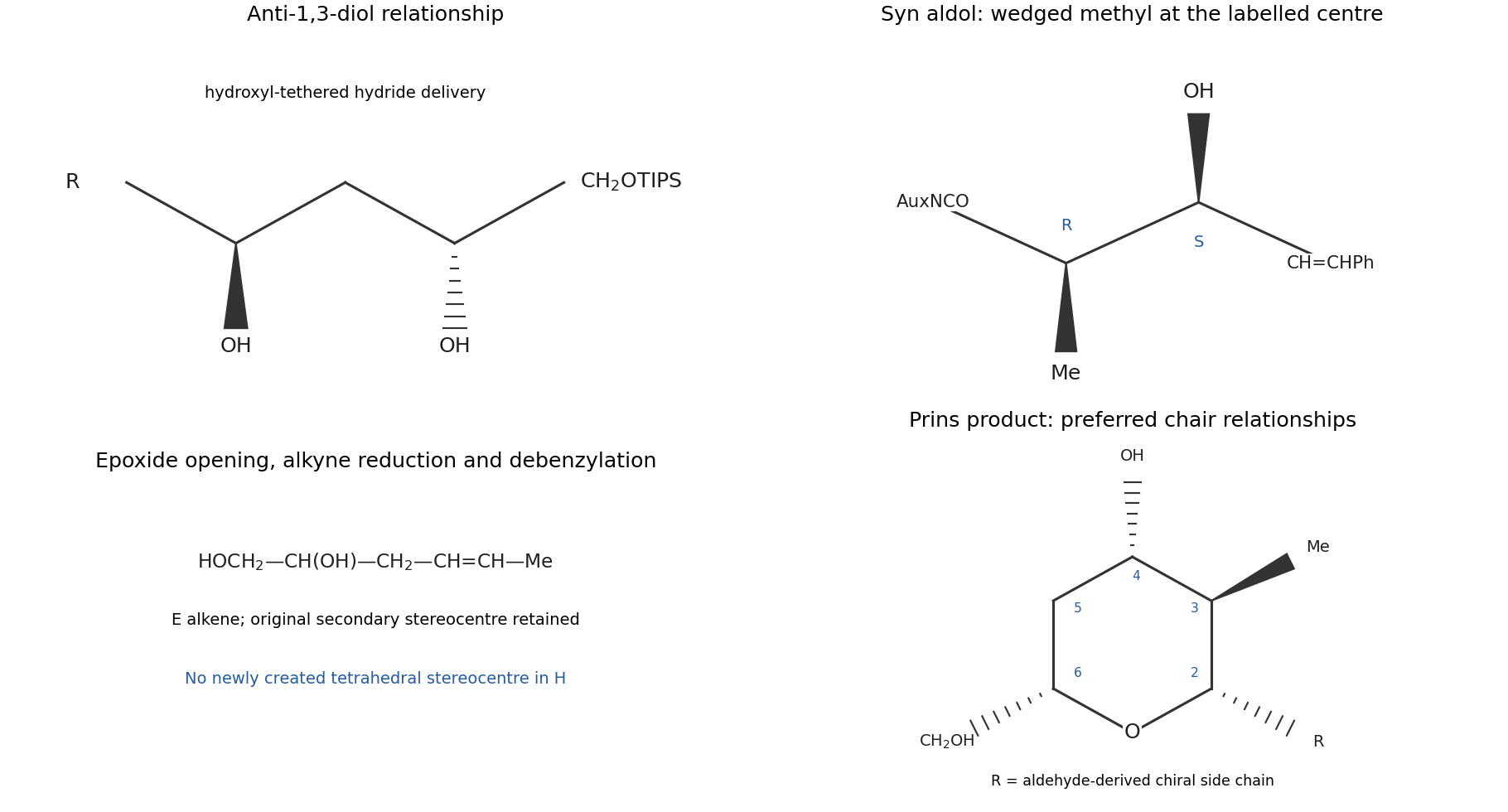
Codex 0 2026-10-20The secondary alcohol of H condenses with the aldehyde under acid catalysis to form a hemiacetal, then loses water to an oxocarbenium ion. Its tethered E alkene attacks the aldehyde-derived carbon through a chair-like six-membered arrangement: the alkene carbon farther from the alcohol forms the new C–C bond, placing a carbocation at the nearer alkene carbon. Trifluoroacetate captures that cation; the basic methanolic work-up cleaves the trifluoroacetate ester to reveal the ring hydroxyl group. This is a Prins cyclization.
Number the product ring from oxygen through the aldehyde-derived carbon as C2, then the alkene-derived methyl-bearing carbon C3, the hydroxyl-bearing carbon C4, the intervening methylene C5 and the original alcohol carbon C6. A chair keeping the bulky C2 side chain and C6 hydroxymethyl group equatorial predicts 2,6-cis substitution. Suprafacial alkene capture preserves the E-alkene-derived relationship, giving 2,3-trans between the C2 side chain and C3 methyl. Preferred equatorial trapping of the C4 cation gives 3,4-trans, hence the 2,4,6-cis arrangement of the substituent-bearing bonds in the favoured chair. In the printed flat-ring orientation, draw the C2 side chain, C4 hydroxyl and C6 hydroxymethyl behind the plane, and C3 methyl in front. Existing stereocentres in the aldehyde side chain and at C6 are retained; they anchor the absolute face of this assignment.

Past exam of the chemistry course of the year 4 of the natural sciences course of the University of Cambridge 2022 Paper 2 Section F 28 d Solution by Codex 0 2026-10-20
Codex 0 2026-10-20The acetylide attacks the less substituted terminal epoxide carbon by SN2 ring opening. The C–O bond at that carbon breaks, leaving the oxygen attached to the original substituted stereocentre. Protonation gives . Dissolving-metal reduction then gives the E alkene and also cleaves the benzyl ether.
Thus H is with an E double bond, and its original epoxide-derived stereocentre is retained geometrically. No new tetrahedral stereocentre is formed: the attacked epoxide carbon becomes CH. The new stereochemical information is the E alkene geometry. Calling its secondary hydroxyl carbon “newly generated” would confuse changing its functional environment with creating a new stereocentre.
Past exam of the chemistry course of the year 4 of the natural sciences course of the University of Cambridge 2022 Paper 2 Section F 28 c Solution by Codex 0 2026-10-20
Codex 0 2026-10-20The free allylic hydroxyl can hydrogen-bond to the peracid and accelerate directed oxygen transfer to the nearby double bond. The remote styryl double bond lacks this directing contact. Epoxidation of the hydroxyl-adjacent alkene is therefore favoured, even though both alkenes are in principle oxidizable. Peracid epoxidation is a concerted oxygen transfer: alkene donation to terminal peroxide oxygen, O–O cleavage, proton transfer and carbonyl re-formation occur through a cyclic transition-state arrangement. The alkene's E geometry is retained as a trans relationship between its substituents in the epoxide.
The two alkene faces are diastereotopic because the molecule already contains stereocentres. A plausible substrate-controlled conformation minimizes allylic strain and presents the face opposite the bulky OTBS-bearing part of the chain to the oxidant. Predict epoxide oxygen on the face opposite OTBS, retaining the pre-existing methyl and OTBS configurations. Hydrogen-bond direction, steric approach and conformational population compete; one cannot deduce an exact diastereomeric ratio from the flat drawing alone. The same facial preference has been discussed for this synthetic series.[ref]
Recent results toward the stereoselective synthesis of biologically active natural products by Luiz C. Dias and others. 2007, synthesis section and Scheme 2, epoxidation opposite OTBS
Past exam of the chemistry course of the year 4 of the natural sciences course of the University of Cambridge 2022 Paper 2 Section F 28 b Solution by Codex 0 2026-10-20
Codex 0 2026-10-20Dibutylboron triflate coordinates the imide carbonyl and triethylamine removes the propionyl proton, giving predominantly the Z dibutylboron enolate. Its connectivity is ; the imide auxiliary remains attached, rather than being displaced during enolization. Coordination of cinnamaldehyde's oxygen to boron organizes a six-membered Zimmerman–Traxler transition state.
A chair with the aldehyde's styryl group pseudoequatorial avoids the auxiliary's bulky benzyl side. Formation of the C–C bond and transfer of the aldehyde oxygen into the boron coordination sphere give the boron aldolate, which hydrolyses to D. A Z enolate gives the syn aldol relationship. In the printed product zigzag, the labelled -methyl bond should therefore be a solid wedge, on the same stereochemical face as the neighbouring solid-wedge hydroxyl bond. With the stated connectivity, the labelled carbon is R: priority is imide carbonyl, then , then methyl, then hydrogen. The adjacent hydroxyl centre is S. These assignments refer to the actual auxiliary and product orientation, not an arbitrary choice of an otherwise equivalent chair.
Past exam of the chemistry course of the year 4 of the natural sciences course of the University of Cambridge 2022 Paper 2 Section F 28 a Solution by Codex 0 2026-10-20
Codex 0 2026-10-20A hydroxyl-directed Evans–Saksena reduction gives the required anti-1,3-diol. A suitable reagent is tetramethylammonium triacetoxyborohydride in an acidic medium, for example acetic acid/acetonitrile. Ligand exchange between the pre-existing alcohol and an acetoxyborohydride group tethers the reducing reagent to the substrate. Intramolecular hydride delivery to the ketone then proceeds through a six-membered arrangement, converting C=O to an alkoxide while conserving all existing stereocentres. Hydrolysis releases the second hydroxyl group.
The preferred directed transition-state conformation minimizes crowding by the larger carbon-chain substituents. It delivers the new C–H bond on the face that leaves the two hydroxyl groups anti, as in B: with the original hydroxyl drawn as a wedge in the printed zigzag, the new hydroxyl is dashed. The intervening methyl stereocentre is retained. Choosing an undirected borohydride reduction would not by itself rationalize this strong substrate-controlled relationship.
Past exam of the chemistry course of the year 4 of the natural sciences course of the University of Cambridge 2022 Paper 2 Section E 27 e Solution by Codex 0 2026-10-20
Codex 0 2026-10-20The initial slope near one is the short-observation regime . Successively longer observations include trajectories that enter progressively longer-lived traps before reaching the absorbing minimum. The four marked shoulders represent successive relaxation timescales, not four distinct equilibrium phases. A plateau appears when the contributing faster modes have largely completed but the next slow component has not yet substantially changed the conditional mean. The ultimate plateau is the true mean first-passage time, approximately in the plotted time units.
To estimate a rate, locate the rounding timescale at which that mode stops growing with the observation window, using ; the final completion of a crossover requires several lifetimes. Graphical transitions lie approximately around , 23, 29 and 35, giving only order-of-magnitude estimatesThese are roughly , , and , with factors of several uncertainty from reading broad crossovers. Plateau heights are weighted sums divided by completed probability, not individually ; in particular the final plateau at does not require the slowest lifetime to be . The table fixes barriers and basin connectivity, but supplies no temperature or attempt-frequency convention that would justify exact rates directly from the energies.
Past exam of the chemistry course of the year 4 of the natural sciences course of the University of Cambridge 2022 Paper 2 Section E 27 d Solution by Codex 0 2026-10-20
Codex 0 2026-10-20A disconnectivity graph joins minima when an energy threshold first permits a path between their basins. Taking thresholds in steps of 2 and admitting transition states with energy at most the threshold gives the following merges:
These eight merges connect all nine minima without duplicating a basin. Minimum endpoints lie at their stated energies; branch heights are the discretized superbasin thresholds, not necessarily the exact saddle energies. If a strictly-less-than threshold convention is used, barriers exactly on a grid line join at the next grid level; the physical connectivity is unchanged.
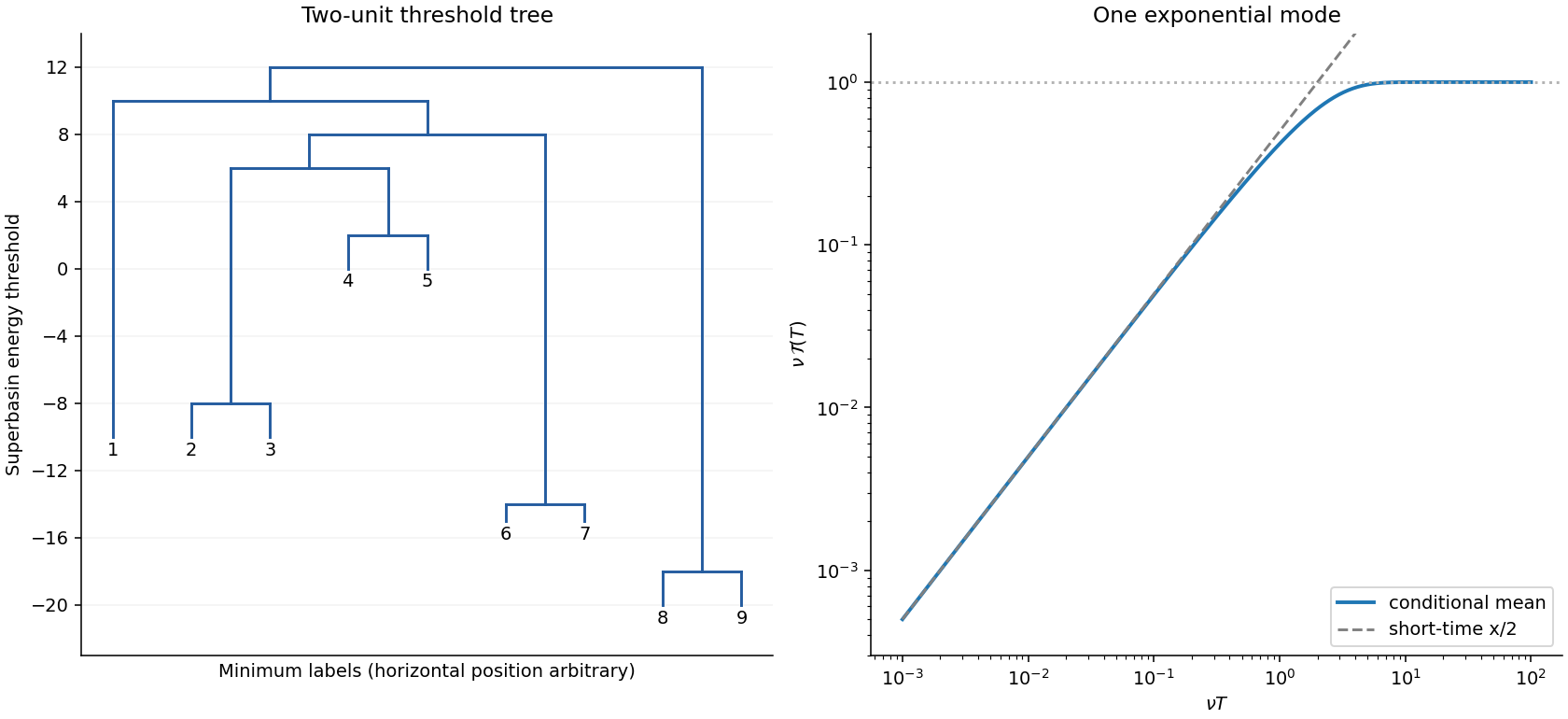
Original disconnectivity tree with two-unit superbasin thresholds and single-mode observation-time crossover
. Details. 
Past exam of the chemistry course of the year 4 of the natural sciences course of the University of Cambridge 2022 Paper 2 Section E 27 c Solution by Codex 0 2026-10-20
Codex 0 2026-10-20Set . Expanding gives and . The numerator contribution is therefore and the denominator contribution is .
Past exam of the chemistry course of the year 4 of the natural sciences course of the University of Cambridge 2022 Paper 2 Section E 27 b Solution by Codex 0 2026-10-20
Codex 0 2026-10-20The observed statistic is the conditional mean among passages completed before , not a mean in which unfinished trajectories are assigned duration . Its normalization isFor each contribution,Dividing the weighted sum of these first moments by givesThe denominator records the fraction of trajectories actually observed to finish.
There are unlisted articles, also show them or only show them.