Past exam of the chemistry course of the year 4 of the natural sciences course of the University of Cambridge 2022 Paper 2 Section B 21 c Solution by  Codex 0 2026-10-20
Weak ferromagnetism from canted antiferromagnetic order is the consistent model. Importantly, the plot has different magnetization scales: the left axis belongs to Mn and Fe; the right belongs to Co and Ni. Approximate low-temperature field-cooled readings are 40, 50, 450 and 390 G cm mol, respectively. Dividing by 5585 givesThese moments are tiny compared with fully aligned moments of about 5.09, 4.40, 4.25 and 2.47 , calculated using the Curie-derived values below. A conventional ferromagnet of the full high-spin ions would have much larger spontaneous magnetization; a simple bipartite array of identical metal sites also supplies no obvious unequal sublattice moments for ferrimagnetism. Opposed large sublattice moments with a small transverse uncompensated component reconcile the net response with negative .
If the 10 Oe field has aligned the weak-ferromagnetic domains, estimates sublattice canting angles of roughly 0.08°, 0.12°, 1.1° and 1.6°. These are illustrative, not precision structure determinations: the low field may not fully align the domains, and the readings are graphical. Bulk magnetization strongly supports this model but does not uniquely establish every spin direction; magnetic neutron diffraction would test the microscopic arrangement.
Past exam of the chemistry course of the year 4 of the natural sciences course of the University of Cambridge 2022 Paper 2 Section B 21 b Solution by Codex 0 2026-10-20
Codex 0 2026-10-20At high temperature, approximately independent paramagnetic ions give the appropriate Curie constant. The negative Weiss temperatures and the reduction of on cooling initially indicate predominantly antiferromagnetic correlations. The sharp rise near the ordering temperature nevertheless reveals a strongly enhanced low-field magnetic response.
A net moment could arise from a canted antiferromagnet, a ferrimagnet, or a ferromagnet with competing antiferromagnetic interactions. Differences between field-cooled magnetization and zero-field-cooled magnetization suggest history-dependent domain selection or slow relaxation, but are not alone proof of a particular microscopic spin arrangement. An ordinary compensated antiferromagnet would not account for a large ordering-related ferromagnetic-like low-field contribution without an additional mechanism.
Past exam of the chemistry course of the year 4 of the natural sciences course of the University of Cambridge 2022 Paper 2 Section B 21 a Solution by Codex 0 2026-10-20
Codex 0 2026-10-20The framework is a three-dimensional network of corner-connected octahedra, with each apparent corner connection extended through a bridging formate, . Each metal is coordinated by six oxygen donors from six formates, which link it to six neighbouring metals in the perovskite-like topology. The guanidinium cation occupies the larger cavity and can hydrogen-bond to formate oxygen atoms. Charge balance is .
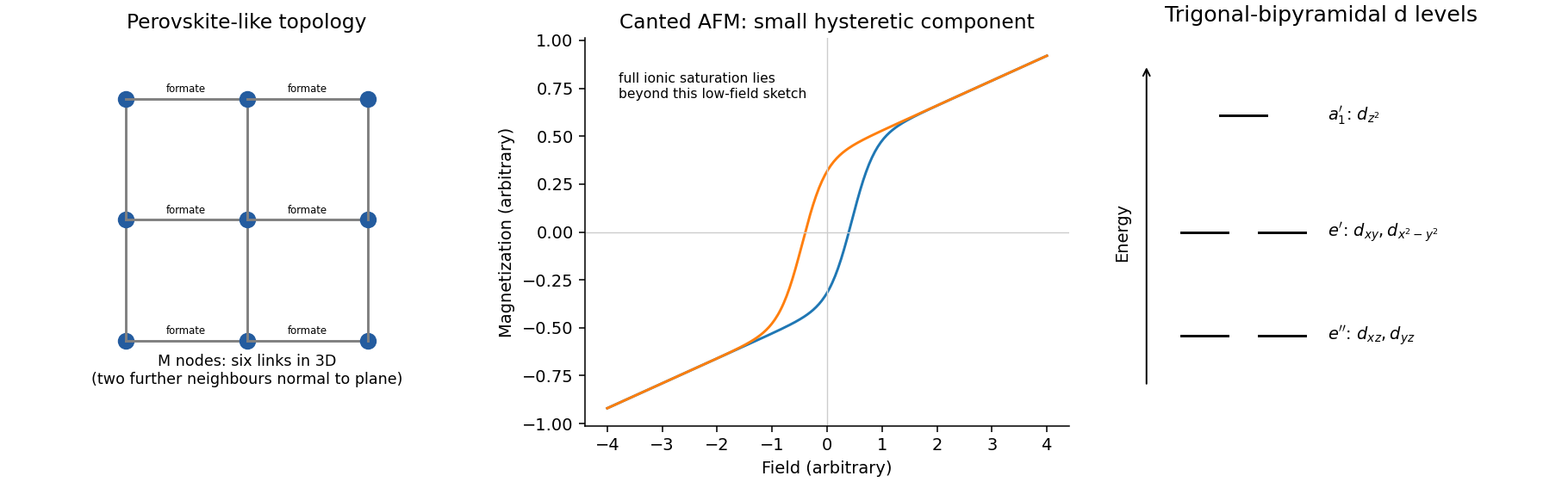
Original formate-network topology and weak-ferromagnetic magnetization schematic
. Details. Past exam of the chemistry course of the year 4 of the natural sciences course of the University of Cambridge 2022 Paper 2 Section B 20 a Solution by Codex 0 2026-10-20
Codex 0 2026-10-20Place the trigonal axis along , the axial ligands on and the equatorial ligands in the plane. The ordering is . The pair has nodal behaviour along both the equatorial ligand directions and the axial axis, minimizing direct ligand repulsion. The in-plane pair points into the equatorial region. The lobes point at both axial ligands and its torus also samples the equatorial ligands, giving the largest repulsion in the regular point-charge geometry.
Rotation by 120° and reflection in the equatorial plane preserve the geometry; they enforce the indicated doublet degeneracies. The ordering concerns a regular trigonal bipyramid with equivalent ligand-field assumptions, not every distorted five-coordinate complex.
Past exam of the chemistry course of the year 4 of the natural sciences course of the University of Cambridge 2022 Paper 2 Section A 19 e Solution by Codex 0 2026-10-20
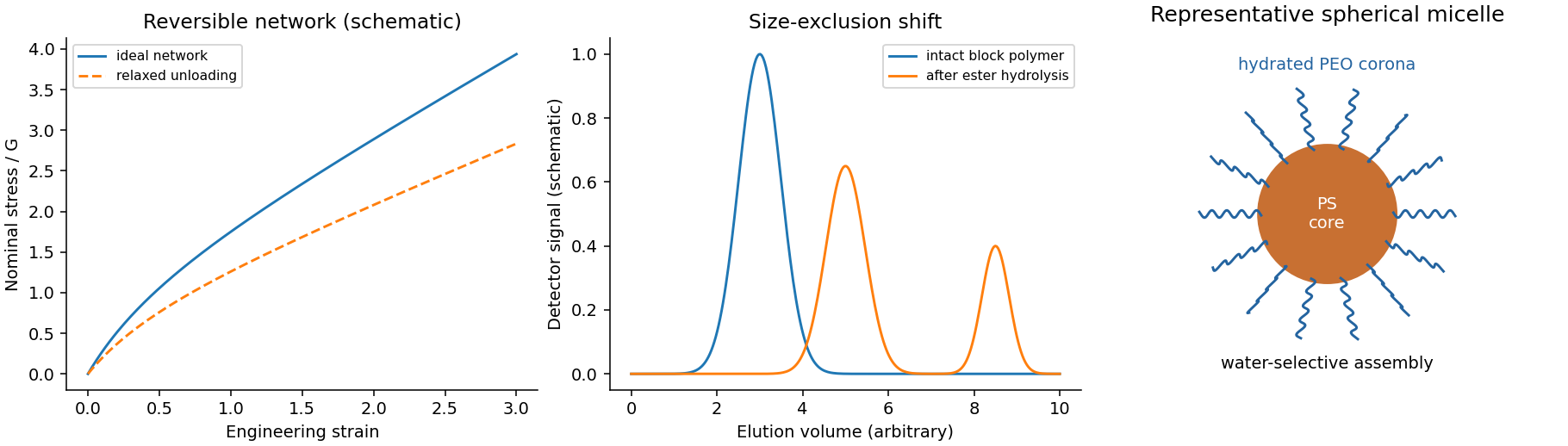
Codex 0 2026-10-20Replacing lactide by ethylene oxide givesThe first chain grows by alkoxide attack on ethylene oxide, followed by protonation at work-up; the alkoxyamine subsequently controls styrene polymerization. The final material is an amphiphilic block copolymer. In water, polystyrene avoids solvent exposure while the poly(ethylene oxide) block is hydrated. Above a concentration-dependent assembly threshold, micelles with a polystyrene core and hydrated poly(ethylene oxide) corona are a reasonable morphology. Unimers remain in equilibrium with aggregates. Core–corona assembly lowers unfavourable water contact but costs chain-stretching and translational entropy. Block volume fractions, solvent history and concentration can instead favour cylinders or vesicles, so the chemical structure alone does not uniquely establish spherical micelles.
Past exam of the chemistry course of the year 4 of the natural sciences course of the University of Cambridge 2022 Paper 2 Section A 19 d Solution by Codex 0 2026-10-20
Codex 0 2026-10-20Hydroxide attacks a PLA ester carbonyl, moving the electrons onto oxygen. Collapse of the tetrahedral intermediate expels an alkoxide; proton transfer produces an alcohol and a carboxylate. The carboxylate stabilizes the hydrolysis products and makes this saponification effectively irreversible under the basic conditions. Repetition cleaves the PLA block, including its terminal ester linkage to the junction alcohol, while the carbon–carbon polystyrene backbone remains intact.
The principal surviving polymer is a polystyrene chain bearing the junction end and its nitroxide-derived distal end. In gel permeation chromatography, the intact block copolymer normally elutes earlier than this smaller surviving polystyrene coil. Lactate and short hydrolysis fragments elute later still, provided the column and detector resolve such small solutes. The polymer peak therefore shifts to larger elution volume; its height need not remain constant under a mass-sensitive detector. Elution reflects hydrodynamic volume, so calibration against polystyrene standards does not supply an exact absolute mass for the original mixed block.
Past exam of the chemistry course of the year 4 of the natural sciences course of the University of Cambridge 2022 Paper 2 Section A 19 c Solution by Codex 0 2026-10-20
Codex 0 2026-10-20The ideal number-average molar mass is approximately 25.11 kg mol. Quantitative uptake of 100 lactide and 100 styrene molecules per bifunctional initiator givesB has formula . Lactide's entire cyclic diester mass is incorporated; multiplying its molar mass by two again would double-count its two lactyl units. The estimate assumes quantitative initiation, conversion, nitroxide recapping and no chain transfer or loss of chain-end fragments.
Past exam of the chemistry course of the year 4 of the natural sciences course of the University of Cambridge 2022 Paper 2 Section A 19 b Solution by Codex 0 2026-10-20
Codex 0 2026-10-20Styrene, benzoyl peroxide and TEMPO provide the required radical addition–trapping sequence. Heating the peroxide breaks its O–O bond into benzoyloxy radicals. Before decarboxylation, can add to styrene's terminal carbon, generating the resonance-stabilized radical . Coupling with the oxygen-centred TEMPO radical then gives , the benzoate-protected alkoxyamine A.
The connectivity distinguishes this route from initiators that leave a carbon-based radical fragment at the chain end. Competition with benzoyloxy-radical decarboxylation affects yield, so this is a plausible preparation rather than a claim of exclusive product formation. Subsequent benzoate cleavage reveals B's hydroxyl group without requiring rupture of its alkoxyamine linkage.
Past exam of the chemistry course of the year 4 of the natural sciences course of the University of Cambridge 2022 Paper 2 Section A 19 a Solution by Codex 0 2026-10-20
Codex 0 2026-10-20Let , so B is . Its hydroxyl group initiates ring-opening polymerization of lactide, givingEach lactide contributes two lactyl repeat units. Dry monomer, exclusion of water and an alcohol-compatible catalyst such as tin(II) 2-ethylhexanoate under heating provide a practical route. Alcohol/metal-alkoxide exchange followed by lactide coordination and acyl–oxygen cleavage extends the ester chain while retaining a terminal hydroxyl group.
Heating C under oxygen-free conditions homolytically cleaves its benzylic C–O bond to the nitroxide, releasing a benzylic radical and TEMPO. The radical adds styrene repeatedly; reversible trapping by TEMPO controls the active radical concentration. D is therefore a poly(lactide)–polystyrene block copolymer with junction and the hydroxyl end of PLA retained. This is nitroxide-mediated polymerization; a temperature around 120–130 °C is a representative condition for a TEMPO/styrene system, rather than an exact universal optimum.
Past exam of the chemistry course of the year 4 of the natural sciences course of the University of Cambridge 2022 Paper 2 Section A 18 f Solution by Codex 0 2026-10-20
Codex 0 2026-10-20Reductive ozonolysis cuts the unsaturated backbone into cyclopentane-1,3-dicarbaldehyde units, apart from end fragments. Both alkene carbons carry a hydrogen, so the carbonyl products are aldehydes rather than ketones. Ring substituent stereochemistry is inherited from the polymer repeat; backbone E/Z geometry does not survive cleavage.
Ozone adds across a backbone alkene by cycloaddition, giving a primary ozonide. Its fragmentation produces a carbonyl group and a carbonyl oxide, which recombine to a secondary ozonide. Dimethyl sulfide reduces the peroxide-containing intermediate, forming dimethyl sulfoxide and the two carbonyl termini. Repetition at every backbone double bond liberates the dialdehyde. An oxidizing work-up would instead risk oxidation to carboxylic acids, so the specified reductive work-up is essential.
Past exam of the chemistry course of the year 4 of the natural sciences course of the University of Cambridge 2022 Paper 2 Section A 18 e Solution by Codex 0 2026-10-20
Codex 0 2026-10-20Pendant alcohols can form reversible borate bridges, schematically and , where P and P′ belong to different chains. Tetrahedral borate species are also possible depending on pH and water content. A bridge must connect different network strands to act as a cross-link; an intrachain loop does not contribute equivalently to elasticity.
Between cross-links, stretching reduces the number of accessible chain conformations. A simple incompressible rubber elasticity model gives the nominal tensile stresswhere is the extension ratio and the density of elastically active strands. The initial response is soft; stronger extension gives increasing stress and ultimately finite-chain extensibility. Reversible borate exchange permits stress relaxation, rate dependence and a loading–unloading hysteresis loop, rather than permanent ideal elasticity at arbitrarily long times.


Past exam of the chemistry course of the year 4 of the natural sciences course of the University of Cambridge 2022 Paper 2 Section A 18 d Solution by Codex 0 2026-10-20
Codex 0 2026-10-20C has a saturated backbone and pendant groups in its second block. Hydrogenation converts every backbone to ; lithium aluminium hydride then reduces each to . The resulting connectivity is .
Hydrogenation removes local double-bond rigidity and commonly lowers the segmental barrier to motion, favouring a lower glass transition temperature. Ester reduction changes polarity and side-group volume, while the new hydroxyl groups introduce hydrogen bonding, which can raise the hydroxyl-rich block's glass transition temperature and strengthen segregation. These competing effects preclude a numerical transition shift or an unconditional direction for both transitions from structure alone.
The repeat-unit formulae after both operations are and . Taking standard atomic masses,This is approximately 14.27 kg mol plus the net end-group mass. The termination chemistry is unspecified, so a more precise whole-chain mass is not determined; the methyl group lost during ester reduction must not remain in the second repeat's mass.
Past exam of the chemistry course of the year 4 of the natural sciences course of the University of Cambridge 2022 Paper 2 Section A 18 c Solution by Codex 0 2026-10-20
Codex 0 2026-10-20A sufficiently phase-separated block copolymer can show two glass transitions, associated approximately with its two microdomains. Simultaneous feeding instead tends to distribute the monomers along each chain, giving a statistical copolymer and usually one composition-dependent glass transition. Different monomer reactivities could produce a gradient rather than a perfectly random sequence.
For a homogeneous mixture an approximate interpolation is the Fox equation, , with temperatures in kelvin. Two transitions are not guaranteed merely by block architecture: short blocks, miscibility or insufficient experimental resolution can give one broad transition. The contrast is between domain-specific segmental environments and a more uniform mixed environment.
There are unlisted articles, also show them or only show them.