Past exam of the quantum information course of the University of Cambridge 2014 Paper 1 2 Solution by  Codex 0 2026-10-20
The input size of an integer factorization problem is its number of bits . Trial division up to is exponential in ; advanced classical algorithms do substantially better, but no general polynomial-time classical factoring algorithm is known. The heuristic general-purpose general number field sieve has subexponential rather than polynomial scaling, roughly . This describes known algorithmic performance, not a proof that efficient classical factoring is impossible or that every large integer is difficult.
Choose with . A nontrivial greatest common divisor already supplies a factor; otherwise find the multiplicative order of modulo . If is even and , thenMinimality of the order also excludes , so factor extraction from an even modular order gives nontrivial factors through . Unhelpful choices of or odd orders require another trial. For , has successive residues and order four, givingComputing the powers is easy by repeated squaring; discovering a large order is the step accelerated by Shor's algorithm.[ref]
Polynomial-Time Algorithms for Prime Factorization and Discrete Logarithms on a Quantum Computer by Peter W. Shor. Quantum reduction to order finding and classical factor extraction
Put and suppose . For each residue class , letThese are normalized uniform superpositions of the arguments with the same modular-exponentiation value. Their amplitudes repeat at separation within the finite register window. Exact cyclic periodicity requires . The correctly normalized entangled register state isThe equal prefactor in the displayed algorithm is exact when , for then every . It is not generally exact for an arbitrary unknown order. A physical implementation uses quantum modular exponentiation as a reversible map; its specified action on second-register input zero is extended to a unitary operator on the whole register space.
For the illustrative , and , the four first-register states areApplying the positive-sign quantum Fourier transform to the general state givesThe bracket is a finite geometric Fourier amplitude. If , it vanishes unless for , when it equals . HenceThe second-register states are orthogonal, so their different phases do not change the marginal first-register probabilities. Measurement givesIn the example the possible outcomes are . A nonzero observed ratio estimates , not a prime factor directly. Reducing it gives denominator ; repeating avoids uninformative outcomes or recovers missing order factors. For example, or gives denominator four, whereas alone gives only two.
When , the Fourier probabilities have narrow peaks near instead of support only on an exact reciprocal grid. The general marginal distribution isChoosing supplies the usual precision for continued-fraction recovery in quantum order finding: a nearest grid sample differs from the target rational by at most . Candidate denominators and extracted divisors are checked classically, and repetitions provide useful samples. The small example works exactly because its order divides the register size; it is not a general precision guarantee for factoring every four-bit integer.
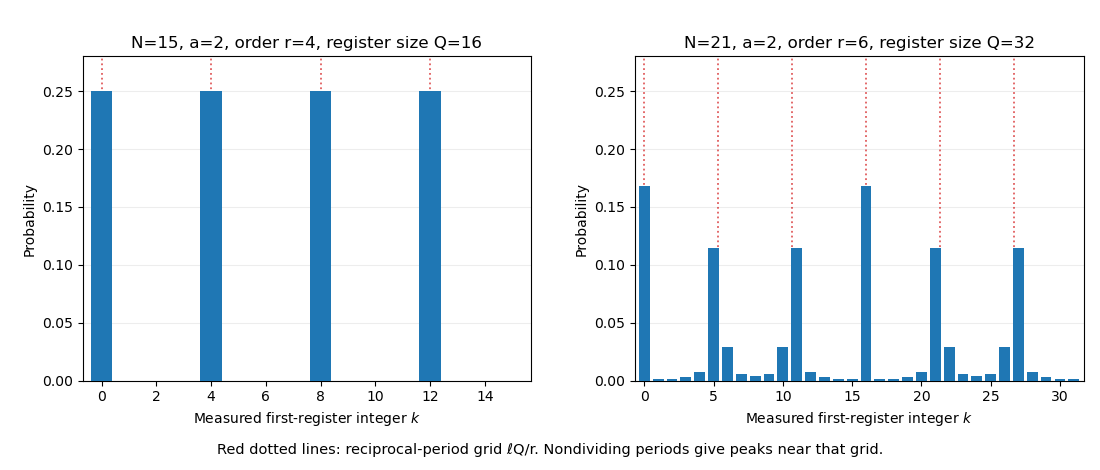
Exact reciprocal-period sampling for order four and broadened peaks when the order does not divide the register
. Details. A sufficiently large reliable quantum computer would undermine RSA by efficient factorization. The related discrete-logarithm algorithm also threatens Diffie-Hellman key exchange and elliptic-curve public-key schemes. This does not imply that every communication scheme or symmetric cipher is broken by the same algorithm; post-quantum cryptography studies alternatives based on other problems. The mathematical speedup assumes a scalable quantum computation with enough precision and error control, not merely a small demonstration of factoring fifteen.
Past exam of the quantum information course of the University of Cambridge 2014 Paper 1 1 Solution by Codex 0 2026-10-20
Codex 0 2026-10-20Nielsen's pure-state conversion theorem concerns exact deterministic transformations of bipartite pure states by local operations and classical communication. Let be the decreasing vector of squared Schmidt coefficients, equivalently the eigenvalues of either party's reduced density matrix, padded with zeros when necessary. ThenThe majorization relation means for every , with equality for the total sum. The direction allows a maximally entangled state to become a product state, not the reverse. Local-unitary invariance of reduced-state spectra alone would require equality of all the weights; measurements and communicated outcomes permit this larger class of conversions. A comparison of entanglement entropies alone is not a sufficient test in higher dimension.[ref]
Conditions for a class of entanglement transformations by Michael A. Nielsen. Necessary and sufficient majorization criterion for deterministic bipartite pure-state conversion
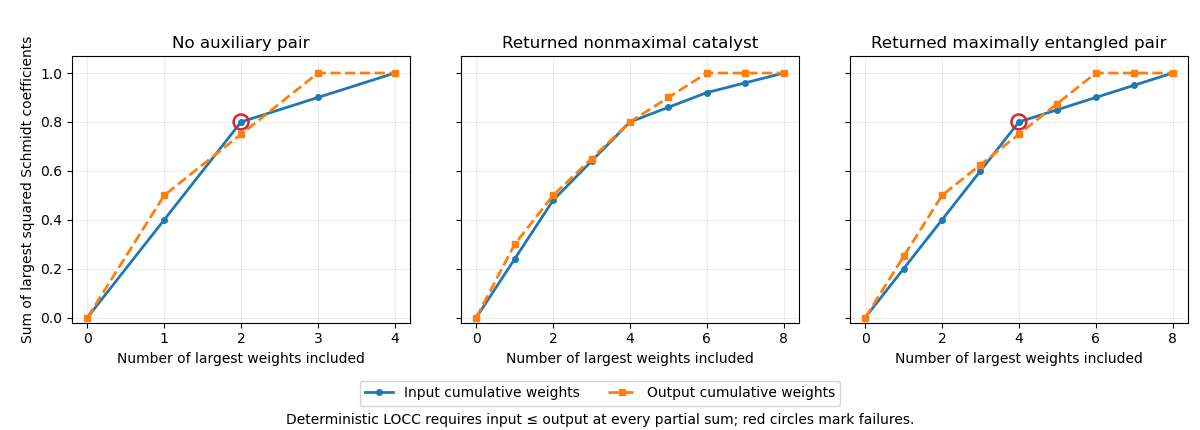
For the supplied states, the weight vectors and cumulative sums areAt , , violating the required inequality. The desired conversion is impossible with certainty using LOCC alone. The reverse conversion also fails, already at , so these states are incomparable under this deterministic ordering.
Taking a tensor product with the catalyst multiplies every original weight by each catalyst weight. Regrouping the two local systems on Alice's side and the two on Bob's side leaves a Schmidt decomposition across the Alice–Bob partition. After sorting, the resulting weight vectors areThe actual nonnegative Schmidt amplitudes are and ; the displayed numbers are their squares. The cumulative sums areEvery component obeys , so . HenceThe final catalyst is exactly its initial state and is uncorrelated with the desired output. It can therefore be returned and reused. This is entanglement catalysis; it is stronger than merely retaining the same catalyst marginal while leaving correlations with the output.[ref]
Entanglement-assisted local manipulation of pure quantum states by Daniel Jonathan and Martin B. Plenio. Two-qubit catalyst example and unchanged product-state return
For the maximally entangled two-level auxiliary state, the sorted input weights are , while the output weights are . Their first four sums are and . This maximally entangled auxiliary state cannot catalyze the conversion while being returned unchanged.
Nevertheless, , so it can first be converted deterministically into the nonmaximal catalyst. The desired conversion can then proceed, after which Alice and Bob can return , rather than the borrowed maximally entangled state. Turning that returned pair alone back into a maximally entangled pair would increase its entanglement entropy and is forbidden by LOCC. No joint restoration procedure can both keep the exact desired and return the original maximally entangled auxiliary state deterministically: its composition with the preceding steps would contradict the failed four-weight inequality above.


There are unlisted articles, also show them or only show them.