Past exam of the relativistic Astrophysics and Cosmology course of the University of Cambridge 2016 Paper 1 2 Solution by  Codex 0 2026-10-20
Use the geodesic radial comoving coordinate, in which the Friedmann-Lemaître-Robertson-Walker metric has the formOn a slice of constant cosmic time, the radial proper-length element is . ThereforeIf one starts from a curvature coordinate with radial element , then ; the curvature coordinate itself is not generally the used above.
For a comoving galaxy, , so . The definitions areThis recession law concerns proper distances on common cosmic-time slices. It is not a local special-relativistic relative velocity measurement; a large recession rate is not a signal exceeding the local speed of light.
For a comoving volume , total fluid energy is . Adiabatic energy conservation gives . Expanding,henceHere is mass-equivalent energy density. Radiation loses energy both by dilution and by pressure work; pressureless matter only dilutes in this description.
In the time-unit convention for the cosmological constant, it represents a uniform vacuum contribution with pressure equal to minus its energy density. There is a units convention in the printed field equations: their term is , so the symbol there has units of inverse time squared. If the geometrical constant is instead given in inverse length squared, this symbol equals . The curvature parameter labels constant-curvature spatial slices; with a conventional scale-factor normalization it is for positively curved, flat and negatively curved slices. It fixes local curvature sign, not every possible global spatial topology.
For a flat fluid-only model without a cosmological constant and with , the two field equations giveThe two printed cases and their scale-factor laws are worked under the literal inline labels below.
Inflation is accelerated expansion, , equivalently a decreasing comoving Hubble radius on an expanding branch. An approximately constant positive vacuum-like energy can give nearly exponential expansion. Enough inflation can put regions now widely separated inside a common earlier causal patch, suppress and dilute unwanted relics such as monopoles. These are the horizon, flatness and relic-abundance motivations. Reheating is needed to populate the subsequent hot universe. Quantum fluctuations can seed primordial perturbations, but inflation alone is not a universal solution to the initial singularity or a proof that all initial conditions inflate.
Now adopt the printed natural units . For the Homogeneous massive-scalar equation in an expanding universe,The continuity equation givesWhere , this implies the expanding-universe Klein-Gordon equationA regular canonical-field solution extends it through isolated turning points by continuity. Purely dividing the conservation equation does not determine a trajectory on an interval where is identically zero; canonical field dynamics, or variation of its action, supplies the equation there. In particular a constant nonzero massive field is not an exact freely evolving solution.
With ,ThereforeThis inflation condition for a homogeneous massive scalar means a potential-dominated field has sufficiently negative pressure to accelerate expansion. In quadratic chaotic inflation, a large initial field with can enter slow roll, with and . The potential slow-roll parameter is , so a large field relative to the gravitational scale can support many e-folds. The field eventually rolls far enough that this regime ends and oscillation and reheating become relevant. Large potential energy with arbitrary initial kinetic energy does not by itself guarantee an inflationary interval.
Differentiating the flat Friedmann equation and then using the scalar equation,For the expanding branch,This Nonincreasing Hubble rate for a canonical inflaton decreases strictly where the field rolls and can be momentarily stationary at a turning point; the statement “always decreasing” means nonincreasing. This does not conflict with acceleration, because remains positive when .
At horizon exit, larger comoving wavelengths leave earlier, when is larger. For a canonical field in slow roll, with reduced Planck mass ,The decreasing expansion rate gives a red tensor tilt at this order. The scalar curvature spectrum also contains the conversion from field fluctuations to curvature:Here counts elapsed e-folds. Thus the Decreasing Hubble rate does not alone fix scalar tilt. Evolution of matters. For the quadratic slow-roll model, and . If e-folds remain until the end, leading estimates give and tensor-to-scalar ratio , with small end-of-inflation corrections.
The relevant contemporary comparison is a nearly scale-invariant but red scalar spectrum. The February2015 Planck analysis reported for its temperature, low-polarization and lensing combination, and an upper limit at95percent confidence. The scalar tilt is qualitatively consistent with a slowly evolving inflaton, but that result does not establish the quadratic potential; its relatively large tensor prediction was already disfavored against lower-tensor alternatives in that analysis.[ref]
Planck 2015 inflation constraints by Planck Collaboration. February2015 original version, abstract; dataset combination, spectral index and tensor bound
Past exam of the relativistic Astrophysics and Cosmology course of the University of Cambridge 2016 Paper 1 1 Solution by Codex 0 2026-10-20
Codex 0 2026-10-20An active galactic nucleus is a compact, exceptionally luminous central source powered chiefly by black-hole accretion rather than ordinary stellar fusion. Typical signatures include a broad spectral-energy distribution extending from radio to X-rays, rapid variability implying a small emitting region, strong optical or ultraviolet emission lines and, in some objects, radio jets and lobes. Broad permitted lines indicate rapidly moving dense gas; narrower forbidden lines can arise farther out. Obscuration and viewing orientation can hide the broad-line region, and many active nuclei are radio quiet, so no one signature is required in every object.
For the Schwarzschild circular-ring energy shift, set and let be the photon energy in the orbiting gas frame. A local static observer in Schwarzschild spacetime measures . For gas receding along the line-of-sight component of its velocity, special-relativistic frequency transformation givesPropagation from that static frame to a distant stationary observer contributes . HenceThe factors describe gravitational redshift, transverse time dilation and the longitudinal Doppler shift. Here the emitter is on the maximally receding azimuth of a circular disc ring. A general azimuth has a smaller projected velocity, and a fully ray-traced image must use the photon direction at emission rather than equating that local direction with the distant inclination. The supplied expression is the direct-projection transfer model, not a complete light-bending calculation.
The innermost stable circular orbit is the marginal stable timelike circular geodesic separating stable circular motion from radial instability. In Schwarzschild spacetime,For example, the circular-orbit specific angular momentum satisfies ; its radial stability changes where , at . This is outside both the horizon at and the circular photon orbit at .
The printed local orbital-speed relation gives . Combining the gravitational and transverse factors,At the ISCO, , soThe Edge-on Schwarzschild ISCO redshift envelope is reached for an edge-on disc on its receding side:The approaching edge has . For a fixed inclination below degrees the maximum is smaller; the quoted number is an upper envelope, not the value for every observer. Within the stated ring model the receding factor increases inward across stable orbits, so the inner edge sets that envelope. Emission from a plunging region, occultation and returning rays are outside this ISCO-emitting model.
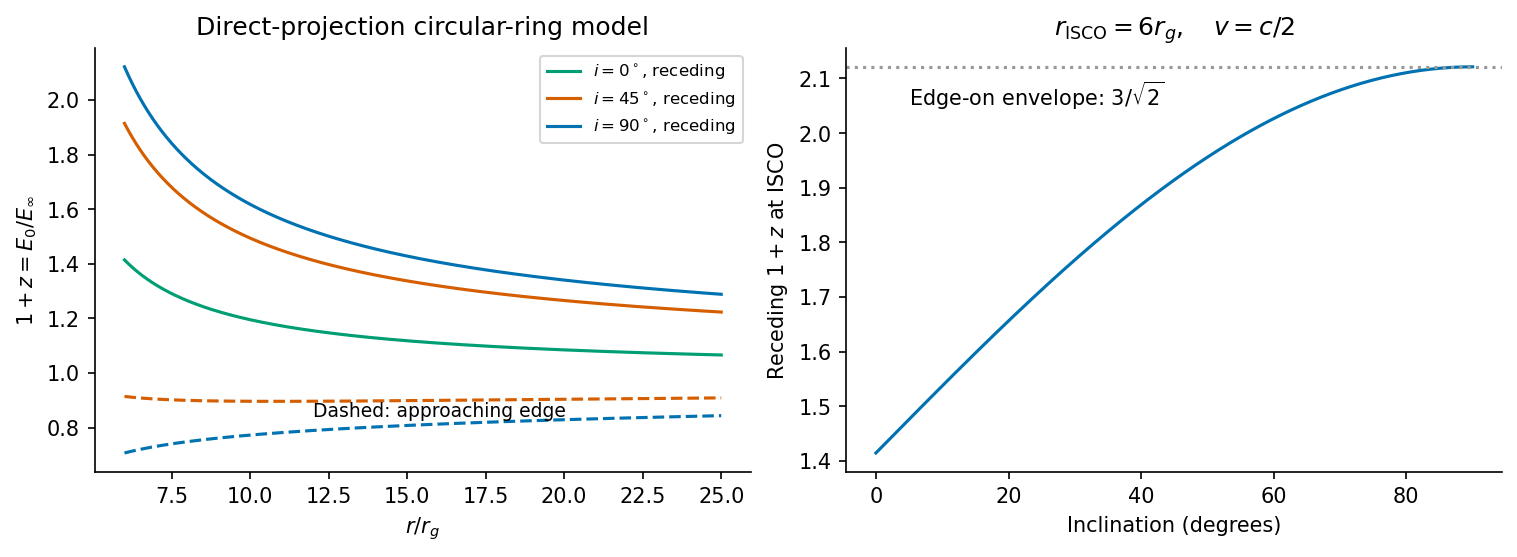
Original Schwarzschild circular-ring transfer calculation showing inclination dependence and the edge-on ISCO redshift envelope
. Details. The Kerr ISCO efficiency limits follow from equatorial circular orbits in the Kerr metric. Prograde motion has a smaller ISCO than the non-spinning case, while retrograde motion has a larger one. A zero-torque thin disc radiating the orbital binding energy before the gas plunges has efficiency , where is energy per unit rest-mass energy at infinity. The ideal limiting values areThus more orbital binding energy is available in the prograde inner disc. The extremal values are formal geodesic limits: photon capture, inner stresses, outflows and finite accretion thickness change the efficiency of real flows. An ISCO inside the ergoregion is not a claim that material or radiation escapes from inside the horizon.
For accretion output relative to galactic binding energy, distinguish accreted rest mass from the mass retained by the black hole. At constant radiative efficiency, building a hole from a negligible seed to emitsA non-negligible seed replaces by the actual mass increase. Let the first use of mean the total three-dimensional rms random speed. For an approximately virialized galaxy with negligible boundary term, and . The ratio to the magnitude of its gravitational potential energy is thereforeIf “binding energy” means the net energy needed to unbind the virialized system, , the ratio is twice as large. The widely used order-of-magnitude estimate drops the retained-mass correction and writes ; it should not be confused with a precisely fixed structural coefficient.
For the numerical parameters given,No efficiency is specified, so this function is the numerical result. For an explicitly chosen illustration , it is about , or relative to the net virial binding energy. The non-spinning zero-torque efficiency gives about relative to ; the ideal retrograde and prograde limits give about and , respectively. Spin affects the ratio through the adopted efficiency and orbital orientation, not through a universal rule that a larger unsigned spin always means a larger efficiency.
Such large energy ratios make even a modest coupling of the output to galactic gas dynamically important. Radiation and winds can heat or eject gas and reduce star formation or later black-hole feeding. For the illustration a percent-level coupling is already comparable to . Energy available is not energy necessarily deposited: cooling, escape directions, gas geometry, photon opacity and the duration of activity determine the actual feedback. It does not follow that the entire stellar galaxy must be disrupted.
For the swept-shell calculation, the problem now explicitly redefines as a one-dimensional line-of-sight dispersion. The specified isothermal profile hasNeglecting central-hole gravity and the shell's self-gravity, the inward force due to the remaining interior component isIn a single-scattering momentum-driven model with the shell intercepting the central luminosity, . At the hydrogen Eddington luminosity this becomes . Sustained outward acceleration against that weight requiresand henceThe radius cancels because the swept isothermal mass is proportional to . This is the isothermal-galaxy momentum-balance shell threshold, with its fourth-power dispersion scaling.
The coefficient identifies the approximations. Self-gravity in a thin spherical shell expansion adds the shell's inward pressure-equivalent force and replaces by . A shell intercepting only a fraction of the photon momentum needs a larger luminosity; Thomson-thin material does not automatically receive . Conversely, multiple scattering or an energy-driven hot wind changes the force model. A shell already carrying sufficient outward kinetic energy need not satisfy this instantaneous acceleration condition everywhere to escape. The printed inequality is the stated quasistatic, fully coupled momentum-balance estimate, not an assumption-free lower bound for every possible shell trajectory.
Past exam of the relativistic Astrophysics and Cosmology course of the University of Cambridge 2015 Paper 1 2 Solution by Codex 0 2026-10-20
Codex 0 2026-10-20Definitions and pressure convention. is the scale factor, cosmic time and dots time derivatives. is the gravitational constant, the speed of light, the mass-equivalent density of the material fluid and the spatial-curvature sign in this normalization. here has units of inverse time squared, rather than inverse length squared. Comparison of the acceleration equation with fixesThis is a pressure parameter, unrelated to Question 1's radiative efficiency. pressureless matter has and . When solving the generalized model below, is assumed constant.
Evidence for a positive vacuum component. Standardized Type Ia supernovae measure the luminosity-distance–redshift relation. Their corrected apparent magnitudes at cosmological distances imply greater distances than a decelerating matter-dominated model of comparable parameters, favoring late accelerated expansion. Light-curve standardization, interstellar extinction, selection bias and possible population evolution must be controlled rather than treating every supernova as an identical candle.[ref]
Observational Evidence from Supernovae for an Accelerating Universe and a Cosmological Constant by Adam Riess and others. Abstract and distance–redshift analysis
[ref]Measurements of Omega and Lambda from 42 High-Redshift Supernovae by Saul Perlmutter and others. Abstract and cosmological likelihood analysis
The cosmic microwave background and baryon acoustic oscillation measurements constrain geometry and matter density in combination. Near spatial flatness together with a subcritical matter density leaves room for an additional smooth component; cosmic ages and structure growth supply consistency tests. A positive cosmological constant fits these observations within the standard framework. They do not establish that every allowed dark-energy theory must be a strictly constant vacuum energy; the inference depends on the cosmological and gravitational model.
pressureless matter evolution. Set and . Since , eliminating givesFor , and . ThereforeOn the expanding Big-Bang branch with positive , chooseThe origin is the Big Bang; an arbitrary time translation would shift this origin. Integrating gives . At early times , while at late times .
Age and the density fractions. Dividing the flat constraint by , with , givesThe solution implies , soHere , using the printed megaparsec conversion. Taking one year as days givesFor the same , an Einstein-de Sitter universe hasA cosmic model must be older than its oldest objects, with additional time allowed for their formation. Old stellar populations are dated through stellar-evolution fitting, particularly the globular cluster main-sequence turnoff, with uncertainties from distances, composition and input stellar physics. A pre-examination globular-cluster age constraint on cosmology obtained a lower cosmic-age limit of after allowing for formation time. This conflicts with the model but is compatible with the calculation.[ref]
New Globular Cluster Age Estimates and Constraints on the Cosmic Equation of State and The Matter Density of the Universe by Lawrence M. Krauss and Brian Chaboyer. Abstract and stellar-age/formation-time analysis
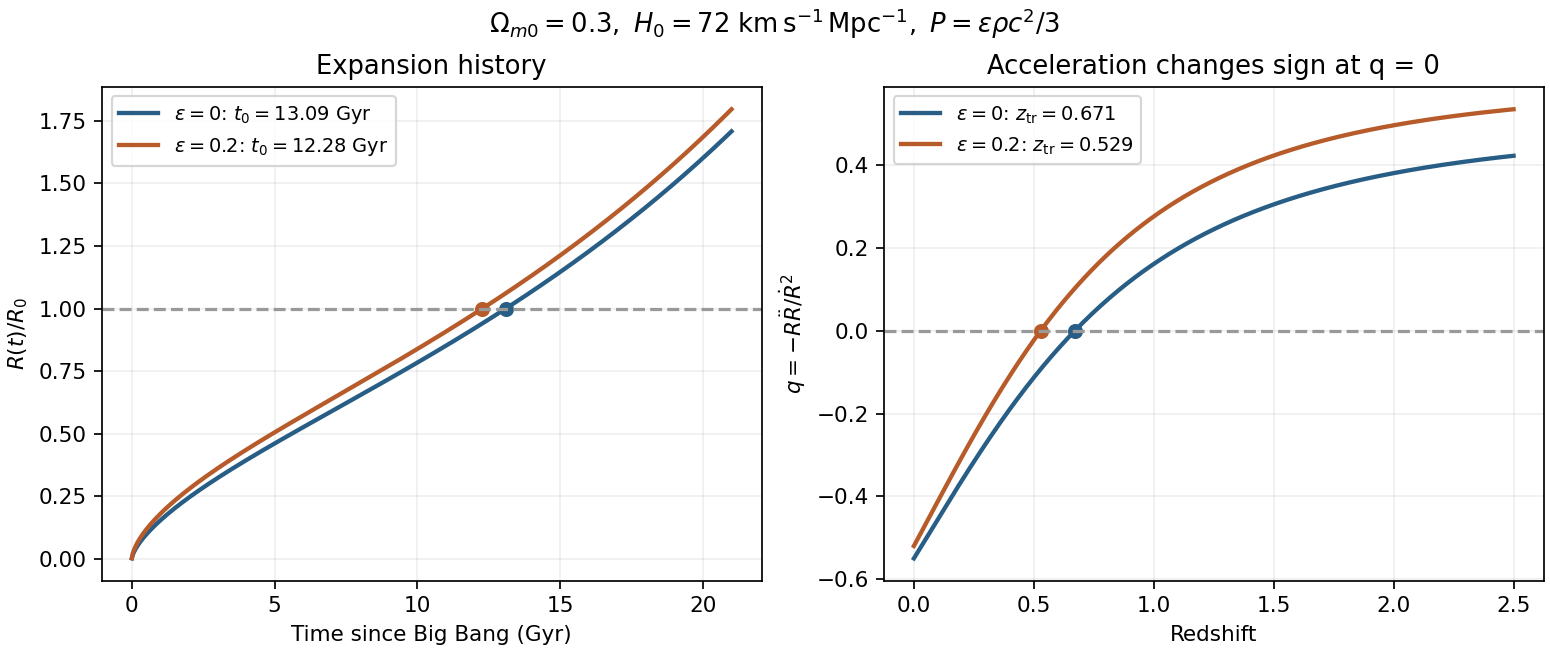
Individual stellar age estimates are not exact clocks, and the numerical is the result for the specified and matter fraction, not a claim to be a contemporary best-fit age.Constant nonzero pressure parameter. Eliminating before setting the pressure to zero instead givesHenceFor constant , the positive-density expanding Big-Bang branch isEquivalently use in the pressureless matter solution. The scale factor obeys , and the early limit is . The age of a flat barotropic matter-vacuum universe with the same present density fractions and isThusThe small positive pressure makes the early universe expand with a smaller age at the same late expansion parameters.
The acceleration transition. Normalize the present scale factor to one. Constant and the continuity equation give . Dividing the acceleration equation by givesAt the barotropic matter-vacuum acceleration transition its right-hand side vanishes. For the parameters here, , so the past transition isAt greater redshift the material term dominates and expansion decelerates; at smaller redshift vacuum energy dominates and expansion accelerates. The pressure factor belongs in the numerator of the gravitating material term; omitting it would confuse this model with pressureless matter.


There are unlisted articles, also show them or only show them.