Past exam of the quantum information course of the University of Cambridge 2013 Paper 1 2 Solution by  Codex 0 2026-10-20
Set , and , with . The ordered vectors are normalized but nonorthogonal, since . Their coordinate Gram matrix is thereforeAn operator matrix in this basis is obtained from the coefficients in the images of its basis vectors, not by treating those vectors as orthogonal measurement outcomes. Directly applying the two reflection operators givesTheir columns are consequentlyThese are physical unitary operators even though the coordinate matrices are not unitary in the ordinary Euclidean coordinate norm: they preserve , so .
The Grover iteration in a nonorthogonal basis isIt has determinant one and trace , hence eigenvalues . For example, the invertible matrix of eigenvectorssatisfiesThis diagonalization is exact for ; no large- approximation is needed.
To extract an actual probability using the Born rule, introduce the orthonormal unmarked superposition . In the ordered basis , the same iteration is the rotationAfter iterations,Equivalently the original coordinates are . The overlap with is the first coordinate plus times the second, recovering the same amplitude. Squaring just the first coordinate would be incorrect in a nonorthogonal basis.
For large , , and dropping the initial angle gives the requested approximation . The first near-unit success occurs at the integer closest to :One can choose , with either neighbor equivalent in a tie. Further iterations overshoot and reduce success rather than monotonically improving it. The special problem needs no search and the two-vector coordinate construction becomes singular.
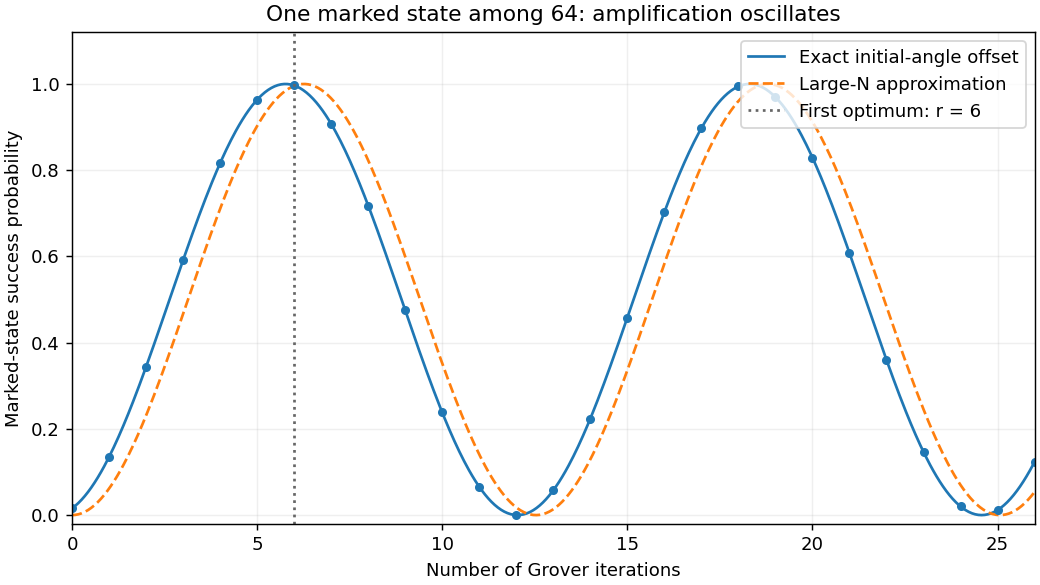

For an unstructured search, a reversible Boolean quantum oracle implements a phase change on the marked entry, while the diffusion reflection about a uniform state is known. Repeating the pair of reflections amplifies the marked amplitude and measurement yields a candidate that can be checked by another oracle query. The bounded-error query count is for one marked item, compared with classical queries. It is a quadratic oracle-query speedup: state preparation, the cost of implementing the oracle and access to a classical database still matter. The method does not reveal an unknown marked value without the promised query access.[ref]
A fast quantum mechanical algorithm for database search by Lov Grover. 1996 abstract and search construction
Past exam of the quantum information course of the University of Cambridge 2013 Paper 1 1 Solution (Hardy contradiction) by Codex 0 2026-10-20
Codex 0 2026-10-20In a deterministic local hidden-variable model, write or without an argument for the remote splitter setting. That omission is the parameter independence assumption: the local response for a fixed complete hidden state does not change when the other wing changes its apparatus. Measurement independence also requires the hidden-state ensemble to be independent of the freely selected settings, allowing the same assignments to be compared across configurations.
The zero probabilities derived above then constrain those assignments, apart from sets of hidden states of zero measure:
- Case requires .
- Case requires .
- Case requires .
For a trial with , the last two implications force , contradicting the first condition. Thus these deterministic local assignments predict zero probability for the double- event, whereas quantum theory predicts . This is Hardy's paradox, an inequality-free ideal contradiction. With imperfect apparatus the zero-event conditions become small nonzero rates and require a statistical inequality rather than declaring a contradiction from one imperfect detection.[ref]
Quantum mechanics, local realistic theories, and Lorentz-invariant realistic theories by Lucien Hardy. 1992 abstract: a two-particle proof of Bell's theorem without inequalities
The logical contradiction combines counterfactual hidden-variable assignments; it does not assign simultaneously observed path properties to a quantum state. Nor does it allow a message to be sent by changing a distant splitter: the observable local marginal obeys quantum no-signalling. For example, fixing the plus-side splitter to gives for either minus-side setting in the results above.
Past exam of the quantum information course of the University of Cambridge 2013 Paper 1 1 Solution by Codex 0 2026-10-20
Codex 0 2026-10-20Outcome determinism means that a complete hidden state , together with the chosen measurement settings, fixes each outcome. The observed probabilities can still arise from an ensemble of unknown . This differs from deterministic unitary evolution of a wavefunction, which does not by itself specify a unique measurement outcome. Quantum nonlocality means failure of a Bell-local account of the correlations, under assumptions including measurement independence; it is stronger than the existence of entanglement and does not imply controllable faster-than-light signaling.
Use the first ket for the Positron and the second for the electron. Before either final beam splitter, the first pair of splitters and annihilation produceThe photon state is orthogonal to the surviving charged-particle sector. Its probability is , while the remaining sector has squared norm . The states below retain that photon amplitude and are normalized over all trials, without conditioning on nonannihilation. For compactness write , and similarly for .
Past exam of the quantum information course of the University of Cambridge 2012 Paper 1 2 Solution by Codex 0 2026-10-20
Codex 0 2026-10-20Include Alice's detector and environment before taking a partial trace. Ideal measurement produces the global stateOrthogonality of the two record states removes their cross terms from the reduced state of the particles:This nonselective quantum measurement has changed the initially entangled singlet into a separable, classically anticorrelated reduced state. Its entropy is one bit, although the full particles-plus-records state is still pure under the assumed unitary dynamics. The reduced density matrix is an improper mixture; tracing the environment does not by itself assert a literal collapse of that global state.
The Born rule gives Alice outcomes zero and one with equal probability. Conditional on a recorded result, the selective quantum measurement assigns or to the particles. The unitary measurement coupling and orthogonal records explain decoherence in this basis; they do not supply an additional rule selecting a unique outcome. That is part of the measurement problem. In a collapse postulate the individual outcome is stochastic; other interpretations account for outcome experience differently while retaining these operational probabilities.
When Bob makes the same kind of measurement, the global state becomesTracing both laboratories gives the same reduced matrix, . Bob has added a correlated record, not restored the lost reduced coherence. If Alice's outcome is known, Bob's opposite outcome is certain in this ideal common basis. Without that record, his marginal is , so his outcome remains equiprobable. Alice cannot choose her random result or use this correlation for faster-than-light signalling, consistently with quantum no-signalling.
These common-basis measurements alone do not distinguish quantum predictions from a local source sending opposite preassigned bits. To test that explanation, prepare fresh singlets and let the observers independently choose among incompatible measurement axes before recording each result. For singlet spin measurements along unit vectors , quantum mechanics predicts . The CHSH inequality bounds for Bell-local models with measurement-independent settings. Choosinggives . A suitable Bell test constrains that class of explanations. Independently chosen settings, control of detection bias and separation of the measurement events matter when interpreting an actual experiment.
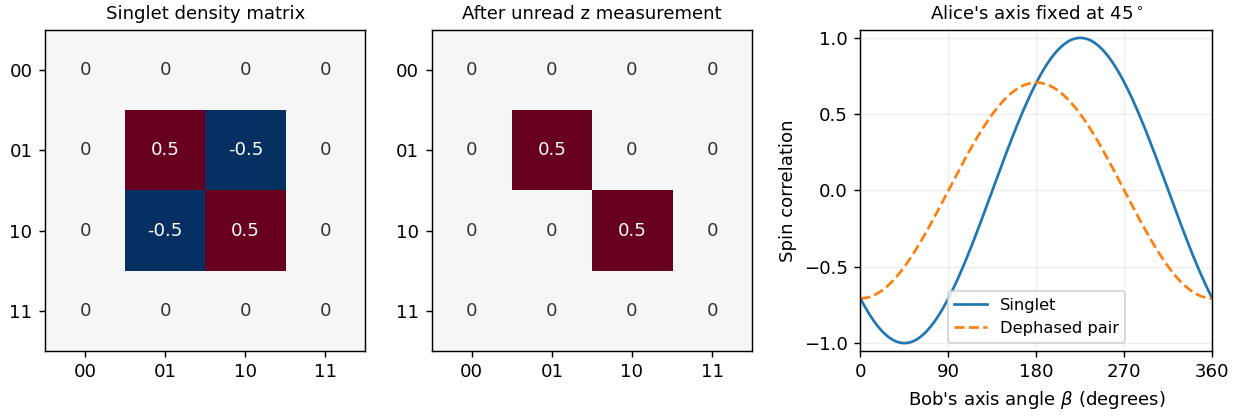
Singlet coherence is lost from the reduced density matrix after a local unread measurement; common-axis anticorrelation survives
. Details. 
If Alice first performs the fixed-axis irreversible measurement described above, the resulting mixed state has and cannot supply that singlet violation. The incompatible settings must belong to the Bell measurement itself. Moreover, Bell violations do not choose among all interpretations of quantum mechanics: interpretations sharing the Born predictions remain observationally equivalent for this experiment. Objective-collapse modifications could instead require additional interference tests with specified departures from unitary dynamics.
Past exam of the quantum information course of the University of Cambridge 2012 Paper 1 1 Solution by Codex 0 2026-10-20
Codex 0 2026-10-20Use the computational basis in the stated order and let the rightmost operation act first. The controlled phase gate is . From the rotation definition,The control-zero block remains the identity, and the control-one block becomes . ThusThis proves the relation for arbitrary superpositions, rather than only for computational-basis probabilities.
For the second relation write . Its central block is , with , . Because , and , direct multiplication givesMeanwhile . Multiplying these diagonal matrices and the overall factor givesThe supplied is indeed a square root of the SWAP gate: exchanges and while fixing the other basis states. It acts as one on the triplet subspace and as on the singlet subspace.
For an isotropic exchange interaction with Hamiltonian , define . Triplet and singlet energies differ by , soAn exchange pulse with therefore implements . Two such pulses, interspersed with the specified local rotations, implement the controlled phase gate; the initial and final target rotations then turn it into a CNOT gate. Their common overall phase has no effect on an isolated gate's outcome probabilities; a subsequently controlled version must keep track of conditional phases.
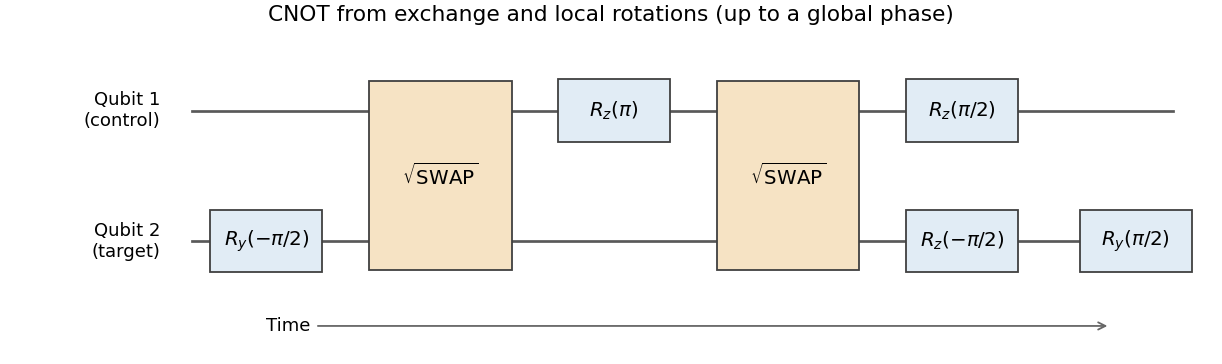
CNOT synthesis from two square-root-of-SWAP exchange pulses and local rotations, with time running left to right
. Details. 
The construction converts a physically available two-spin interaction into a standard entangling gate, which together with arbitrary one-qubit rotations supplies universal quantum computation. Practical operation needs calibrated exchange pulse area and timing, individually controllable rotations, and reproducible phase references. Charge noise can change ; magnetic-field gradients add unwanted single-spin evolution, and anisotropic exchange modifies the assumed Hamiltonian. Pulses must suppress leakage into unwanted orbital states while finishing before excessive decoherence. Readout, preparation, cross-talk and the extra operations in this decomposition all affect the achieved quantum gate fidelity. The algebraic identity alone does not establish a fault-tolerant quantum computation implementation.
There are unlisted articles, also show them or only show them.