Past exam of the quantum condensed matter course of the University of Cambridge 2015 Paper 1 4 Solution by  Codex 0 2026-10-20
Assume three-dimensional parabolic band edges, with density-of-states masses and one valley per edge, each with spin degeneracy two. Their effective densities of states areFor the semiconductor mass-action law, integrating the square-root density of states against the Boltzmann tail gives and . Multiplication cancels the chemical potential, givingIf there are additional valley degeneracies, multiply by their product; anisotropic bands use the appropriate density-of-states masses. In the later equal-mass model, . No numerical mass or valley multiplicity has been invented.
When , the conduction-edge occupation is exactly , so the nondegenerate approximation for electrons fails at every positive temperature. Define the Normalized complete Fermi-Dirac integralFor the carrier densities with chemical potential pinned to a band edge, with the two specified equal masses, put . Direct Fermi-Dirac integration then givesThus exactly within the parabolic model. At low temperature, is thermally activated; at , from below. Both vanish at zero temperature and increase at fixed chemical potential. The other states that pin can supply the compensating charge; one must not additionally impose .
For the Pauli reduction of the pinned-edge mass-action product, the exact product relative to the classical law isIt approaches at low temperature and in the formal high-temperature limit. The low-temperature activation factor is unchanged but its prefactor is reduced; the classical mass-action formula overestimates the product. The high-temperature limit here refers to the given unbounded parabolic bands, not a claim that real semiconductor band structures remain unchanged at arbitrarily high temperature.[ref]
Quantum Gases by David Tong. Sections 3.1 and 3.6.1–3.6.4: density of states, Fermi occupation and Sommerfeld expansion
Finally, for a fixed positive , the zero-temperature Fermi sphere has radius , soThe low-temperature expansion at fixed gives the fixed-chemical-potential Sommerfeld density increase:The monotonic density at fixed chemical potential in a square-root density of states initially rises quadratically from . For , its leading behaviour crosses to . The fixed chemical potential is what allows the particle number to change.
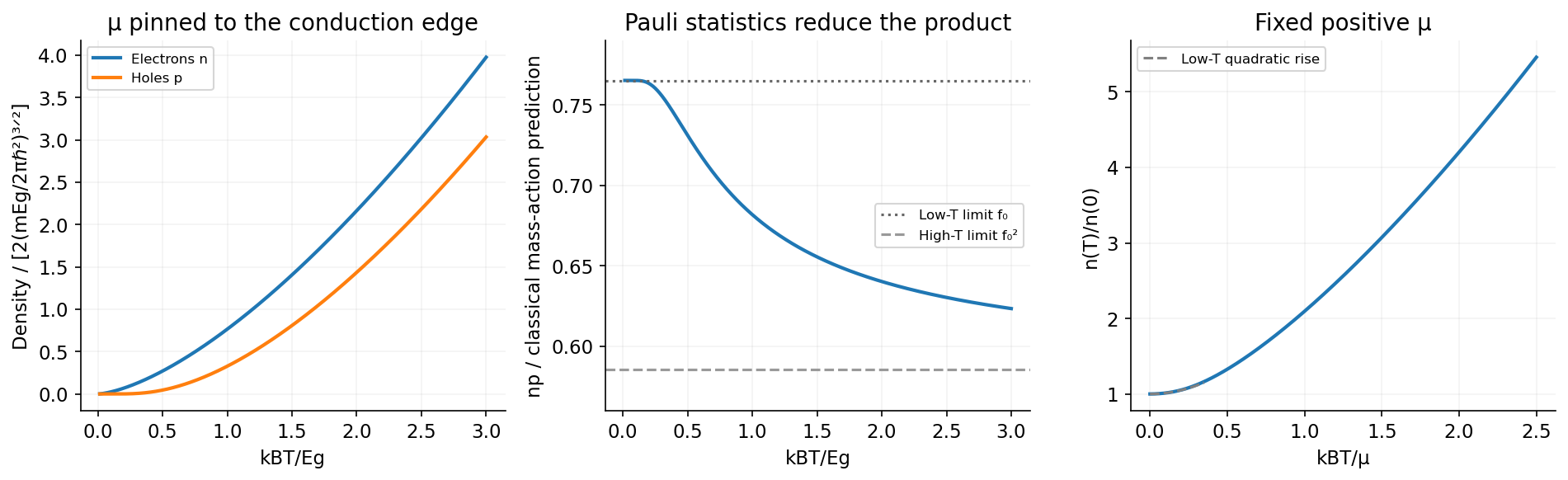
Pinning the chemical potential to or above a band edge changes carrier populations and the mass-action product
. Source. Details. Past exam of the quantum condensed matter course of the University of Cambridge 2015 Paper 1 3 Solution by Codex 0 2026-10-20
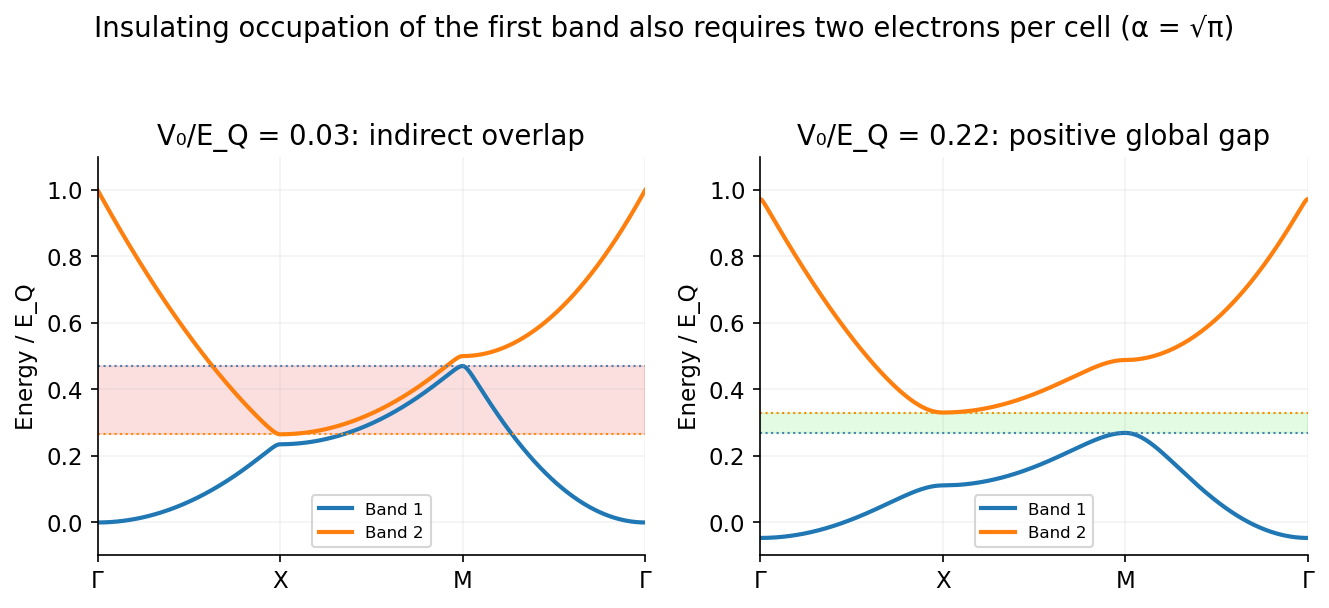
Codex 0 2026-10-20For a spin-degenerate band, each unit cell contributes two available states. An even electron count per cell can fill an integer number of bands; a band insulator additionally needs a global gap between the highest occupied and lowest unoccupied bands. Even filling alone is not sufficient when bands overlap.
For a free two-dimensional gas with spin degeneracy two,The reciprocal vectors of the periodic potential are and . Its first Brillouin zone is the square , of side and area ; the real-space cell has side .
At zero potential, the extended-zone Fermi surface is the circle of radius . Since , it crosses every square face but misses the corners. For Fermi-surface reconstruction in a weak square potential, weak positive potential opens gaps at the Bragg crossings: the second band has electron pockets at the two inequivalent edge centres , while unfilled regions of the first band form a hole pocket at the zone corner . Opposite edges are identified: four edge half-pockets are two electron pockets, and four corner pieces are one hole pocket.
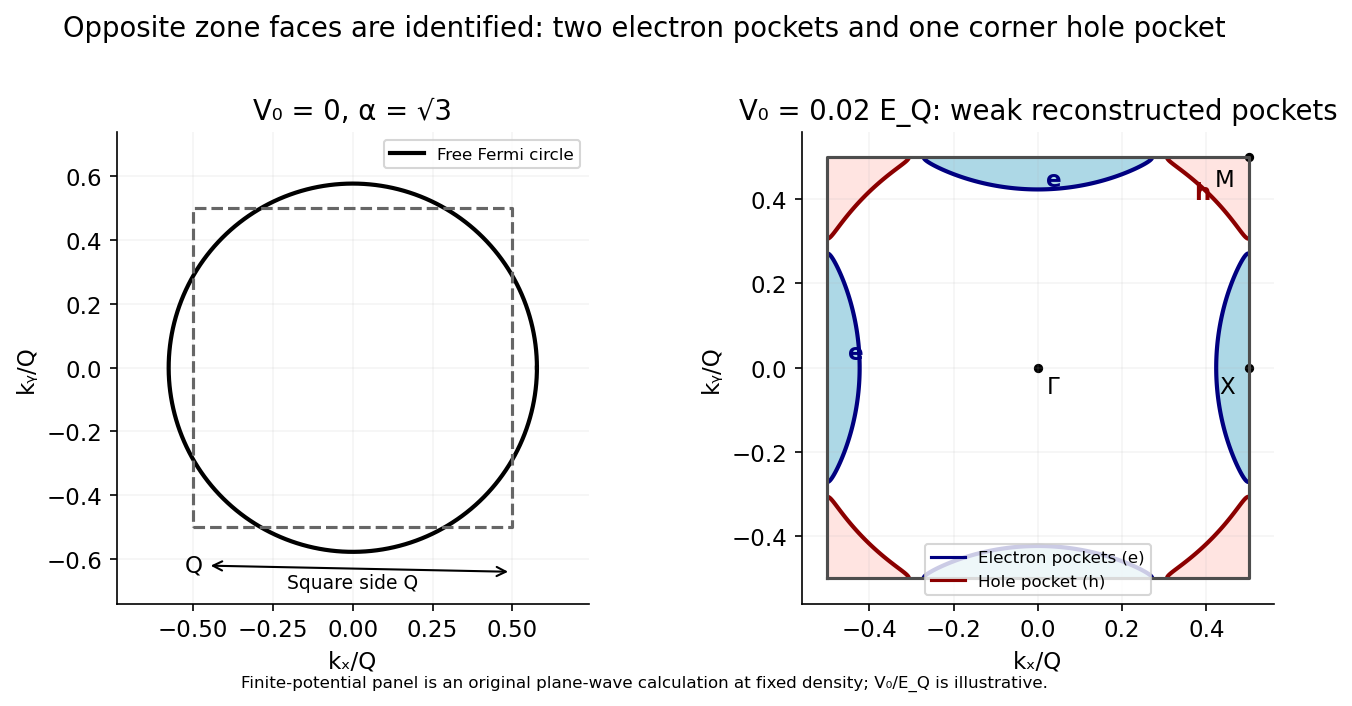
A square Brillouin zone reconstructs the free Fermi circle into edge-centred electron pockets and a corner-centred hole pocket
. Source. Details. For the circular-cap carrier count in a square Brillouin zone, put and . Each circular cap outside a square face has areaNo two such caps overlap in the specified interval. The total second-band electron area is . The first-band hole area is the square area minus the occupied central-circle area, . Including spin,Thus at ,The carrier densities are the electron- and hole-pocket counts, not the total electron density. The carrier compensation and even band filling in a square lattice follows because their difference obeys , so compensation occurs at . These area formulas are the limit, before finite-gap reconstruction changes the pocket shapes.[ref]
The filling per real-space cell is . In the given interval, the only even integer filling is , again requiring . At any other fixed filling a full gap cannot yield an ordinary spin-degenerate band insulator in this unchanged periodicity. In particular, the system retains excess electron carriers even after its holes disappear.
A rough gap threshold comes from comparing different symmetry directions, rather than only a direct zone-face gap. Define . The zone-face two-plane-wave gap for a cosine potential follows because each cosine couples plane waves by , giving the one-dimensional zone-edge levels . The four-plane-wave splitting at a square-zone corner is the sum of two such pairs. The potential is separable in , so to first orderThe indirect gap of a separable square cosine potential is consequentlyAt the compensated filling, this is , with . An insulator needs both the even filling and a positive indirect gap. At the touching threshold the gap is zero; a positive direct gap at every Bragg crossing is not by itself sufficient. The estimate neglects higher-plane-wave corrections and is not an exact critical amplitude.


Past exam of the quantum condensed matter course of the University of Cambridge 2008 Section B B3 Solution by Codex 0 2026-10-20
Codex 0 2026-10-20Let , so the initial conduction-electron kinetic energy is . In the normal momentum-conserving process with the final hole fixed at zero wavevector, the two final conduction electrons obey . Their total kinetic energy satisfiesEnergy conservation for impact ionization is . Consequently , givingThe bound is attained when ; opposite spins permit the two electrons to share that wavevector. Fixing the hole momentum is essential: a mobile final hole gives a different threshold. This is the threshold for impact ionization with a hole at zero momentum.
The two hot electrons subsequently redistribute energy by electron-electron collisions and transfer it to the lattice by electron-phonon scattering. Optical-phonon emission can provide large discrete losses while the electrons are hot; acoustic phonons dominate later small energy exchanges. Electron-electron collisions alone conserve the electron system's total energy and do not cool it into the lattice. The electron-hole pair eventually recombines radiatively or through nonradiative channels, such as defect-assisted recombination or Auger recombination. Recombination is distinct from the preceding intraband cooling.
There are unlisted articles, also show them or only show them.