Past exam of the chemistry course of the year 1 of the natural sciences course of the University of Cambridge 2023 Paper 1 3 b Solution by  Codex 0 2026-10-20
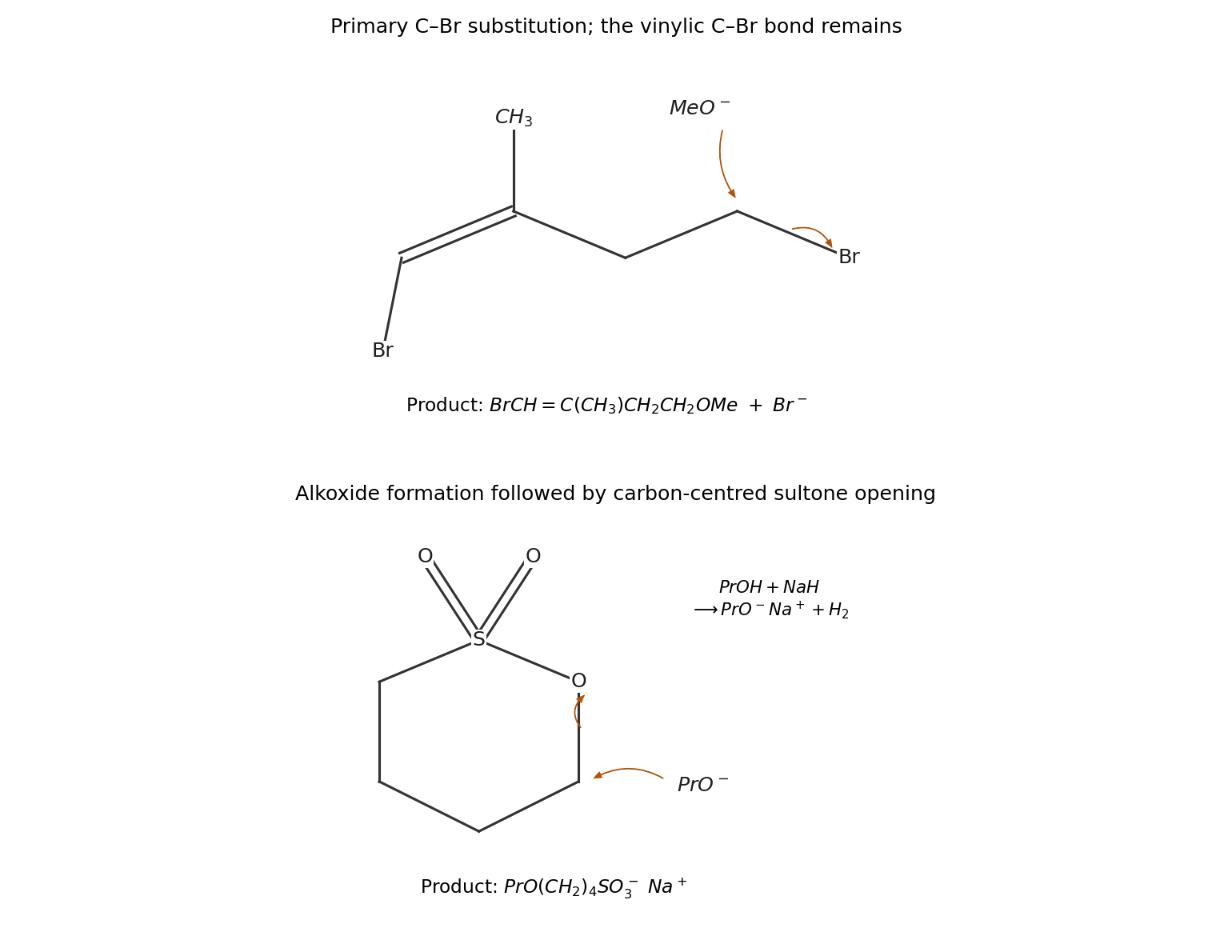
The first product is , with the original alkene geometry retained. methoxide attacks the primary saturated carbon bearing bromine from the backside. Its oxygen lone pair forms the new C–O bond as the C–Br bonding pair leaves with bromide. The other bromine is vinylic, directly bonded to an sp carbon: ordinary SN2 reaction is unfavourable there, and ionization would require an unstable vinyl cation. Thus the primary alkyl bromide is replaced selectively, rather than replacing the vinylic halide or moving the double bond. There is no observable inversion label at the attacked carbon because it is a methylene.
The second product is sodium 4-propoxybutane-1-sulfonate, . sodium hydride first removes the alcohol proton, giving propoxide and hydrogen. The propoxide oxygen then attacks the primary ring carbon bonded to the ring oxygen; simultaneous cleavage of that carbon–oxygen bond opens the sultone. The departing ring oxygen remains attached to sulfur as part of the resonance-stabilized sulfonate anion. The carbon attached directly to sulfur is not the substitution site, because cleavage there would not expel the same stable sulfonate leaving group. This is carbon-centred ring opening of a cyclic sulfonate ester, not addition across an S=O bond.

Past exam of the chemistry course of the year 1 of the natural sciences course of the University of Cambridge 2023 Paper 1 3 a Solution by Codex 0 2026-10-20
Codex 0 2026-10-20The ordering is allyl chloride 1-chloropropane 2-chloropropane. Iodide is a good nucleophile but a weak base, and polar aprotic solvent acetone favours its SN2 reaction. SN2 reaction and C–Cl cleavage occur in one step; precipitation of sodium chloride can also favour halide exchange without changing the basic steric comparison.
The primary saturated chloride supplies the reference rate. Allyl chloride is also primary, but its neighbouring pi system stabilizes the developing delocalized electronic structure in the substitution transition state. It can therefore react about 64 times faster without requiring a free allylic carbocation. The secondary chloride is sterically crowded at the attacked carbon, making backside approach and the crowded transition state less favourable; its rate is about 0.02 times the primary value. The leaving group and nucleophile are the same in the comparison, so assigning the ordering to different halide leaving groups would be incorrect. If prefactor differences are neglected, at 333 K gives roughly and for the allylic and secondary substrates respectively: modest barrier changes produce large rate ratios.
Past exam of the chemistry course of the year 1 of the natural sciences course of the University of Cambridge 2022 Paper 1 6 c Solution by Codex 0 2026-10-20
Codex 0 2026-10-20The simplest assignment is two phenylethynyl bridges and four equivalent terminal methyl groups, represented as . All 12 methyl protons then occupy the same class of environment, accounting for the single nonaromatic singlet without requiring methyl bridge/terminal averaging. The phenyl protons account for the aromatic-region signals; the metal-bound acetylide has no terminal acetylenic hydrogen.
An alkynyl bridge has electronic possibilities unavailable to a saturated methyl: in addition to sigma attachment from its carbon end to one Lewis acid centre, its occupied C≡C pi system can donate to the other aluminium. A delocalized sigma/pi description stabilizes the phenylethynyl-bridged arrangement while keeping the methyl groups terminal. One must not draw an unchanged localized triple bond plus two independent full ordinary Al–C bonds at the same carbon and count all of them as separate two-electron bonds. The exact distribution of sigma and pi donation requires structural or orbital evidence; this NMR observation alone does not supply a numerical bridge bond order.
The absence of concentration or temperature dependence is consistent with this preferred arrangement throughout the measured range. It is not proof that the molecule has no motion: exchange between symmetry-equivalent terminal positions, or exchange remaining fast throughout that range, could be spectroscopically invisible. Phenylethynyl bridging in this particular dimethylaluminium dimer has independent primary NMR precedent.[ref]
Organoaluminium compounds. XIII. Association through aryl and phenylethynyl bridges by E. A. Jeffery and others. 1968, printed p. 137, summary: phenylethynyl groups bridge dimethyl(phenylethynyl)aluminium dimers
There are unlisted articles, also show them or only show them.