Past exam of the chemistry course of the year 1 of the natural sciences course of the University of Cambridge 2023 Paper 1 6 d Solution by  Codex 0 2026-10-20
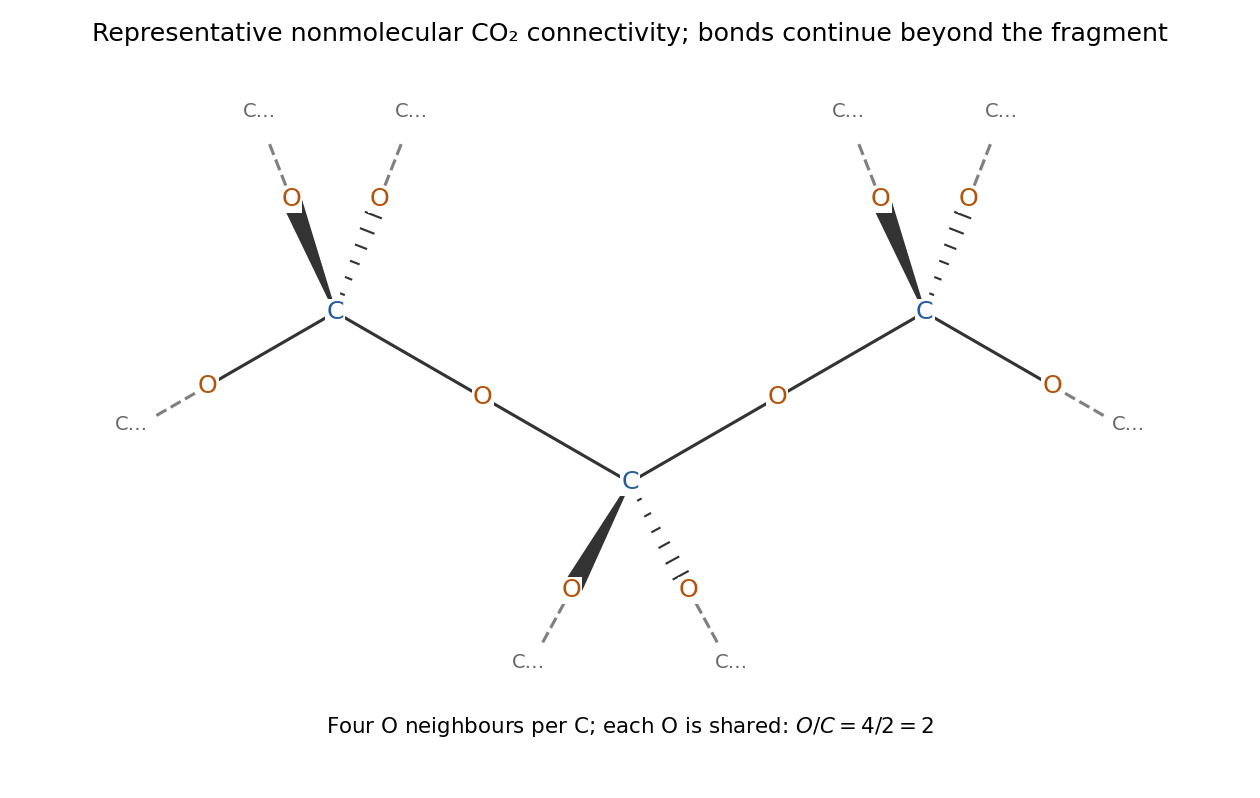
A suitable representative structure is a three-dimensional network of corner-sharing CO tetrahedra, with C–O single bonds. Each carbon is four-coordinate; every bridging oxygen is bonded to two carbons. Sharing four oxygens between two tetrahedra gives oxygens per carbon, so the network retains empirical formula CO without containing separate O=C=O molecules.
High pressure favours a compact, highly coordinated network through its smaller molar volume: at fixed temperature, increasing pressure changes relative Gibbs energies according to . Heating helps overcome the large reconstructive barrier to breaking and redistributing molecular pi bonding and establishing an extended single-bond network. It should not be argued that high temperature by itself favours the lower-entropy network. Nor is merely freezing molecular CO sufficient: dry ice remains a molecular solid.
The sketch shows connectivity and local tetrahedral coordination, not a unique predicted crystal structure. Real amorphous carbonia need not have perfect periodic order or exclusively one coordination environment. The original carbonia experiments combined high-pressure preparation with infrared, Raman and diffraction evidence for loss of molecular character and formation of an amorphous network.[ref]
Amorphous silica-like carbon dioxide by Mario Santoro and others. Abstract: spectroscopy and diffraction evidence for amorphous nonmolecular CO2
Past exam of the chemistry course of the year 1 of the natural sciences course of the University of Cambridge 2023 Paper 1 6 c Solution by Codex 0 2026-10-20
Codex 0 2026-10-20CO and CO are discrete molecules, whereas the other oxides gain stability from extended bonding or ionic lattices. carbon's compact 2p orbitals overlap effectively with oxygen 2p orbitals, allowing strong multiple bonds that satisfy the valence requirements within small molecules. Intermolecular forces between CO or CO molecules are much weaker than those internal bonds, so low condensation temperatures and gaseous states at room conditions are unsurprising. CO is nonpolar overall but still has London dispersion forces and interactions between electric quadrupoles; “nonpolar” does not mean no attraction.
For larger Group 14 atoms, overlap with oxygen 2p orbitals is less effective for strong localized multiple bonding. SiO instead forms an extended network of SiO tetrahedra with each oxygen bridging two silicon atoms. Breaking or melting the network involves much more than separating intact SiO molecules. The Si–O electronegativity difference is , so these are strongly polar covalent bonds rather than evidence for a molecular solid.
For Pb–O the difference is , and ionic Pb/O or Pb/O descriptions provide useful starting points, with appreciable covalent contributions. PbO has layered structures with asymmetric oxygen coordination consistent with a stereochemically active 6s pair. A common PbO structure is rutile-like, with PbO octahedra linked through oxygen. Extended lattice interactions account for their solid states.[ref]
https://doi.org/10.1103/PhysRevLett.107.246402. Geometry and Electronic Structure: rutile PbO2, six-coordinate Pb and three-coordinate O
The similar Si–O and Pb–O electronegativity differences show why a single difference threshold cannot determine the entire bonding type, coordination number or structure. Past exam of the chemistry course of the year 1 of the natural sciences course of the University of Cambridge 2023 Paper 1 6 a Solution by Codex 0 2026-10-20
Codex 0 2026-10-20The large drop from carbon to silicon is the main trend; the smaller reversals at Ge and Pb reflect changes in shielding and valence-electron binding. Allen electronegativity is based on the mean binding energy of valence electrons in free ground-state atoms, rather than an arbitrary charge-transfer count. Moving to larger principal shells generally makes the valence electrons more diffuse and more shielded, reducing their attraction to the nucleus. carbon's compact second-shell valence orbitals therefore give particularly high electronegativity.
The intervening filled 3d shell shields imperfectly, increasing effective nuclear attraction in germanium relative to a simple smooth extrapolation from silicon. This helps explain Ge being slightly above Si rather than below it. Increased size then lowers Sn relative to Ge. The filled inner d and f shells and relativistic stabilization of lead's 6s electrons modify the next step; contraction and stronger binding of the 6s contribution help Pb lie slightly above Sn. The small reversals should not obscure the much larger C-to-Si change. The spectroscopic definition includes both occupied s and p valence contributions, so the relativistic s effect can influence the Allen average even though not every electron participates equally in every bond.[ref]
Electronegativity is the average one-electron energy of the valence-shell electrons in ground-state free atoms by Leland C. Allen. Definition of the valence-shell spectroscopic average
Past exam of the chemistry course of the year 1 of the natural sciences course of the University of Cambridge 2023 Paper 1 4 d Solution by Codex 0 2026-10-20
Codex 0 2026-10-20For a reversible temperature change at constant pressure and fixed composition, and . HenceWith , termwise integration yieldsThe last sign follows from integrating , not . Every term has units ; the logarithm has a dimensionless argument. Inserting 800 K gives an entropy increase of , and thereforeThe standard pressure remains fixed during this integration; the 200-bar equilibrium mixture is not the standard state. Differentiating the integrated expression recovers , providing a check on all five terms. Using the ammonia heat-capacity polynomial here does not retroactively replace the explicitly requested constant-reaction-enthalpy approximation in the preceding equilibrium calculation.
Past exam of the chemistry course of the year 1 of the natural sciences course of the University of Cambridge 2023 Paper 1 4 c Solution by Codex 0 2026-10-20
Codex 0 2026-10-20Using the equilibrium constant calculated without premature rounding,Then givesThe sign agrees with the reduction in gas stoichiometric amount. The standard reaction entropy is not the absolute entropy of ammonia: its stoichiometric coefficient is two. ThereforeThis is an absolute standard molar entropy inferred within the paper's thermodynamic approximations, not a claim that elemental gases have zero absolute entropy. Only their standard enthalpies of formation are zero in this calculation.
Past exam of the chemistry course of the year 1 of the natural sciences course of the University of Cambridge 2023 Paper 1 4 b Solution by Codex 0 2026-10-20
Codex 0 2026-10-20The two remaining partial pressures sum to bar. Their ratio therefore gives bar and bar. With the ideal-gas activity approximation and bar,The equilibrium constant is dimensionless: pressures enter as ratios to the standard pressure. Blindly substituting pressures in pascals into an unnormalized expression would give a different, incorrect thermodynamic .
The standard reaction enthalpy is per mole of reaction as written, because the elements are in their reference states. ThusThis calculation uses the supplied constant-enthalpy simplification. At 200 bar, an accurate thermodynamic treatment would use chemical fugacities rather than ideal partial pressures; no chemical fugacity coefficients are supplied. The iron catalyst changes the approach to equilibrium, not its thermodynamic value.
Past exam of the chemistry course of the year 1 of the natural sciences course of the University of Cambridge 2023 Paper 1 4 a Solution by Codex 0 2026-10-20
Codex 0 2026-10-20Let be Gibbs free energy, enthalpy and thermodynamic temperature for a fixed amount and composition of material, with the derivative taken at constant pressure. Apply the Gibbs–Helmholtz equation to the standard molar reaction quantities, obtained by summing product minus reactant contributions with their stoichiometric coefficients:Define as the dimensionless thermodynamic equilibrium constant expressed using activities in specified standard states. Since , where is the molar gas constant,If the reaction enthalpy is constant over the interval, integration givesThis is the requested Van't Hoff equation. For an exothermic reaction, increasing temperature decreases . Although the name “isochore” is often used in this context, the displayed enthalpy form follows from standard Gibbs energies and the stated constant-pressure Gibbs–Helmholtz identity; the analogous ideal-gas concentration form involves internal energy when the temperature dependence of standard concentration is retained.
Past exam of the chemistry course of the year 1 of the natural sciences course of the University of Cambridge 2023 Paper 1 3 d Solution by Codex 0 2026-10-20
Codex 0 2026-10-20Build the phenethyl grignard reagent, use one portion to make a phenethyl-substituted ester, and add two further equivalents to that ester. Write ; the target is , so all three carbon substituents must be phenethyl, not benzyl.
hydroboration followed by oxidation of styrene gives : use in a suitable ether, followed by alkaline hydrogen peroxide. The Anti-Markovnikov addition regiochemistry is essential; acid-catalysed Markovnikov addition of water would give the wrong alcohol. Convert the primary alcohol to with phosphorus tribromide, then form with magnesium in dry ether. The organomagnesium reagent must be prepared and used without a protic solvent.
carboxylate one portion with carbon dioxide and acidify to obtain , then esterify with ethanol under acid catalysis to give . Treat the isolated ester with at least two equivalents of another portion of and then perform an aqueous acidic work-up:The first addition to the ester gives a ketone after ethoxide elimination; the second addition gives the tertiary alkoxide. Work-up supplies its OH proton. The extra central carbon comes from carbon dioxide, and each original styrene contributes one intact eight-carbon phenethyl unit. The resulting carbon count is , matching the target skeleton.
Past exam of the chemistry course of the year 1 of the natural sciences course of the University of Cambridge 2023 Paper 1 3 c Solution by Codex 0 2026-10-20
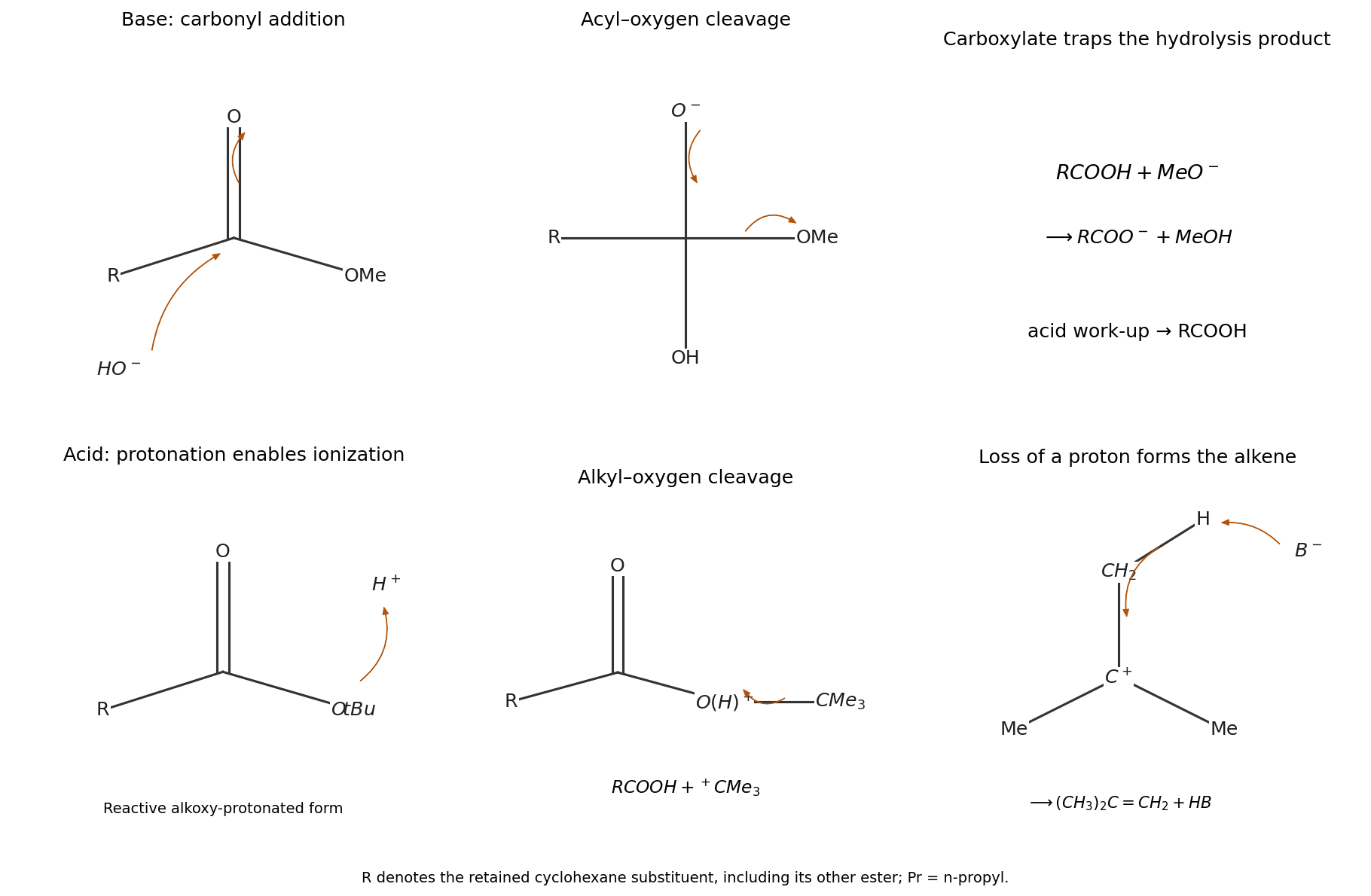
Codex 0 2026-10-20Aqueous base selectively converts the methyl ester to a carboxylate, and brief acidification gives the corresponding monoacid while retaining the tert-Butyl ester. At the methyl-ester end, a hydroxide lone pair attacks the acyl carbon and the carbonyl pi pair moves to oxygen. The tetrahedral intermediate collapses as the oxygen anion reforms C=O and the acyl C–OMe bond breaks to methoxide. proton transfer then gives the carboxylate and methanol. carboxylate formation makes the net saponification effectively irreversible under the basic conditions; protonation protonates that carboxylate.
The tert-Butyl ester reacts more slowly under these conditions because its bulky alkoxy group hinders acyl attack, and tert-butoxide is a stronger base and poorer leaving group than methoxide. The selectivity is kinetic, not an assertion that tert-butyl esters can never undergo base hydrolysis. The work-up should be sufficiently mild and brief to avoid the separate acid-labile pathway.
Anhydrous trifluoroacetic acid instead removes the tert-butyl group, leaving the methyl ester. protonation activates the ester; in a useful reactive protonation form the alkoxy oxygen bears the proton. The O–C(tert-butyl) bond then cleaves with its electron pair going to oxygen, producing the carboxylic acid and a tert-butyl-cation-like fragment. Loss of a methyl proton gives 2-methylpropene and regenerates the acid catalyst. Carbonyl-oxygen protonation and charge delocalization can precede cleavage; drawing alkoxy-oxygen protonation is a transparent way of tracking the bonds broken. The key distinction is alkyl–oxygen cleavage here versus acyl–oxygen cleavage in the base reaction. Methyl-cation formation is strongly unfavourable, and without water ordinary acid-catalysed methyl-ester hydrolysis is not available. No water is required to account for the tert-butyl deprotection or its alkene by-product.


There are unlisted articles, also show them or only show them.