Past exam of the chemistry course of the year 1 of the natural sciences course of the University of Cambridge 2024 Paper 1 3 b Solution by  Codex 0 2026-10-20
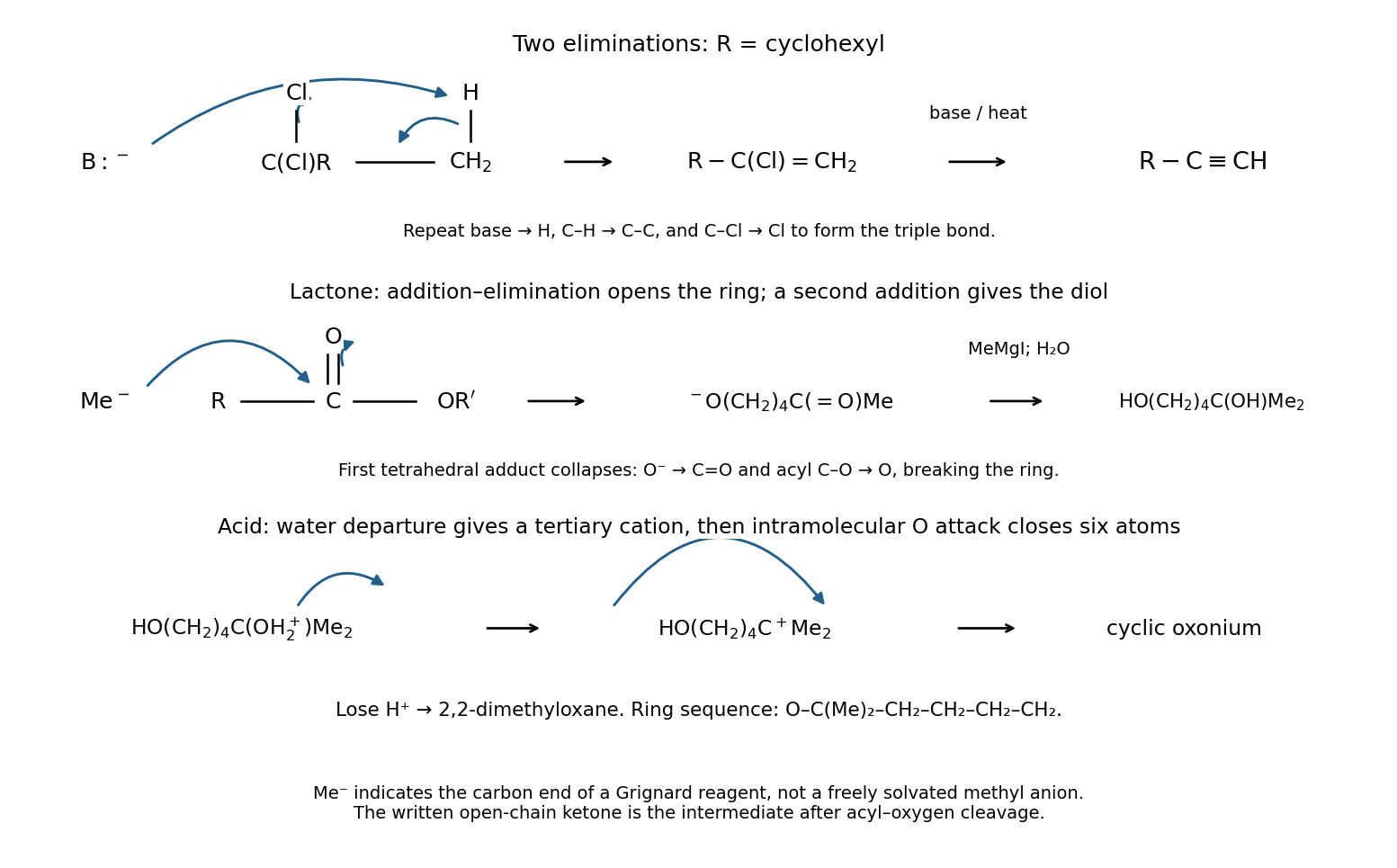
The first transformation is two successive dehydrohalogenations; the second opens the lactone by two methyl additions and then closes a six-membered cyclic ether. Both schemes must be accounted for within this part.
For the dichloride, write . In the product-forming path, tert-butoxide removes a hydrogen from the methyl group of . Draw arrows from the base lone pair to H, from C–H into the C–C bond, and from C–Cl to Cl. This E2 elimination gives . A second base-induced elimination removes a vinyl hydrogen and the remaining chloride, forming . The second elimination is more demanding because a vinylic bond is involved, consistent with the strong-base, heated conditions. This route explains the displayed product without asserting that no other elimination regioisomer can ever form.
For the lactone, a methyl equivalent from methylmagnesium iodide attacks the ester carbonyl carbon, with its pi pair moving to oxygen. Collapse of the tetrahedral intermediate reforms C=O and cleaves the acyl–oxygen bond, opening the ring to the magnesium alkoxide corresponding to . The newly formed ketone is more susceptible to a second methyl addition; its pi pair again moves to oxygen. After water workup, the product is the diol .
Under acid and heat, protonate its tertiary OH, then move the C–O pair onto oxygen as water leaves. The resulting is trapped intramolecularly by the remaining primary-alcohol oxygen. Its lone pair forms the closing O–C bond, producing a six-membered cyclic oxonium ion. Deprotonation yields 2,2-dimethyloxane, also called 2,2-dimethyltetrahydropyran. Ring closure retains four chain methylenes; it does not form a five-membered ring. The two methyl groups both derive from the two equivalents of Grignard reagent.

Past exam of the chemistry course of the year 1 of the natural sciences course of the University of Cambridge 2024 Paper 1 3 a Solution by Codex 0 2026-10-20
Codex 0 2026-10-20The most acidic sites are: acetic-acid O–H, ; phenol O–H, ; ethanal alpha-CH, –; propyne terminal ≡C–H, . These are ordinary approximate organic-chemistry estimates; exact acidities depend on solvent and reference convention.
Acetic acid gives a carboxylate in which negative charge is delocalized over two oxygens through equivalent resonance structures. Phenol gives a phenoxide with delocalization into the aromatic system, but its important contributors are less equivalent and do not stabilize the charge as effectively as a carboxylate.
For ethanal, removal of a methyl hydrogen gives the enolate . The aldehydic hydrogen is not the preferred acidic site: removing it does not give this alpha-carbon/oxygen delocalization. For propyne, loss of the terminal hydrogen gives an acetylide with a lone pair in an orbital. Its greater s character stabilizes negative charge relative to an ordinary or carbanion; the methyl hydrogens are much less acidic.
Past exam of the chemistry course of the year 1 of the natural sciences course of the University of Cambridge 2024 Paper 1 2 h Solution by Codex 0 2026-10-20
Codex 0 2026-10-20The two carbon skeletons are allene, , and propyne, . “Linear” describes the three-carbon skeleton; it does not mean every hydrogen lies on the same line.
For allene, use the contributor . A terminal lone pair attacks a water hydrogen while the O–H pair returns to oxygen, giving and hydroxide. Repeat at the still-dianionic end, then protonate each remaining terminal carbanion. The four successive proton transfers givewith two hydrogens placed on each terminal carbon in this branch.
For propyne, the resonance contributor makes the alternative electron flow clear. Three successive protonations of the singly bonded terminal carbon convert its three lone pairs into C–H bonds; protonation of the acetylide end gives . These are formal protonation pathways for the multiply charged anion, not a claim that the highly charged resonance contributors are separately isolable species. Each transfer produces ; overallAllene has one proton resonance integrating to 4H, ideally a singlet because its four hydrogens are chemically equivalent. Proton-decoupled carbon NMR has two resonances, in ratio two terminal carbons to one central carbon: approximately and ppm, respectively. The unusually downfield central cumulene carbon is not a carbonyl.
Propyne has two proton resonances, integrating 3H near – ppm and 1H near – ppm. If the small four-bond coupling is resolved, they are a methyl doublet and an acetylenic quartet; if unresolved, each can look like a singlet. Proton-decoupled carbon NMR has three resonances: one methyl carbon near ppm and two distinct sp carbons around – ppm. These are approximate predictions, not supplied measured shifts.
Past exam of the chemistry course of the year 1 of the natural sciences course of the University of Cambridge 2024 Paper 1 2 g Solution by Codex 0 2026-10-20
Codex 0 2026-10-20The intended ordinary-carbide comparison is energetic: the smaller, more strongly polarizing can stabilize a different balance of lattice energy and carbon-anion bonding from the larger . Stabilization of the highly charged group competes with acetylide formation; electron counting alone does not require the same carbide stoichiometries for both metals. Ionic size and charge density provide a qualitative explanation, not a complete phase-stability calculation.
The literal claim that calcium has only one carbide is too broad. Primary calculations and high-pressure synthesis have established additional calcium carbides, including and ; known calcium-carbide chemistry also includes . Thus the conventional comparison must be limited to the familiar salt-like compounds and conditions intended here, rather than treated as a prohibition on other calcium–carbon compositions.[ref]
Investigation of exotic stable calcium carbides using theory and experiment by Yan-Ling Li and others. 2015, abstract, Ca2C3 section and experimental synthesis
Past exam of the chemistry course of the year 1 of the natural sciences course of the University of Cambridge 2024 Paper 1 2 f Solution by Codex 0 2026-10-20
Codex 0 2026-10-20The extra electron associated with trivalent lanthanum weakens the C–C bond by occupying states with C–C antibonding character. Calcium gives the ten-valence-electron acetylide description , with formal bond order three, consistent with the short pm distance.
A fully ionic count for gives . The eleventh valence electron then enters a orbital, giving the simple estimate . This explains the longer pm bond. In the actual solid that electron is not necessarily localized on an isolated radical: metal–carbon mixing and band delocalization make “triple bond plus partial antibonding occupation” more appropriate than an exact isolated-ion bond order. Bond length alone does not determine a unique numerical bond order.
Past exam of the chemistry course of the year 1 of the natural sciences course of the University of Cambridge 2024 Paper 1 2 e Solution by Codex 0 2026-10-20
Codex 0 2026-10-20The acetylide has ten valence electrons, two more than neutral . They fill the p-derived sigma bonding orbital, giving the formal configuration above the cancelling pair. Its bond order is three, with the Lewis structure and a lone pair at each end; each carbon is approximately hybridized.
The tricarbide has valence electrons and is isoelectronic with carbon dioxide. The cumulene contributor has a central carbon, two sigma bonds and two perpendicular pi bonds. The end carbons each have two lone pairs and can be described with an localized basis. Its two C–C bonds have formal order two in this model; the central C–C–C angle is . Other resonance contributors help describe its protonation chemistry.
Past exam of the chemistry course of the year 1 of the natural sciences course of the University of Cambridge 2024 Paper 1 2 d Solution by Codex 0 2026-10-20
Codex 0 2026-10-20The elementary valence-MO model gives . Each carbon supplies four valence electrons, so fill eight electrons in the ordering appropriate to the lighter second-row diatomics:The two orbitals are degenerate, as are the two orbitals. The bonding and antibonding occupations cancel; four net p-bonding electrons remain, giving . Mixing between sigma orbitals of compatible symmetry places the occupied pair below the empty p-derived orbital in this diagram. All occupied orbitals are paired.
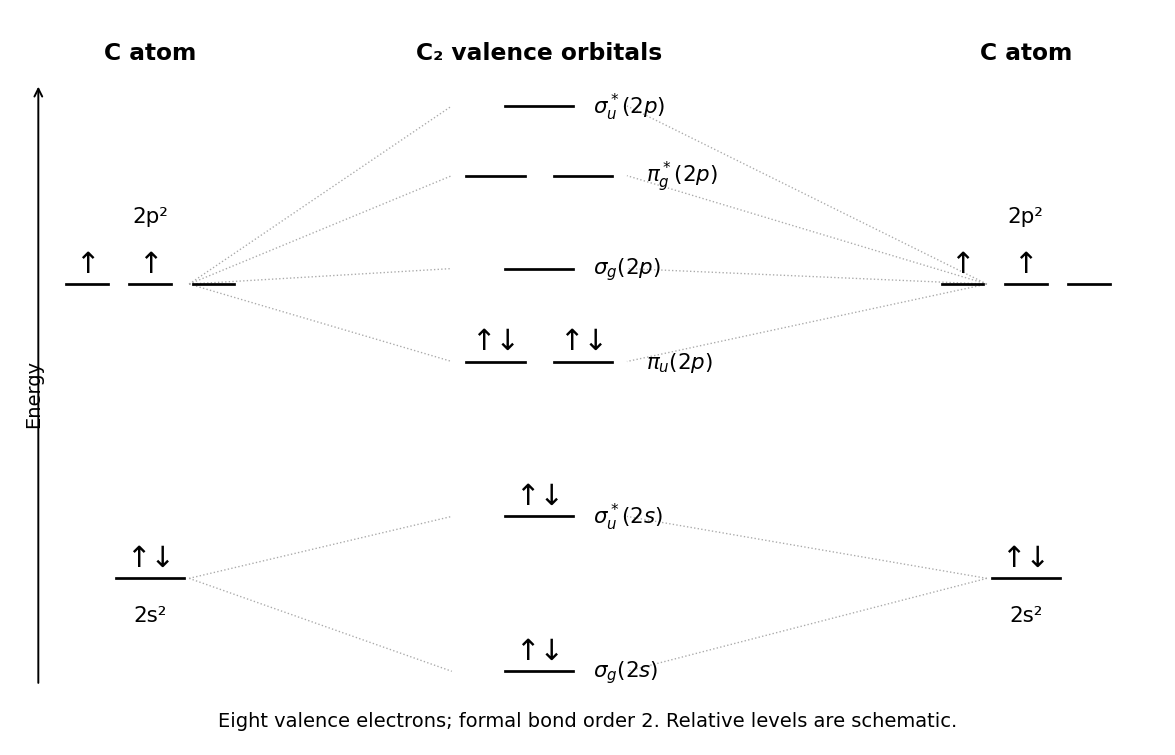
Original valence molecular orbital energy diagram for carbon dimer, with atomic inputs and symmetry labels
. Details. 
The omitted orbitals form filled and levels. Their contributions to the formal bond order cancel, and their low energies and small spatial extent make them largely core-like. Omitting them simplifies this valence diagram without claiming they do not exist or have exactly no effect on molecular energies.
Past exam of the chemistry course of the year 1 of the natural sciences course of the University of Cambridge 2024 Paper 1 2 c Solution by Codex 0 2026-10-20
Codex 0 2026-10-20The product is carbonic acid, . The oxygen lone pair Homo of water donates into the carbon-centred component of the carbon dioxide LUMO. Draw an electron-pair arrow from the water oxygen to carbon and a second from one C=O pi bond onto its oxygen:The first step bends the original linear electrophile and gives carbon three oxygen neighbours; carbon is approximately trigonal planar in the resulting carbonate framework. Proton transfer from the oxonium oxygen to the negatively charged oxygen produces the neutral acid. In real water, solvent molecules relay that proton rather than requiring a strained isolated intramolecular transfer. The forward mechanism does not assert that most dissolved carbon dioxide is present as carbonic acid at equilibrium.
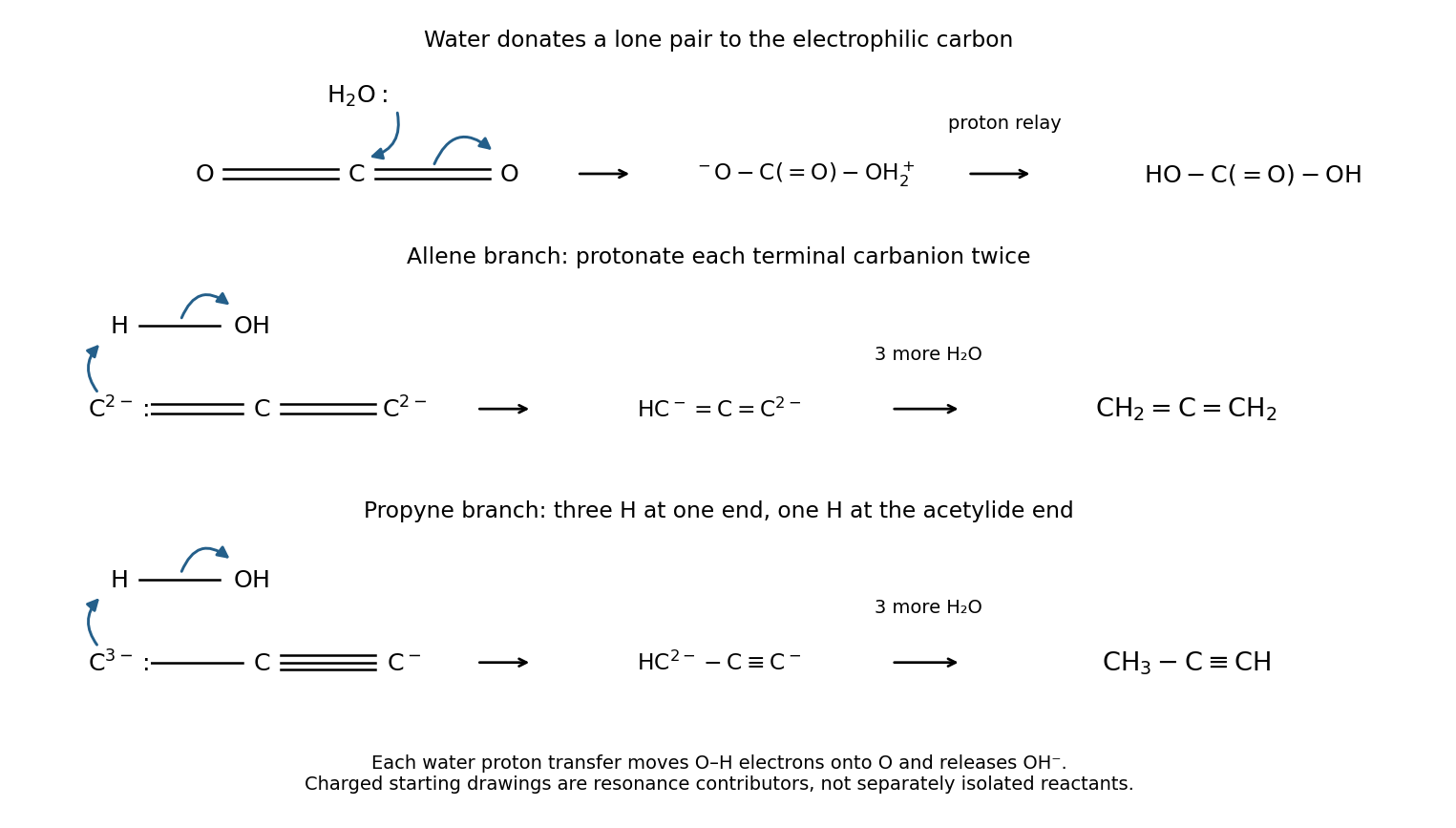
Original electron-pair arrows for carbon dioxide hydration and protonation routes from the tricarbide ion
. Details. 
Past exam of the chemistry course of the year 1 of the natural sciences course of the University of Cambridge 2024 Paper 1 2 b Solution by Codex 0 2026-10-20
Codex 0 2026-10-20The central carbon in carbon dioxide has two bonding directions and no lone pair, whereas the central oxygen in ozone has two bonding directions and one lone pair. In the VSEPR model, carbon dioxide therefore has a linear arrangement; ozone has an approximately trigonal-planar electron-domain arrangement but a bent atomic skeleton. Multiple bonding occupies one direction for this geometrical count. The extra central-oxygen lone pair, rather than a different number of atomic nuclei, creates the difference.
Past exam of the chemistry course of the year 1 of the natural sciences course of the University of Cambridge 2024 Paper 1 1 b Solution by Codex 0 2026-10-20
Codex 0 2026-10-20The carbon spectra are A → 5, B → 8, C → 6, and D → 7. Number each acyclic acid or ester chain from its carbonyl carbon. The assignments below account for every carbon-13 NMR environment.
For A, both ketone carbonyl carbons have ppm and all four methylene carbons have ppm. Molecular symmetry and rapid conformational averaging explain why six carbons give only two resonances.
For B, written , assign , , , , , and ppm. The alternation among vinylic chemical shifts reflects polarization of the conjugated chain, especially the deshielded carbon beta to the carboxyl group.
For C, written , assign the carbonyl at , the adjacent sp carbon at , the other sp carbon at , and the terminal methyl at ppm. The two methylene resonances are and ppm. A plausible assignment is and ppm, but their ordering is tentative from the supplied shift list alone; a correlation experiment would resolve it.
For D, written , the carbonyl is at ppm. The crotonyl beta-CH, alpha-CH and methyl carbons are at , and ppm, respectively. The O-bound vinyl CH is at ppm and its terminal is at ppm. The two sides of the ester oxygen therefore produce quite different vinylic environments.
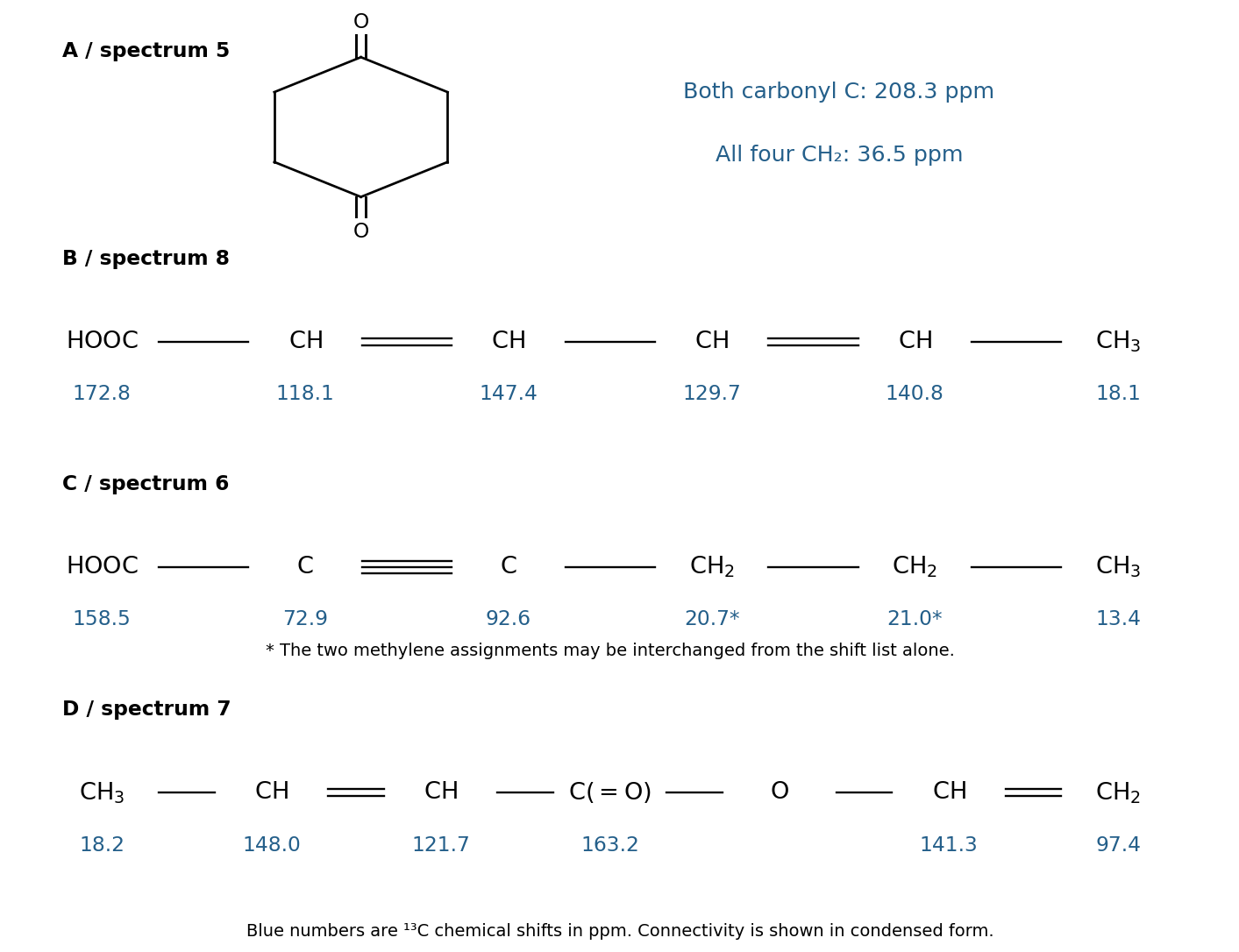
Original structural maps of all supplied carbon-13 NMR assignments
. Details. 
Past exam of the chemistry course of the year 1 of the natural sciences course of the University of Cambridge 2024 Paper 1 1 a Solution by Codex 0 2026-10-20
Codex 0 2026-10-20The assignments are A → spectrum 3, B → spectrum 4, C → spectrum 1, and D → spectrum 2. The useful infrared spectroscopy evidence is the combination of functional-group absorptions, rather than every feature of the fingerprint region.
A is a saturated diketone: spectrum 3 has a strong ketone C=O band near without the very broad acid O–H absorption. Its two symmetry-related carbonyls do not require two well-separated diagnostic bands.
B is a conjugated dienoic acid: spectrum 4 combines a broad carboxylic acid O–H envelope, approximately –, with a conjugated C=O band near – and C=C absorptions around –.
Past exam of the chemistry course of the year 1 of the natural sciences course of the University of Cambridge 2023 Paper 1 6 e Solution by Codex 0 2026-10-20
Codex 0 2026-10-20Amine nitrogen binds the carbon end of CO; Mg binds through oxygen. The polarized C=O bonds make carbon electrophilic and oxygen electron rich. An amine nitrogen lone pair therefore donates toward carbon, potentially giving a carbamate-like adduct after proton transfer. The hard Lewis acid Mg accepts an oxygen lone pair, either from coordinated CO or from an oxygen of a captured carbamate species. Simply reversing these assignments because nitrogen and oxygen both have lone pairs would put two electron-pair donors together without accounting for the electrophilic site.
The local binding pattern does not by itself determine the full proton-transfer state or whether cooperative chains form; those depend on the framework and amine arrangement. A documented diamine-appended framework shows cooperative carbon-dioxide insertion and ammonium carbamate chain formation, illustrating one possible implementation.[ref]
To regenerate the material, lower the CO chemical potential using reduced pressure or a CO-free purge, and, where binding is exothermic, heat the framework to favour desorption. The temperature must remain compatible with framework stability. This reverses adsorption or reversible chemisorption; it does not require permanently destroying the metal–organic framework.
There are unlisted articles, also show them or only show them.