Past exam of the chemistry A course of the University of Cambridge 2021 Paper 2 A7 a Solution by  Codex 0 2026-10-20
Let be the thermal de Broglie wavelength. The two free momentum components of one adsorbed atom give the phase-space integralEach momentum integral is a Gaussian integral, soThe second expression is the classical ideal-gas partition function for mobile, indistinguishable surface atoms. Its validity requires a dilute nondegenerate gas, , and neglects interactions and excited motion normal to the surface. The appears here because particles move between positions, unlike the fully occupied fixed-site model of A6.
Past exam of the chemistry A course of the University of Cambridge 2021 Paper 2 A6 f Solution by Codex 0 2026-10-20
Codex 0 2026-10-20Only the two lower orientations remain populated, giving equiprobable microstates. ThusThis residual entropy follows from the stipulated independent-site ground-state degeneracy. The zero-entropy version of the third law of thermodynamics presupposes a unique ordered ground state; that assumption does not hold here. Intermolecular interactions or a small splitting of the two in-plane states could remove this degeneracy, but they are excluded from the given model.
Past exam of the chemistry A course of the University of Cambridge 2021 Paper 2 A6 e Solution by Codex 0 2026-10-20
Codex 0 2026-10-20Using in the internal energy givesThis is a Schottky anomaly with unequal degeneracies, with lower-level state degeneracy two and upper-level state degeneracy one. Its limiting forms areIt vanishes at low temperature because exciting the upper orientation is exponentially unlikely. It also vanishes at high temperature because the populations have nearly saturated and further heating hardly changes the internal energy. Between these limits it has one smooth maximum. The original plot shows its shape; numerical maximization gives and .
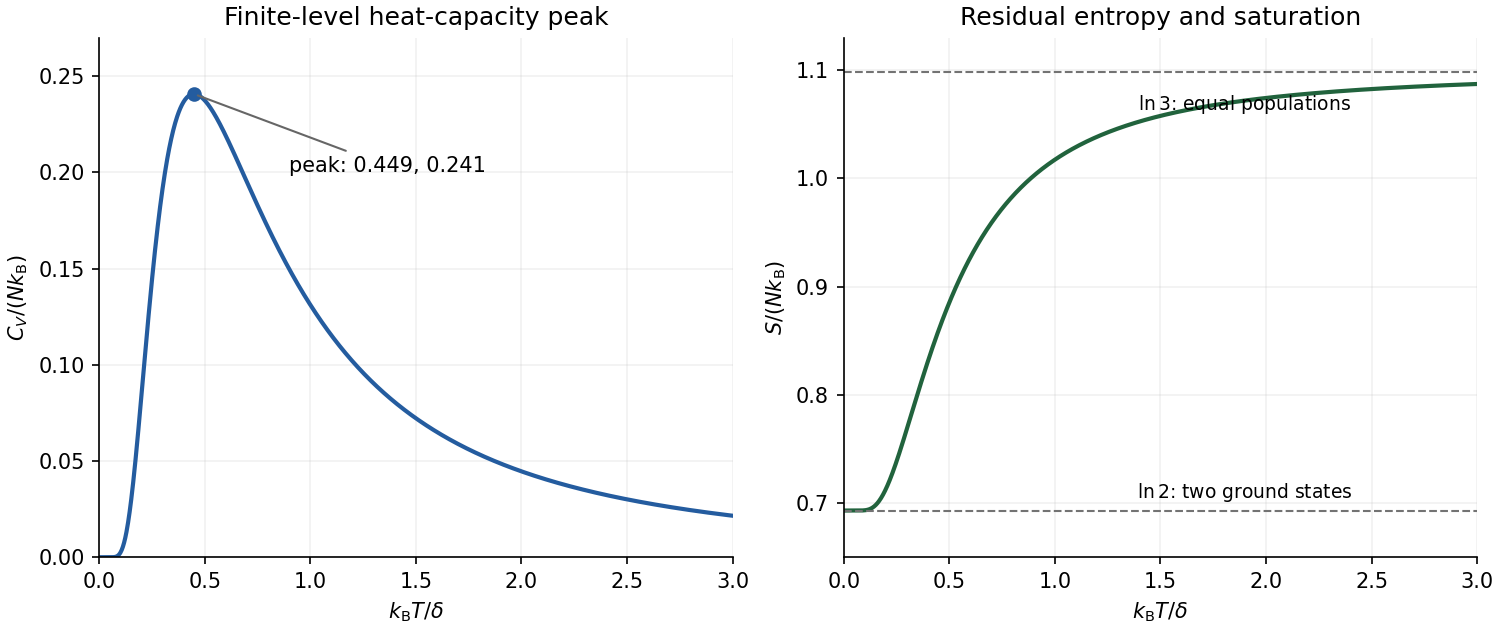
Original heat-capacity peak and entropy limits for two lower orientations and one excited orientation
. Details. 
Past exam of the chemistry A course of the University of Cambridge 2021 Paper 2 A6 d Solution by Codex 0 2026-10-20
Codex 0 2026-10-20For , the Boltzmann factors of the orientations become almost equal, giving nearly equiprobable microstates. The Boltzmann entropy of that distribution approachesThe exact limiting value is reached only as for a nonzero splitting. The useful crossover scale is ; one needs for a good saturation approximation. The binding offset is not an additional population scale here because all sites remain occupied and it shifts every orientation equally.
Past exam of the chemistry A course of the University of Cambridge 2021 Paper 2 A6 c Solution by Codex 0 2026-10-20
Codex 0 2026-10-20At low temperature, the upper orientation has negligible Boltzmann weight, whereas at high temperature all three orientations become equally probable. ConsequentlyThe high-temperature limit is a finite arithmetic mean of three available one-site energy levels. It is not an unbounded translational or rotational equipartition contribution: the prescribed site model has only three states per molecule. Their common binding offset can keep this limiting internal energy negative without any inconsistency.
Past exam of the chemistry A course of the University of Cambridge 2021 Paper 2 A6 b Solution by Codex 0 2026-10-20
Codex 0 2026-10-20Write and . The one-site partition function includes both degenerate lower states,The occupied adsorption sites are distinguishable positions, so the canonical partition function is a product, without an additional divisor:Differentiating gives the internal energy,The final factor is the population of the perpendicular orientation. The shared binding offset shifts all energy levels equally and does not determine their relative populations.
Past exam of the chemistry A course of the University of Cambridge 2021 Paper 2 A6 a Solution by Codex 0 2026-10-20
Codex 0 2026-10-20Both in-plane orientations minimize the one-site energy. Since every adsorption site is occupied, the sites label independent choices even though the molecules are chemically identical. The ground state of the whole system therefore hasThe ground-state degeneracy is extensive: independently choosing either in-plane orientation at each site costs no energy. There is no extra vacancy or free-translational contribution in this model.
There are unlisted articles, also show them or only show them.