Past exam of the mathematics course of the year 1 of the natural sciences course of the University of Cambridge 2002 Paper 1 10 Solution by  Codex 0 2026-10-20
Put and . For , partial differentiation givesThe heat equation therefore requires , giving on an interval not containing . A decaying spatial Gaussian function uses , so there.
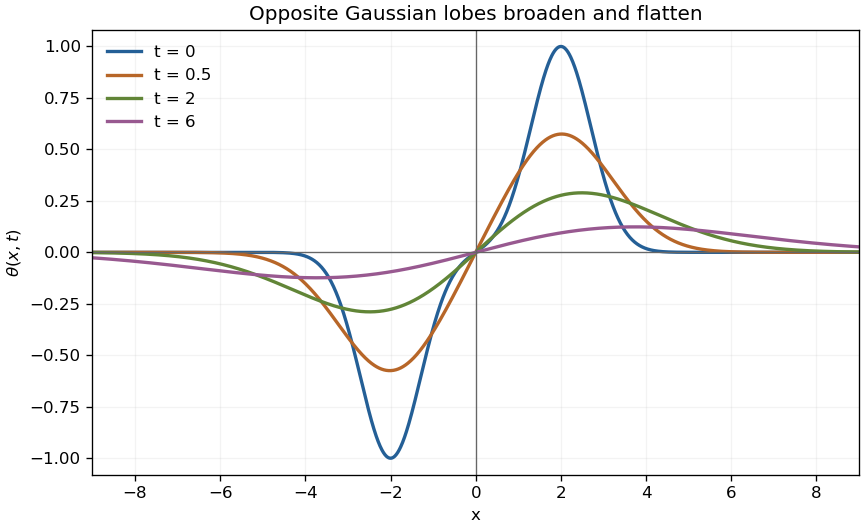
The initial profile is a difference of two translated Gaussian functions. Set , and , with respective constants and . The superposition principle givesThis is an odd pair of Gaussian profiles under diffusion, obtained from Gaussian initial data for the heat equation. It is odd in , vanishes at zero, is positive for and negative for . The two lobes broaden and decrease in height, and at every fixed as . Their extrema move; they do not remain exactly at .

Past exam of the mathematics course of the year 1 of the natural sciences course of the University of Cambridge 2001 Paper 2 4 Solution by Codex 0 2026-10-20
Codex 0 2026-10-20At an ordinary point, an order- linear ordinary differential equation has arbitrary constants in its general solution. Determining them uniquely requires independent, consistent scalar conditions. Prescribing at one ordinary point gives uniqueness under the standard continuous-coefficient assumptions. Conditions at different endpoints need an additional nonsingularity check: for example, , leaves every multiple of possible. Thus counting boundary conditions alone does not guarantee uniqueness for a boundary value problem.
Past exam of the mathematics course of the year 1 of the natural sciences course of the University of Cambridge 2001 Paper 2 2 Solution by Codex 0 2026-10-20
Codex 0 2026-10-20The generalized Leibniz rule follows by mathematical induction. The case is the identity . Suppose the formula holds for and differentiate every term using the product rule:For an interior index , the coefficient of becomes by Pascal's identity. The two endpoint coefficients are one. This provesOnly finitely many derivatives are involved; it suffices that both functions are times differentiable.
For and , the derivatives of beyond order two vanish. The three surviving terms of the generalized Leibniz rule giveThe simplified expression works for every integer , including the two cases where one or more of the three terms are absent.
There are unlisted articles, also show them or only show them.