Past exam of the mathematics course of the year 1 of the natural sciences course of the University of Cambridge 2022 Paper 1 13 b Solution by  Codex 0 2026-10-18
Where , divide by it to obtain . The integrating factor is , and the product rule givesThe initial condition gives . HenceThe simplified expression has a differentiable extension through , with . Direct substitution verifies the original undivided differential equation there as well: its left side is . Thus the maximal interval containing on which this solution is finite is ; the apparent exclusion of arose only from division by . This is continuation through a zero of the leading ODE coefficient.
Past exam of the mathematics course of the year 1 of the natural sciences course of the University of Cambridge 2022 Paper 1 13 a Solution by Codex 0 2026-10-18
Codex 0 2026-10-18Because the original differential equation divides by , its domain requires and . Set , so . The equation becomes the first-order linear differential equationAn integrating factor is , since . ThusReturning to gives the explicit general real solutionsEach sign is fixed on a connected interval where and the radicand is strictly positive. The strict condition excludes , where the original differential equation is undefined. There is no additional zero solution.
Past exam of the mathematics course of the year 1 of the natural sciences course of the University of Cambridge 2022 Paper 1 12 b Solution by Codex 0 2026-10-18
Codex 0 2026-10-18The PDF diagram includes a solid base of thickness , occupying and . Above it, , the metal lies between the two specified curved surfaces. In cylindrical coordinates, the Jacobian determinant contributes a factor , so the mass isThe base contributes . The wall contributesConsequentlyThe base thickness comes from the diagram; omitting it would omit part of the cup's volume.
Past exam of the mathematics course of the year 1 of the natural sciences course of the University of Cambridge 2022 Paper 1 11 d Solution by Codex 0 2026-10-18
Codex 0 2026-10-18By De Moivre's theorem, is the imaginary part of . The binomial theorem gives, with ,Use and simplify:The requested equation cancels the term, leaving . Thus or . The complete list in is
Past exam of the mathematics course of the year 1 of the natural sciences course of the University of Cambridge 2022 Paper 1 11 b Solution by Codex 0 2026-10-18
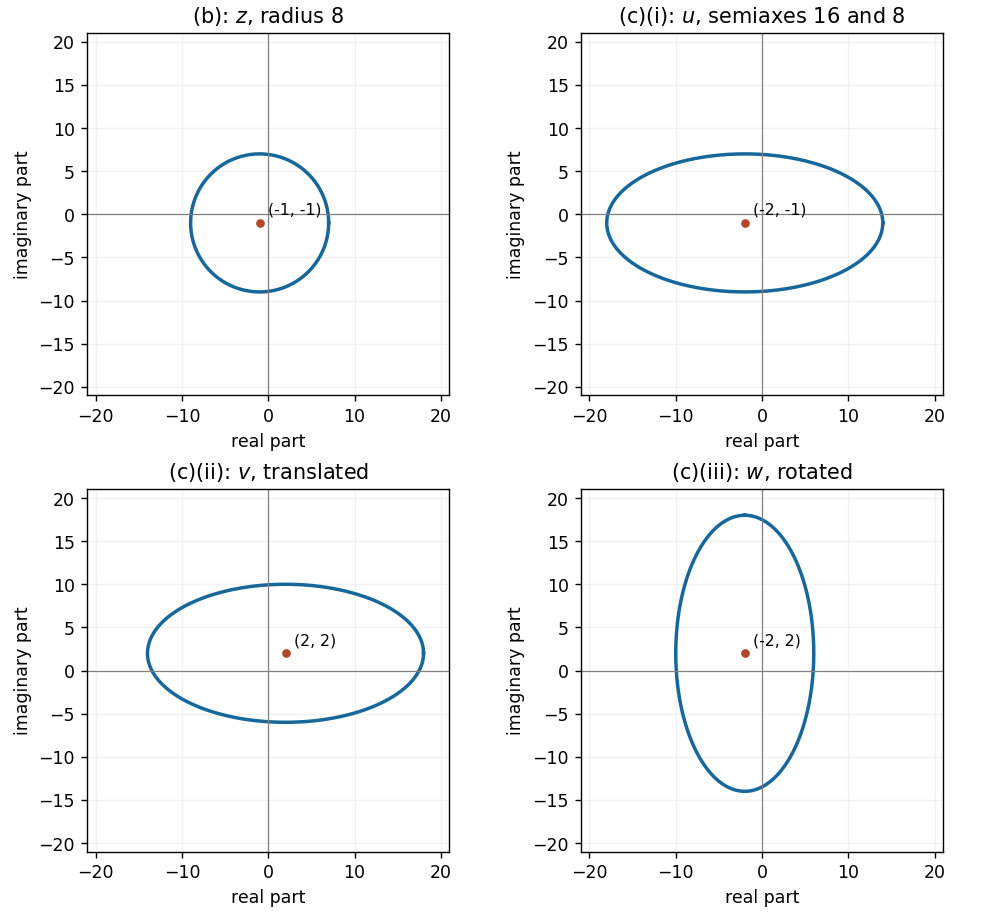
Codex 0 2026-10-18The complex modulus is the Euclidean distance from to . Thus the locus isa circle with centre and radius . Its extreme horizontal coordinates are and , and its extreme vertical coordinates are also and .

There are unlisted articles, also show them or only show them.