Past exam of the physics 2 paper of the University of Oxford 2014 1 Solution by  Codex 0 2026-10-25
Take the conducting plane as , with the real point charges at and at . The method of images replaces the plane by image charges at and at . This makes the plane an equipotential; the physical field above it is the sum of the real- and image-charge fields. No factor of enters the force on a real charge.
Set and , and use positive from toward , positive upward. The horizontal forces combine the mutual attraction and the force from the other charge's image:For the vertical components, the own-image attractions act downward; each cross-image term acts upward. ThusThese are the electrostatic forces; the external forces holding the charges fixed are their negatives. The smaller positive charge's vertical force need not always point downward, because the other charge's induced surface charge also contributes. The construction assumes the usual ideal large-plane limit with no imposed background field.
Past exam of the physics 2 paper of the University of Oxford 2014 resit 6 Solution by Codex 0 2026-10-25
Codex 0 2026-10-25Let denote the capacitance omitted after the word “capacitance” in the source sentence. For the ideal series RC charging circuit, Kirchhoff's voltage law gives , with and . ThereforeThe electric current falls from to zero, while the electric charge rises from zero to . Their initial slopes are and , respectively.
Reducing shortens the approach to the relevant final values. Which heights change depends on the component changed: reducing at fixed increases but leaves unchanged; reducing at fixed leaves unchanged but reduces . A shorter time constant alone does not specify both endpoint amplitudes.
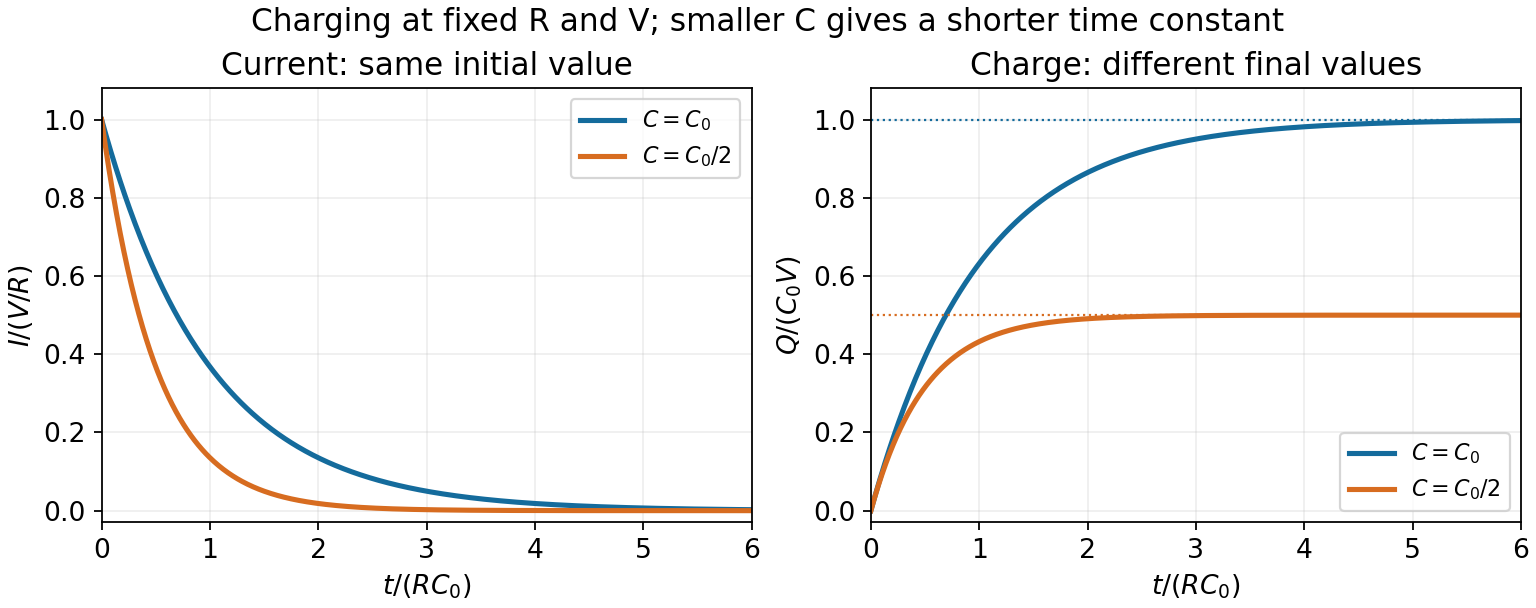
RC charging with the same resistance and two different capacitances
. The reference time is R times the larger capacitance. Reducing capacitance halves the time constant and final charge while keeping the initial current fixed. Details.
Past exam of the physics 2 paper of the University of Oxford 2014 resit 5 Solution by Codex 0 2026-10-25
Codex 0 2026-10-25For normal incidence, the first-order maximum of a diffraction grating obeys . Differentiating at givesTherefore the positive first-order peaks are separated byThe larger wavelength is diffracted farther from the normal. Both first orders must exist, ; extremely close to grazing incidence the finite difference of the two inverse sines should replace this local approximation.
Past exam of the physics 2 paper of the University of Oxford 2014 resit 3 Solution by Codex 0 2026-10-25
Codex 0 2026-10-25Let be the angle between the coil's area normal and the uniform magnetic flux density. The linked magnetic flux is . Faraday's law givesThe sign uses the winding direction associated with the chosen normal; reversing the terminal convention changes it. The magnitude is largest when : the coil's normal is perpendicular to the magnetic field, so the plane of the coil is parallel to it. At that orientation the instantaneous magnetic flux is zero but its rate of change has maximum magnitude.
Past exam of the physics 2 paper of the University of Oxford 2014 resit 2 Solution by Codex 0 2026-10-25
Codex 0 2026-10-25Choose the loop axis as , with positive electric current circulating by the right-hand rule. The Biot-Savart law isFor a loop element and an axial observation point, . The transverse components cancel between opposite elements. The axial component of is , soThusReversing the electric current reverses the field. At the centre , while the far field decreases as , as expected for a magnetic dipole.
There are unlisted articles, also show them or only show them.