Past exam of the physics 2 paper of the University of Oxford 2015 7 Solution by  Codex 0 2026-10-25
Use Fraunhofer diffraction, appropriate to observation in the far field or in the focal plane of a lens, and uniform illumination across the slit. At observation angle , points separated by transverse coordinate acquire a phase difference , where is the wavenumber. The superposition principle for the coherent wave amplitudes givesThe intensity is proportional to the squared modulus of the wave amplitude, soThe limit at is one. The noncentral zeros satisfy for nonzero integers for which the angle is physically allowed. In the Rayleigh criterion, two mutually incoherent point images are just resolved when the central maximum of one diffraction pattern lies at the first minimum of the other. For single-slit diffraction this givesThe exact statement here takes one image on the slit normal; for nearby paraxial images the angular resolution is . The first propagating minimum exists only for . The numerical factor belongs to a circular aperture and does not apply to this slit.
Past exam of the physics 2 paper of the University of Oxford 2015 6 Solution by Codex 0 2026-10-25
Codex 0 2026-10-25Let denote the electric charge on the initially positive capacitor plate and define the discharge electric current by . Kirchhoff's voltage law for the series RLC circuit gives the damped harmonic oscillator equationThe initial conditions are and : the open switch initially prevents electric current, and finite inductance prevents an instantaneous jump in it. Put and . The two characteristic roots are . An oscillatory electric current requires a nonzero imaginary part, henceFor positive and nonnegative , this is the underdamped regime. The initial conditions giveAt equality there is critical damping, and above it there is an overdamped response, with no repeated changes of sign of the discharge electric current. A nonzero initial electric charge is understood; if , the stated initial conditions give no electric current at all.
Past exam of the physics 2 paper of the University of Oxford 2015 5 Solution by Codex 0 2026-10-25
Codex 0 2026-10-25Take the divergence of the proposed Ampère's law. Since the divergence of a curl vanishes identically, it implies . However, local charge conservation requires the continuity equationFor example, electric current entering a charging capacitor accumulates electric charge on its plates, so the charge density is time dependent. The proposed equation cannot describe that process.
From Gauss's law, . Thus , which supplies precisely the missing divergence. Adding the displacement current density gives the Ampère-Maxwell equation:Its divergence now yields the correct continuity equation. Through a fixed surface, the associated displacement current is , where is the electric flux. In a vacuum capacitor gap, this equals the conduction electric current charging the plates, even though no charges cross the gap. Charge conservation fixes the required divergence of the correction; by itself it does not exclude adding a further divergence-free vector field.
Past exam of the physics 2 paper of the University of Oxford 2015 4 Solution by Codex 0 2026-10-25
Codex 0 2026-10-25Choose the entry point as , the initial velocity as , and the slit as , with . A magnetic field perpendicular to the page changes the direction of the velocity, while the Lorentz force does no work. For positive , an upward initial force requires the magnetic flux density to point into the page. The resulting circular motion has centre , since its initial tangent is horizontal.
The slit must lie on the circle, giving and hence . Equating the centripetal force to the magnetic part of the Lorentz force, , givesA negative electric charge requires the opposite direction of magnetic flux density. These expressions assume nonrelativistic motion and negligible energy loss through electromagnetic radiation.
For an opaque screen, reaching the slit must be the first encounter with . The velocity there has , so passage from left to right requires , as in the drawn arrangement. At the trajectory merely touches the screen. If , the same circle first meets the screen at height , where the particle is blocked; its later passage through does not solve the opaque-screen problem. This qualification distinguishes a geometric circle through two points from an accessible slit trajectory.
Past exam of the physics 2 paper of the University of Oxford 2015 3 Solution by Codex 0 2026-10-25
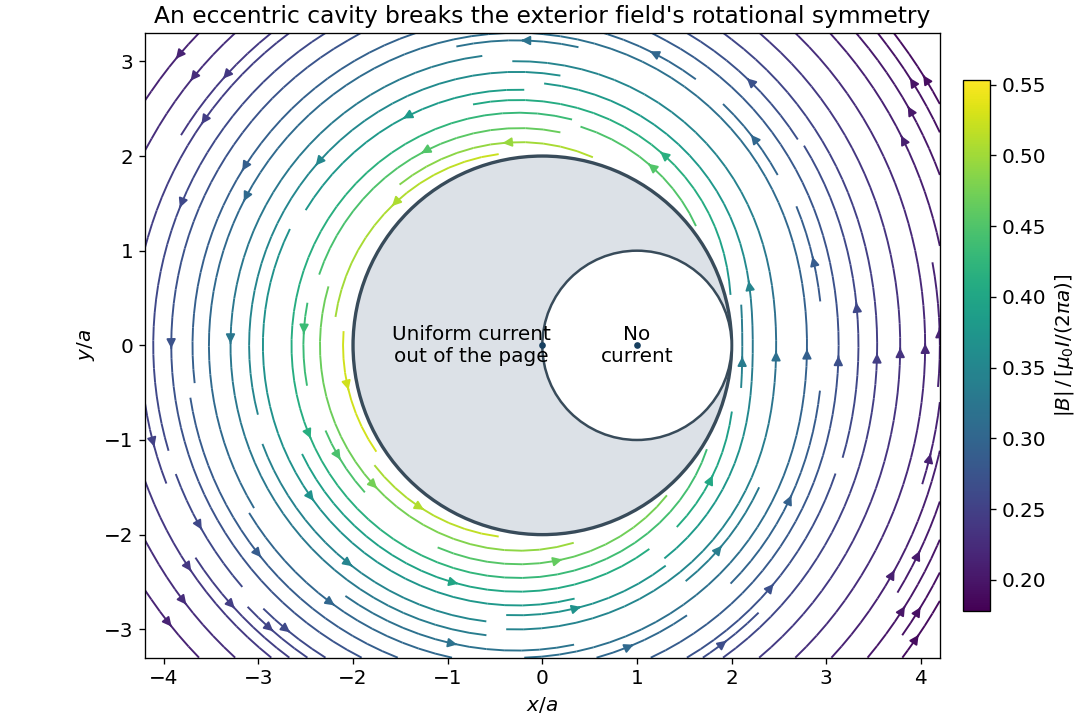
Codex 0 2026-10-25Use the geometric cross-section shown in the source: the outer cylinder has radius and centre , and the circular cavity has radius and centre . Let the electric current be in the direction. The conducting cross-sectional area is , so the uniform electric current density is .
To obtain the exterior magnetic field of a wire with an eccentric cylindrical cavity, apply the superposition principle to a full cylinder of electric current density centred at and a second cylinder of electric current density centred at . Their electric currents are and . This reproduces the actual electric current density everywhere, including zero in the cavity. Outside a long circular cylinder, Ampère's law gives . Every point outside the outer boundary is outside both component cylinders. Consequently, writing ,In Cartesian coordinates, the same magnetic flux density isThe cavity breaks rotational symmetry. Thus the magnetic flux density is generally neither constant in magnitude nor tangential on a circle centred at ; replacing its line integral by would be unjustified. Its line integral is nevertheless , as Ampère's law requires. At distances , the leading term becomes , with corrections of order .

There are unlisted articles, also show them or only show them.