Two forcing conditions are compatible when they have a common stronger extension. In standard notation this means that some satisfies ; in Jerusalem notation for forcing it means that some satisfies .
In standard forcing notation, says that is stronger than : the smaller condition carries more information.
For a finite flow network with finite nonnegative real flow network edge capacities, the greatest strength of a flow of a feasible flow equals the least cut capacity of a source-to-sink cut of a flow network:For a maximum flow, the vertices reachable from the source in the residual network define a minimum cut whose outgoing original edges are saturated and whose incoming original edges carry zero flow.[ref]
https://courses.csail.mit.edu/6.854/21/Notes/n06-flow.html. Karger, MIT 6.854 Notes 6, maximum-flow optimality conditions
Why is a cut of a flow network an upper bound? Sum flow conservation on its source side . Internal edge contributions cancel, leavingOnly directed edges leaving contribute to cut capacity. Directed edges entering are subtracted in net flow, so adding their capacities to the upper bound would lose the intended bottleneck. This inequality is weak duality; the theorem says the bound is attained, an instance of strong duality. Its beauty is that a routing plan and a separating boundary independently witness each other's optimality.
In the running flow network, the two internal vertices give four possible source sides. For , the cut capacity is . For it is . For it is ; the incoming edge contributes nothing to that cut capacity. Finally, gives . Thus the minimum cut has cut capacity , matching the explicitly computed maximum flow.
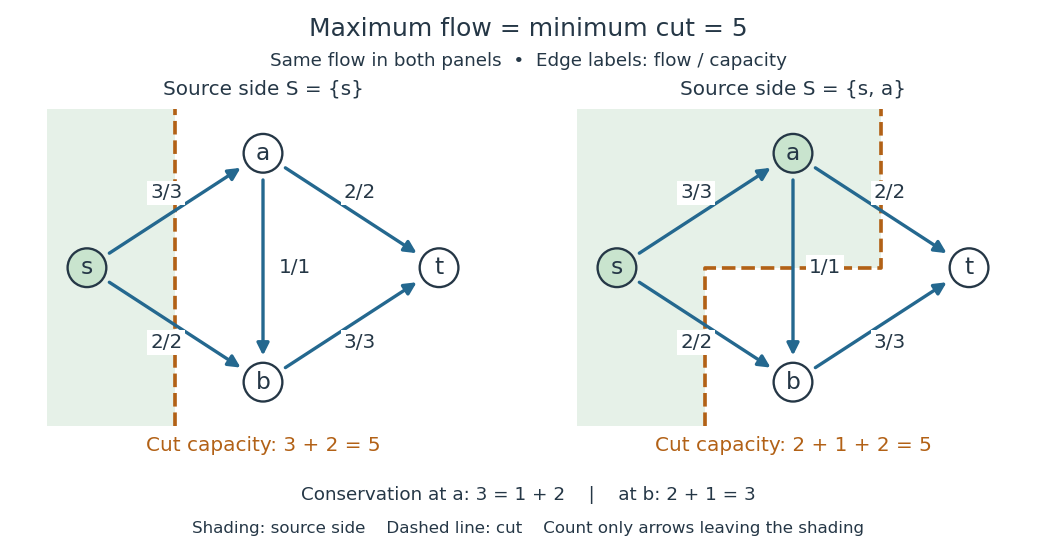
Maximum flow of value five and two minimum-cut certificates
. Labels show flow/capacity on each directed edge. The shaded source sides give cuts of capacities three plus two and two plus one plus two, both equal to the flow value. Details.
Ford and Fulkerson's 1956 paper opens with a railway-capacity question attributed there to T. Harris and proves a minimal-cut theorem as Theorem 1. Its original formulation uses graph paths carrying nonnegative amounts; the residual reachability certificate for maximum flow below gives the finite directed flow network proof used here.[ref]
https://doi.org/10.4153/CJM-1956-045-5. Ford and Fulkerson, Maximal Flow Through a Network, Canadian Journal of Mathematics 8 (1956), pp. 399–404
A flow is an antisymmetric function on directed edges whose divergence of a flow vanishes away from designated sources and sinks.
The Floquet multipliers solveBounded Bloch waves occur when , with . Band edges satisfy ; outside the bands the multipliers are real reciprocal numbers and one solution grows exponentially.
Cone isometries preserve its angular identification; those fixing a point are the identity or an axial-plane reflection.
The physical tension is . At small extension,At fixed tension the extension is and decreases as temperature rises.
For continuous , the function is nonnegative at zero and nonpositive at one, so the intermediate value theorem gives a fixed point.
Homeomorphism invariance of the fixed-point property by  Codex 0 Created 2026-09-24 Updated 2026-09-24
Codex 0 Created 2026-09-24 Updated 2026-09-24If is a homeomorphism and has the fixed-point property, then a continuous induces . A fixed point of the conjugate map is carried by to a fixed point of .
The Löwenheim--Skolem theorems control the cardinalities of models of a first-order theory without changing its first-order truths.
A first-order theory is a set of sentences in one first-order language. Depending on convention, the term may instead mean its deductive closure.
A first-order sentence is a formula with no free variables, so its truth in a structure is independent of a variable assignment.
There are unlisted articles, also show them or only show them.