An occurrence of a variable is free when it is outside the scope of a quantifier binding that variable.
The distinction belongs to free variables and bound variables; an occurrence bound by an enclosing quantifier is not free.
A first-order language specifies its constant, operation, and relation symbols, together with the arity of each nonconstant symbol.
A first-order formula is built from atomic formulas using logical connectives and quantifiers over the elements of a structure.
An adiabatic process has no heat transfer across the chosen boundary throughout the process: , rather than merely zero net heat after incoming and outgoing transfers cancel. It is a condition on energy transfer, whereas an isothermal process holds temperature constant. A sealed cylinder can approach an adiabatic process through insulation or through motion short compared with the time needed for appreciable heat transfer. Its temperature can nevertheless change because work crosses the boundary.[ref]
Take the trapped gas as a closed system, with fixed amount of substance and composition and no net change in bulk kinetic energy or potential energy between the endpoints. Define as heat entering and as work delivered to the surroundings. The first law of thermodynamics givesHere is internal energy. An adiabatic compression normally supplies work, so ; an adiabatic expansion against a resisting load delivers work, so . An adiabatic process need not preserve internal energy and need not make the closed system an isolated system. [ref]
2.5 Control volume form of the conservation laws. MIT Unified Engineering, §2.5.2: heat inward and work outward in the first-law balance
For a reversible thermodynamic process, at positive absolute temperature . A reversible adiabatic process therefore has : it is an isentropic process. Irreversible adiabatic processes can instead generate entropy; free expansion is the existing counterexample, with its calculation in entropy change in free expansion. Conversely, constant entropy alone does not certify an adiabatic process or reversibility: outward heat can export the entropy generated internally. For a closed system the macroscopic entropy balance iswhere is the absolute boundary temperature where each heat transfer occurs and is internal entropy production. With no heat transfer, this reduces to ; reversibility makes . [ref]
https://openstax.org/books/university-physics-volume-2/pages/4-6-entropy. Ling, Moebs and Sanny, University Physics Volume 2, §4.6: reversible heat and irreversible entropy increase
A motivating experiment measures the gas temperature directly during compression and expansion, instead of inferring it from how warm a cylinder feels. PASCO's authored TD-8565 manual describes a sealed piston cylinder, a fine nickel-wire thermometer, an absolute pressure sensor and a position readout for volume. A computer records all three channels together. The wire's electrical resistance changes with temperature; its small size permits a rapid response. [ref]
https://cdn.pasco.com/product_document/Adiabatic-Gas-Law-Apparatus-TD-8565-Manual.pdf. PASCO scientific, Adiabatic Gas Law Apparatus, guide 012-05110D, pp. 1–2: apparatus and readouts
Use ordinary trapped air and the apparatus's designed travel stops; mount the base securely, close the valve during a stroke, and record the actual volume limits. John Hart's university demonstration uses a large transparent cylinder with a low-heat capacity thermocouple, a pressure sensor, a travel gauge and a safety stop. It explicitly keeps the release valve closed during the demonstration. The basic observable is a rise in temperature on compression and a fall on loaded expansion, alongside the corresponding pressure and volume changes. Hart discusses wall thermal conduction, sensor response and leakage as reasons real records differ from the reversible model. [ref]
https://atoc.colorado.edu/TeachingandLearning/Demonstrations/AdiabaticExpansion/Adiabatic_expansion.htm. John Hart, University of Colorado (2000), Adiabatic Expansion and Gas Law Physics: sensor demonstration and limitations
For a proposed rapid-versus-slow comparison, let the air and walls return to the same initial thermal equilibrium before each run, then compare the same starting and finishing volume values with different stroke durations. Read temperature, absolute pressure and position continuously, including the hold after motion stops. A rapid compression gives a temporary temperature rise; holding the smaller volume lets heat leave and the temperature approach the surroundings again. Slow compression in good thermal contact allows that heat transfer during the stroke and approaches an isothermal compression. Loaded expansion reverses the signs: the rapid stroke cools, while heat entering during slow motion reduces the cooling. PASCO explicitly supports rapid nearly adiabatic processes and slow isothermal processes; the matched-run controls here are a proposed extension, not a reported set of measurements. [ref]
https://www.pasco.com/products/lab-apparatus/thermodynamics/gas-laws/td-8565. PASCO scientific, TD-8565 product documentation: simultaneous readouts and adiabatic/isothermal comparisons
Insulation suppresses thermal conduction; it does not prove that heat transfer vanishes. As proposed controls, repeat the matched strokes with and without a removable insulating jacket, record room and wall temperatures, measure fixed-position drift, and check valve closure and seal leakage. Calibrate the thermometer and position readout independently, including any connected dead volume; account for the heat capacity of the probe rather than treating it as a passive observer. Hart explicitly identifies the small air sample relative to the probe and walls, sensor inertia and seal leakage as limitations. A fast display cannot eliminate those physical effects. [ref]
https://atoc.colorado.edu/TeachingandLearning/Demonstrations/AdiabaticExpansion/Adiabatic_expansion.htm. John Hart, Adiabatic Expansion and Gas Law Physics: wall, probe and seal limitations
There are two distinct timing requirements. Let describe internal equilibration, the thermometer response, the stroke duration and the effective heat transfer time constant. A useful sufficient window for a resolved, nearly reversible adiabatic process iswith negligible friction. The left inequality permits a quasistatic process and a usable readout; the right limits heat leakage. A violent stroke may satisfy only the right inequality. PASCO reports a roughly – lag of its temperature channel behind the other channels, so apparent simultaneous samples require care. If no such window exists, analyze equilibrium endpoints with the first law of thermodynamics, and regard the path as approximate. [ref]
https://cdn.pasco.com/product_document/Adiabatic-Gas-Law-Apparatus-TD-8565-Manual.pdf. PASCO scientific, guide 012-05110D, p. 4: temperature-sensor lag
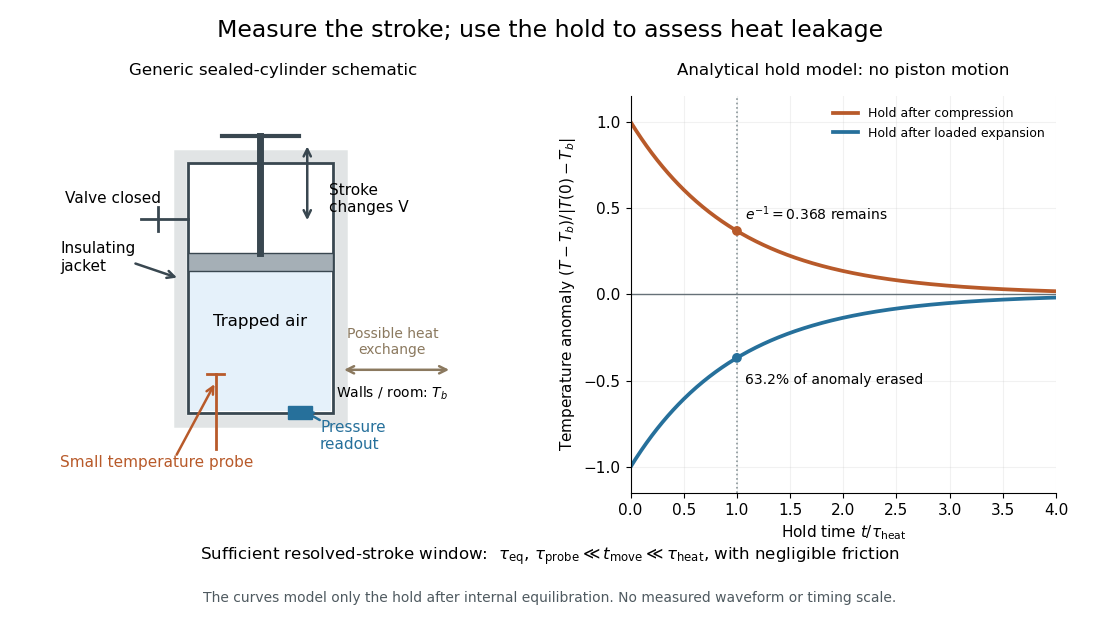

The diagram's model is deliberately a hold after the stroke, when boundary work is zero. For constant whole-sample heat capacity at constant volume and effective thermal conductance , it assumesThis is Newton's law of cooling with one uniform gas temperature and a fixed surrounding temperature; actual wall and probe dynamics can require more than one time constant. At , the fraction of the initial temperature anomaly erased is ; at one time constant it is about . These are analytical fractions, not experimental tolerances or evidence that the preceding stroke was reversible. Measuring the hold helps estimate heat leakage independently of the motion.
The usefulness of an adiabatic process is that it separates mechanical work from heat transfer. Its reversible limit connects temperature changes, mechanical stiffness and entropy in one model: Rüchardt experiment and Clément-Desormes experiment already use that connection to measure heat capacity ratio. The contrast with free expansion explains the deeper point: suppressing heat does not determine how much work is exchanged or how much entropy is produced.
In a positively oriented surface chart,The coordinate-change Jacobian and the metric determinant transform inversely, so this defines a global area form.
A local isometry between Riemannian manifolds is a local diffeomorphism with . Equivalently, its differentials are isometric linear isomorphisms between tangent spaces. It preserves the Levi-Civita connection, intrinsic sectional curvature, and affinely parametrized geodesics. A map whose differentials are merely isometric injections is an isometric immersion; the local diffeomorphism requirement distinguishes these notions.
Position-momentum selection rules in the first excited hydrogen eigenspace by  Codex 0 Created 2026-09-24 Updated 2026-09-24
Codex 0 Created 2026-09-24 Updated 2026-09-24The operators and commute with , so they preserve . Both are odd under parity, so they connect only states of opposite orbital parity. Within the eigenspace, only the pair and can therefore have nonzero matrix elements.
Orbital-angular-momentum-squared perturbation of hydrogen by Codex 0 Created 2026-09-24 Updated 2026-09-24
Codex 0 Created 2026-09-24 Updated 2026-09-24A perturbation preserves the hydrogen eigenbasis and shifts byIn the first excited eigenspace, the state is unshifted and the three states receive the common shift .
The Klein four-group is the abelian group with three nonidentity elements, all of order two.
If with , then has subgroups of order , every -subgroup lies in one, and all such Sylow subgroups are conjugate. Their number satisfies and .
There are unlisted articles, also show them or only show them.