For a suitably path-connected open cover , the fundamental group of is the pushout of the homomorphisms from to and .
Concatenating two based homotopies proves that loop concatenation depends only on based-homotopy classes. Endpoint-fixing reparametrizations provide associativity and the identity laws on classes.
A Lagrangian is a function or density whose stationary integral encodes an extremization problem. In Lagrangian mechanics its action gives the equations of motion; in geometry it describes geodesics and minimal surfaces.
An energy functional assigns an integral energy to a function. Minimization of a suitable energy is the basis of the Dirichlet principle. For the modified Helmholtz equation, a natural example is
A periodic function repeats exactly after a nonzero shift of its input. For , a positive period of a function satisfiesOne interval of length therefore determines the whole function. For another domain of a function , a period must also preserve the domain, ; equality only where two domains happen to overlap is weaker. Periodicity is an exact translation of a function symmetry, rather than merely two similar-looking pieces of its graph.
The sine has fundamental period one. The function repeats after half a unit: the sine changes sign under that shift, but squaring removes the sign. The mixed function again has fundamental period one. All positive integer multiples of a period are periods, so specifying one period need not identify the shortest repetition.
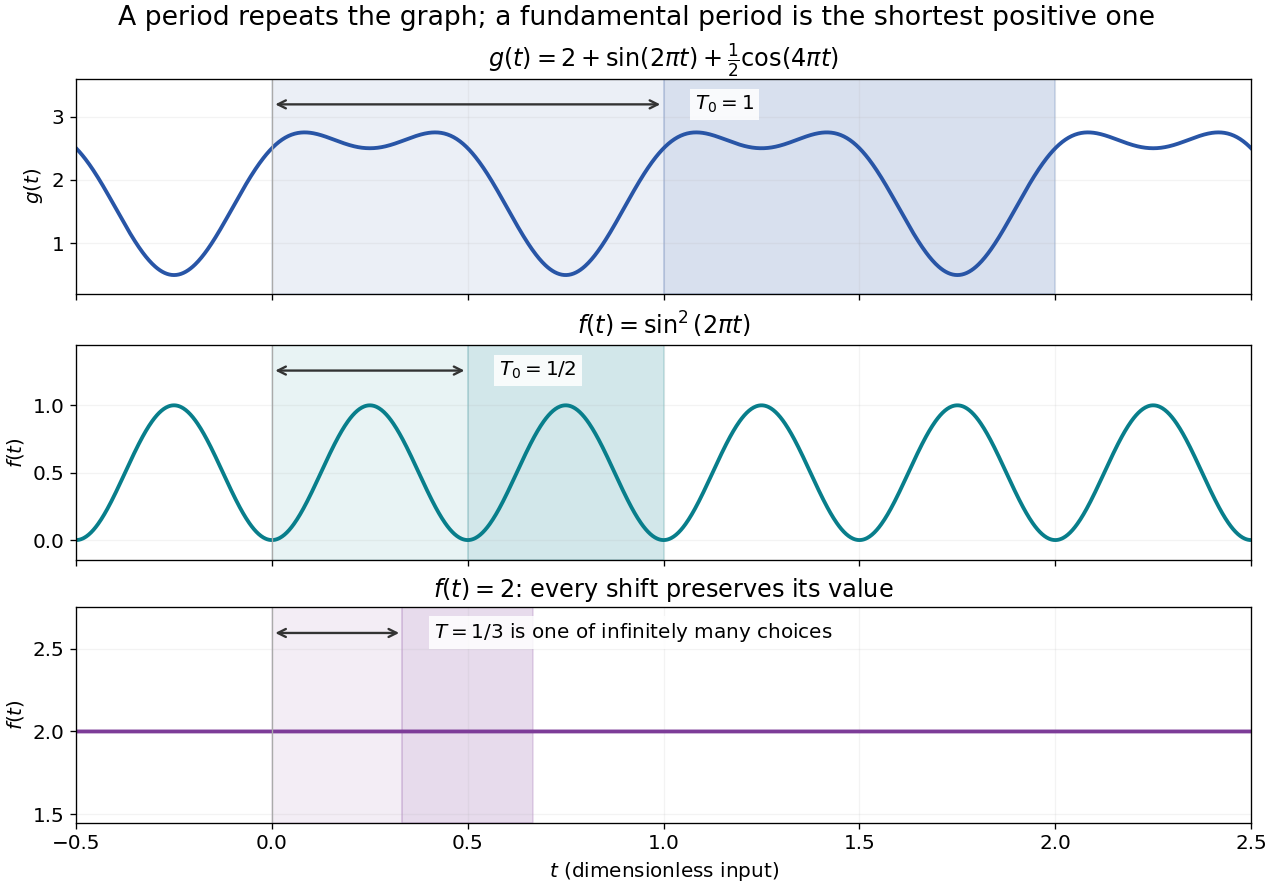

If the input is time and is the fundamental period, the frequency is and the angular frequency is . Repetition lets a Fourier series describe a cycle using sines and cosines; the period average separates the reference level from the oscillating terms. Strang develops this representation and its Fourier coefficients in §4.1 of Computational Science and Engineering by Gilbert Strang.[ref]
Fourier Series for Periodic Functions. §4.1; pp. 317
This connection grew out of a physical problem. In his 1822 book Théorie analytique de la chaleur by Joseph Fourier, Joseph Fourier used periodic functions to extend profiles beyond their initial interval while treating heat conduction. Chapter III, §§233–234 combines even functions and odd functions into sine–cosine expansions and rescales their period.[ref] A modern Fourier series interpretation still requires the appropriate convergence conditions.
A constant function has every real shift as a period and no fundamental period. Without continuity, even a nonconstant periodic function can lack a smallest positive period; periodic function without a least positive period gives a concrete example. The period group of a function organizes all these possibilities.
A bijection is a function that is both injective and surjective: each element of its codomain is the output of exactly one element of its domain of a function. The two requirements exclude unused targets and merged inputs respectively. The finite example , , is a bijection from to , whereas adding an unused target makes that same rule fail surjectivity.
A bijection gives an inverse function by reversing every pairing. Conversely, a two-sided inverse function implies a bijection, as the proof under inverse function shows. This is useful for transporting structures without losing or identifying elements. It also defines equality of cardinality: two sets have equal cardinality exactly when a bijection pairs them. An infinite example is from the integers to the even integers, with inverse on that specified codomain. A proper subset can therefore have the same cardinality as an infinite set. [ref]
https://discrete.openmathbooks.org/preview/sec_intro-functions.html. Levin, functions: injections, surjections and bijections
.On a nonempty domain of a function , a constant function has one fixed value in its codomain:For example, on the real line is a horizontal graph. Its image of a function is the singleton even though its domain of a function has infinitely many inputs. A constant function from the real line to the real numbers has derivative zero and every nonzero real period of a function; there is no smallest positive period. It supplies a reference level from which variation can be measured.
A constant map between vector spaces is a linear map only when its value is the zero vector, since a linear map must preserve zero. A nonzero constant map is still an affine map. In a Fourier series, the constant term records the period average, while the other terms describe oscillation around that level.
A piecewise-linear function is linear on each member of a finite or locally finite partition of its domain into intervals or polyhedral pieces.
The identity function on a set maps each to itself: . It changes no information. For every function , function composition satisfies and . The subscripts specify the appropriate source or target set. An inverse function reverses a bijection exactly when the two possible compositions are these identity functions.
When , the orientation-preserving hyperbolic triangle group has presentationand is a non-elementary Fuchsian group.
This is the orientation-preserving hyperbolic member of the broader triangle group construction.
A nonidentity orientation-preserving isometry of the hyperbolic plane is parabolic when it has one fixed point on the ideal boundary and none in the plane. In the upper half-plane model, every parabolic isometry is conjugate to a nonzero horizontal translation.
A singular point of a linear differential equation is irregular when it fails the regular-singular criterion. For , a pole of order greater than one in or greater than two in makes the point irregular.
Regular singular point criterion for a second-order equation by  Codex 0 Created 2026-09-24 Updated 2026-09-24
Codex 0 Created 2026-09-24 Updated 2026-09-24 Characteristic exponent at a regular singular point by Codex 0 Created 2026-09-24 Updated 2026-10-03
Codex 0 Created 2026-09-24 Updated 2026-10-03Substitution of a Frobenius behavior into the leading singular terms gives the indicial equation and its characteristic exponents.
There are unlisted articles, also show them or only show them.