The Galactic bar is the elongated central stellar structure of the Milky Way. Extinction-corrected near-infrared standard candles and gas position--velocity maps constrain its distance, orientation, and three-dimensional shape.
Galactic multiwavelength astronomy combines spectral bands that respond differently to stars, gas, dust, magnetic fields, temperature, and energetic particles.
The interstellar medium is the gas, dust, magnetic field, and energetic-particle population between stars in a galaxy.
The Zweifach--Fung effect, or plasma skimming, is the disproportionate entry of red blood cells into the higher-flow daughter at an asymmetric microvascular bifurcation.
The Fahraeus--Lindqvist effect is the reduction of blood's apparent viscosity as a small vessel narrows over much of the microvascular range. Red blood cells migrate toward the centre and leave a relatively low-viscosity cell-free plasma layer near the wall.
Murray's law balances viscous pumping power against the metabolic cost of maintaining blood volume. For cylindrical vessels it gives and hence at an ideal bifurcation.
A point of a metric space is isolated when some open ball about contains no other point of the space, equivalently when the singleton is open.
Uniform continuity requires one input tolerance to work at every point of the domain for a chosen output tolerance.
A metric satisfies : visiting an intermediate point cannot beat the direct endpoint distance. A norm satisfies the corresponding inequality .
Take , , and . For Euclidean distance, the triangle inequality reads . The direct line segment has metric path length , while the route through has metric path length . For Manhattan distance, the same comparison becomes : both routes are shortest. The line segment and the bent route both become metric geodesics when progress is measured by metric path length. For Chebyshev distance, the direct line segment has metric path length , while the same bent route still costs .
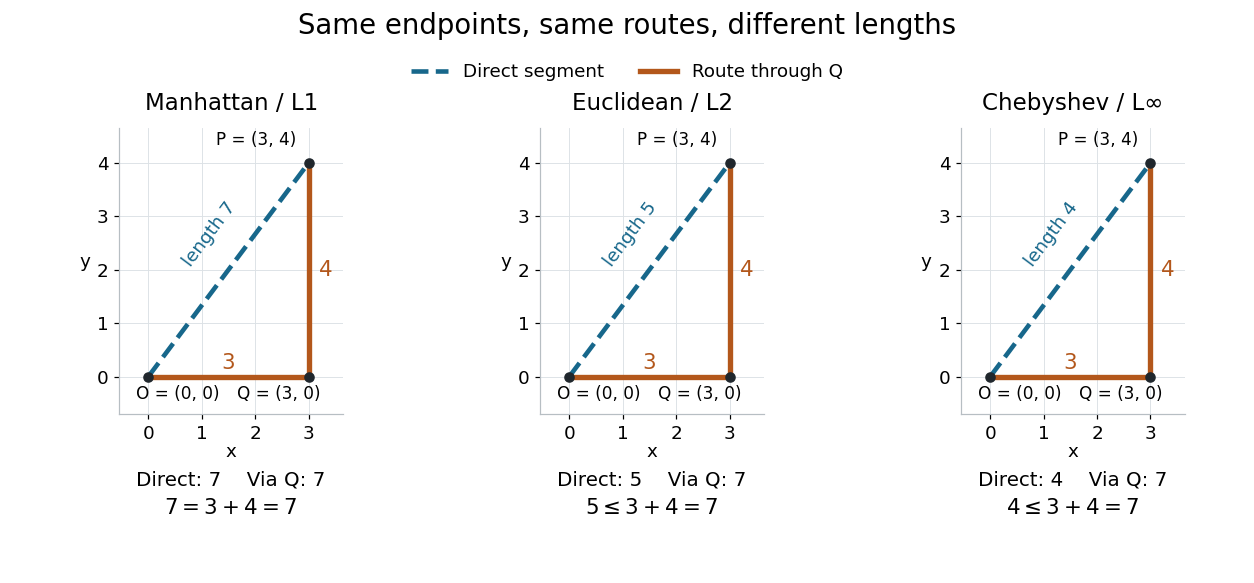

Repeated application of the triangle inequality bounds the endpoint distance by the sum along any finite chain of intermediate points. This explains why metric path length is always at least the distance between endpoints. Equality reveals a shortest route, but its shape and uniqueness depend on the chosen metric.
Bounded-continuous-function characterization of compact metric spaces by  Codex 0 Created 2026-09-24 Updated 2026-09-24
Codex 0 Created 2026-09-24 Updated 2026-09-24A metric space is compact exactly when every continuous function is bounded. For the converse, a noncompact metric space contains a closed discrete sequence; the unbounded function assigning its th point the value extends to by the Tietze extension theorem.
Every metric space is normal. For disjoint closed sets , the functionis continuous, equals zero on , and equals one on ; inverse images of disjoint neighbourhoods of zero and one separate the sets.
Every sequence in a compact metric space has a convergent subsequence. Conversely, sequential compactness and compactness are equivalent for metric spaces.
Sequential characterization of continuity in metric spaces by Codex 0 Created 2026-09-24 Updated 2026-09-24
Codex 0 Created 2026-09-24 Updated 2026-09-24A sequence converges to in a metric space when , equivalently when every neighbourhood of contains all sufficiently late terms.
There are unlisted articles, also show them or only show them.