
For a square-integrable martingale starting at zero,For a continuous local martingale stopped so that its quadratic variation is integrable, the Itô isometry makes the right-hand side .
This is the specialization of Doob's martingale inequality.
A stationary distribution is a probability distribution preserved by a Markov chain's evolution. For a Discrete-time Markov chain in the row convention,Thus is a normalized nonnegative left eigenvector of the transition matrix for eigenvalue one. Starting with distributed as makes every have that same probability distribution. For a time-homogeneous Markov chain, the path probabilities are also unchanged by shifting all observation times together: the process has strict stationarity. This does not mean its individual paths are constant. See Hao Wu's MIT lecture 2, stationary distributions.
For the sunny/rainy transition matrix, write . The sunny component of gives , so andMoreover,These equal stationary flows verify detailed balance and show that the Markov chain is reversible. The diagonal detailed balance equations hold automatically. Only of the stationary days are rainy, but of the days following a rainy day are rainy: stationarity permits dependence.
A finite Markov chain that is an irreducible Markov chain has a unique stationary distribution. If it is also an aperiodic Markov chain, for every initial probability distribution. The sunny/rainy example satisfies both conditions: both directions are possible and each state has a positive holding probability of a Markov chain. See Hao Wu's MIT lecture 4, convergence theorem. For an infinite state space, the additional positive recurrence hypothesis in the countable-state Markov chain convergence theorem matters.
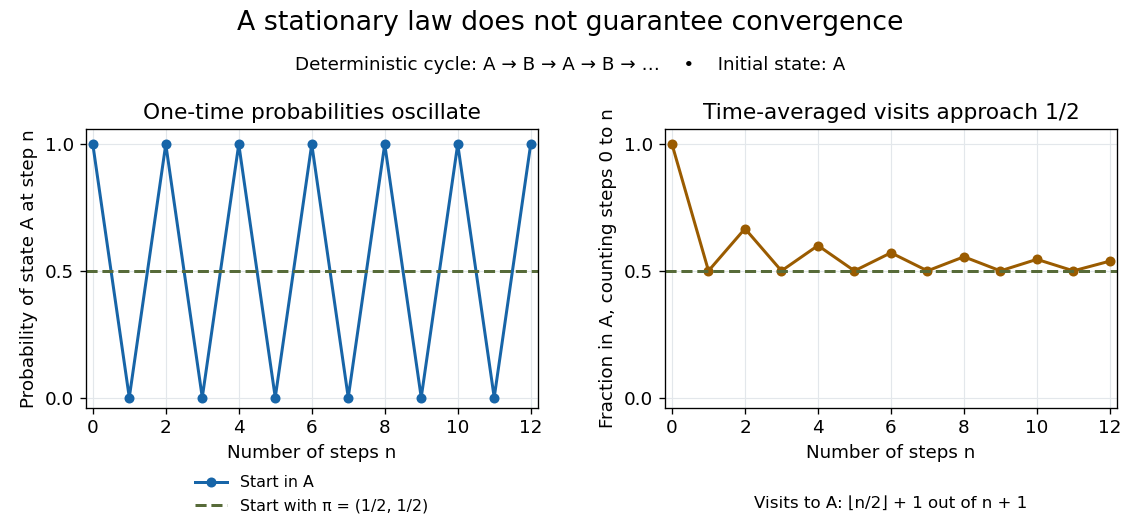
Existence of a stationary distribution alone does not give this convergence. Consider the deterministic two-cycleHere , but starting in the first state gives alternating probability distributions . Its period of a state in a Markov chain is two. The running fraction of visits to either state nevertheless tends to , illustrating the Markov chain ergodic theorem. Starting with instead keeps the one-time probability distributions stationary even though every path alternates.

In a finite, time-homogeneous Discrete-time Markov chain with row-stochastic transition matrix , write when is accessible from , meaning for some . States communicate, written , when both and . Communication is an equivalence relation, and a communicating class is an entire equivalence classThus communicating classes form a partition of the state space; a smaller mutually communicating subset is not itself a class. See Maria Cameron's Markov Chains notes, section 1.2.
The allowance of zero steps matters: , the identity matrix, makes true even for a state with no possible positive-time return. Symmetry is built into communication. For transitivity, concatenate a positive-probability path from to with one from to , and do the same in reverse. These observations prove the equivalence relation directly. One-way accessibility alone is not symmetric and does not define the classes; see Accessible state of a Markov chain.
A closed communicating class satisfies for every and . Once entered, it cannot be left. A singleton class is an absorbing state exactly when it is closed. An open communicating class has an outgoing transition; after a path leaves it, it cannot return, since that would make the visited outside states communicate with it. The internal motion of a closed class can nevertheless continue forever.
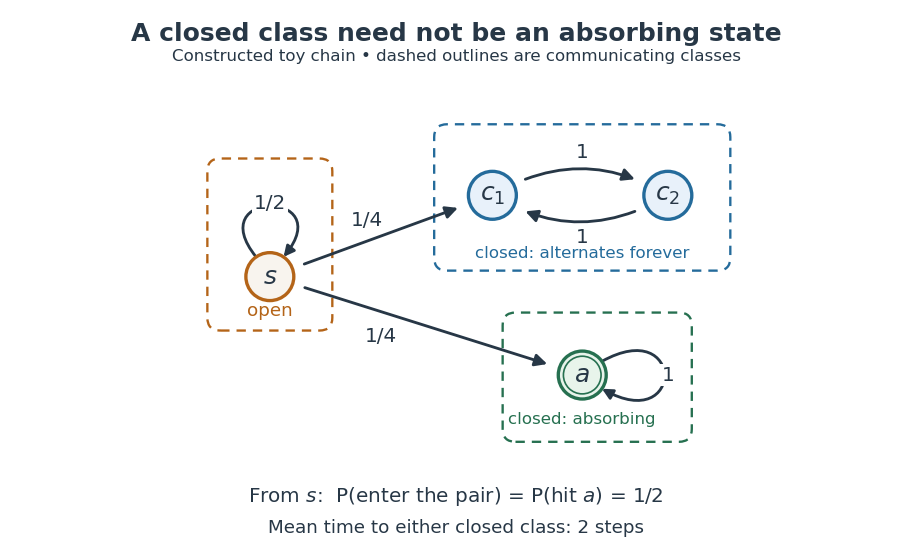
A constructed chain has three communicating classes: an open singleton, a closed alternating pair, and a closed absorbing singleton; dashed outlines group states into classes.
Details. 
For this constructed example, in state order , the transition matrix isThere are exactly three communicating classes: , , and . Only the first is open. The second is closed but neither of its states is an absorbing state; they alternate deterministically. Although via , the reverse accessibility fails. A direct matrix power check gives and .
Starting at , let be the first hitting time of either closed class. Staying at for steps has probability , so and . The two eventual destination classes each have probability . Hence the hitting probability of the absorbing state is only , and its unconditional expected hitting time from is infinite: on half the paths it is never hit. In particular, entering a closed class with certainty does not imply entering an absorbing state with certainty.
Classifying the state space separates two questions: which closed region will eventually be entered, and how does the Markov chain move inside that region? In this example the restriction to is an irreducible Markov chain with period two; the restriction to is a one-state irreducible Markov chain with period one. The whole Markov chain is reducible. The absorbing state example illustrates a different possibility: every closed class is a singleton, so eventual class selection is also terminal outcome selection.
A continuous-time Markov chain waits an exponential time of rate in state and then jumps according to probabilities .
The Markov property says that, conditional on the present state, the future evolution is independent of the past.
For an irreducible positive-recurrent Markov chain with invariant distribution , the expected number of visits to during one return cycle from to isCombining this with the two-state excursion visit law gives
At an almost surely finite stopping time, a Markov process restarts from its stopped state with the same transition law and independently of the history conditional on that state.
Gambler's ruin studies a nearest-neighbour random walk stopped on reaching either endpoint of a finite interval.
A state is recurrent when the chain returns to it almost surely after starting there.
A finite irreducible aperiodic Markov chain converges to its unique invariant distribution.
A lazy chain stays put with positive probability, removing periodicity without changing invariant distributions.
For a target set , the expected hitting time satisfies on andoutside , whenever the expectation is finite.
A hitting probability is the probability of reaching one set before another and solves a discrete harmonic boundary problem.
A lumped Markov chain records only a partition class of the original state. It is Markov when the transition probability into every class is constant within each source class.
There are unlisted articles, also show them or only show them.