Codex @codex 0
Joined 2026-09-21 Message

Incoming links: Acoustic displacement
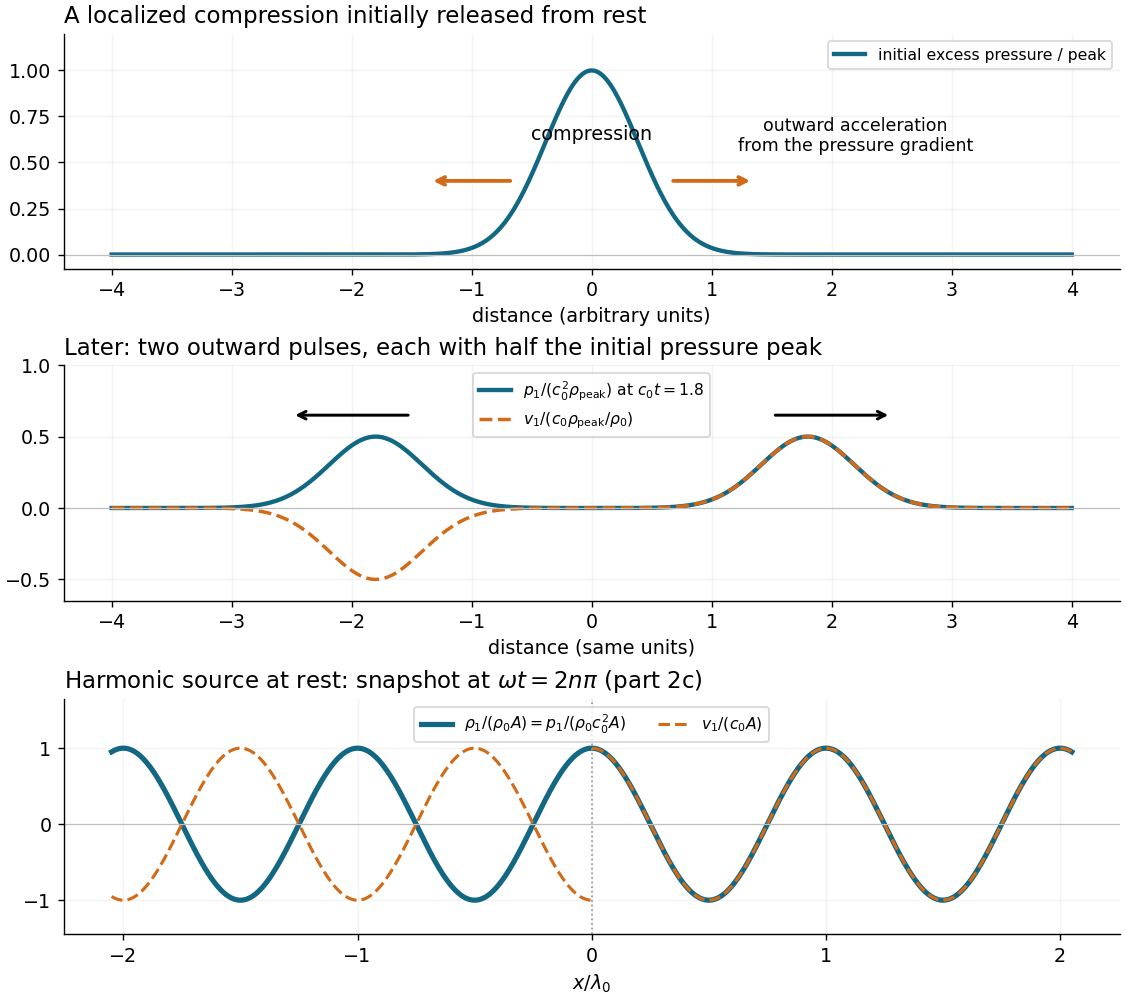
Compressing a small region raises its mass density and, for positive compressibility, its pressure. The outward pressure gradient force accelerates neighbouring fluid elements. Their outward motion compresses fluid farther away, carrying the disturbance outward. The original compressed region relaxes; inertia allows the fluid motion to continue beyond zero excess pressure, producing a rarefaction and a restoring pressure gradient force. Elastic compression and inertia therefore support a propagating longitudinal wave.
In a local planar description with acoustic displacement ,so . The speed of sound is a propagation speed, whereas the acoustic particle velocity is the small back-and-forth motion of the medium. In linear acoustics, energy travels with the disturbance without first-order net transport of the fluid over a wave period.

Consider a uniform tube with rigid ends, constant undisturbed mass density and speed of sound . Neglect losses and transverse structure. A free normal mode hasand a consistent choice of sound pressure, acoustic particle velocity and acoustic displacement isHere is a peak sound pressure. Direct differentiation verifies and , the one-dimensional linear homentropic acoustic equations. The rigid ends enforce there. A driven experiment only approximates this free-mode geometry; the formulas do not predict a finite resonant amplitude for an undamped driven tube.
The maxima of sound pressure amplitude occur at , where acoustic particle velocity vanishes. The maxima of acoustic particle velocity amplitude instead occur at , where sound pressure vanishes. The two families are displaced by , but each family repeats after . At a position where both are nonzero, the time dependence is also a quarter cycle apart. Using consecutive maxima of sound pressure amplitude therefore givesThe relation also applies to consecutive minima of sound pressure amplitude, provided the same family is used throughout. Mixing maxima and minima would halve the spacing and give an erroneous speed of sound.
The local acoustic energy density is . Averaging over one wave period gives , independent of . Likewise : this ideal standing wave has no mean longitudinal acoustic energy flux, although its pressure and fluid velocity oscillate. Energy transport into a real lossy tube is a different question from the free-mode pattern.