The additive energy of a finite set in an abelian group counts additive quadruples, with order and repeated members allowed:At a fixed sum , independently choosing two of its ordered pairs gives additive quadruples. Thus additive energy weights heavily represented sums more strongly than the cardinality of the sumset does.
For and , the sumset representation functions giveThe arithmetic progression has additional coincidences such as . The set still has coincidences forced by commutativity, including , so its additive energy is not merely the sixteen identical-pair comparisons.
The same additive energy can be counted using the difference set. Define . The identity is equivalent to , and the coordinate rearrangement is a bijection. ConsequentlyFor , the difference counts from through are again . For , the zero difference has four representations and each of the twelve nonzero differences has one, giving . The sumset representation functions for sums and differences can look different while their squared totals agree.
For every nonempty finite set in an abelian group ,The lower bound follows from the Cauchy-Schwarz inequality and the total sumset representation function count:For the upper bound, any three members determine at most one fourth member of an additive quadruple. See Yufei Zhao's MIT lecture 25, pages 1-3, for representation counts and the energy bounds.
In the two integer examples, the lower bounds are and , and the upper bound is . For the subgroup of , each element of has three sum representations, so and both bounds are equalities.
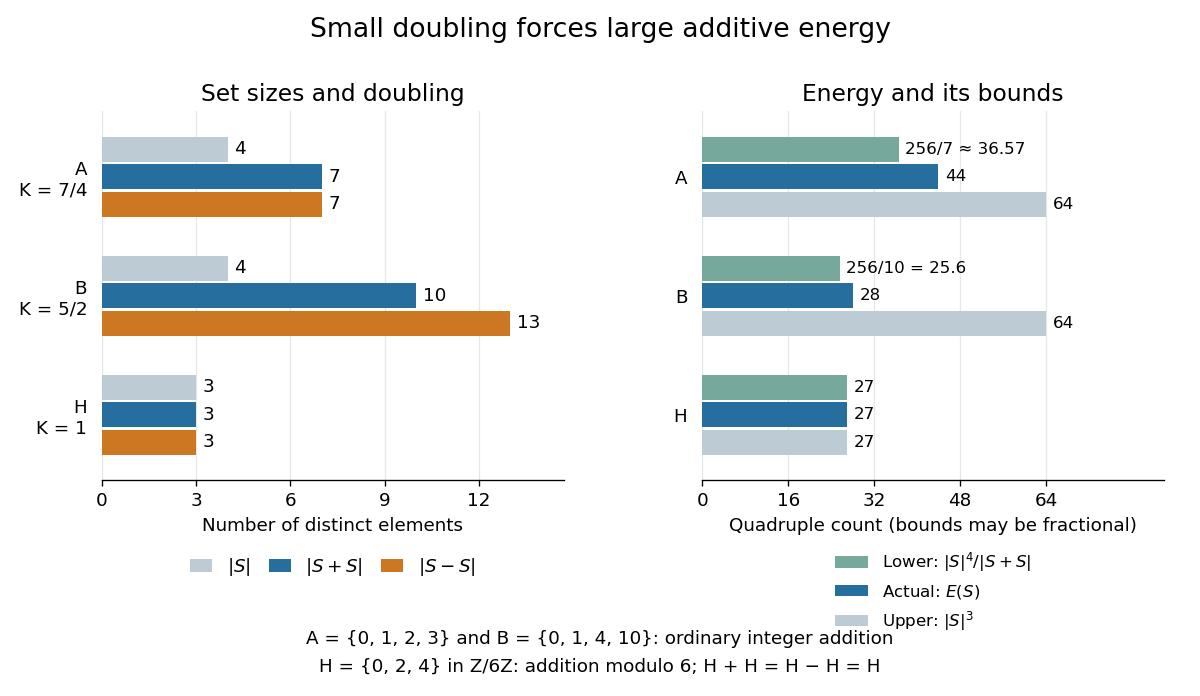
Sumset and difference-set sizes alongside additive energy and its bounds, including a cyclic subgroup
. Details. 
For nonempty , dividing additive energy by gives a relative measure between and one. Small doubling constant therefore forces relatively large additive energy. A converse requires care: the Balog-Szemerédi-Gowers theorem extracts a large subset with small doubling constant, rather than asserting that all of has small doubling constant.
If a subset of a cyclic group has normalized additive energy at most , every nonconstant Fourier coefficient on a finite abelian group of its indicator has modulus at most . Expanding the count of gives the frequency product . The Cauchy-Schwarz inequality and Parseval identity on a finite group bound its nonconstant part by the displayed quantity. Character doubling has multiplicity , so no assumption that the modulus is odd is needed. The error is a normalized density error multiplied by .
For a set of shifts and a map into a circle group, this additive energy counts quadruples whose shift sums and frequency sums both agree. It is the additive energy of the graph of in the product abelian group.
Suppose on a finite cyclic group, has density , and for each the multiplicative derivative has a Fourier coefficient on a finite abelian group of magnitude at least at . Align the correlation phases, apply Cauchy-Schwarz, group pairs by their shift and frequency differences, and apply Parseval identity. This proves the displayed lower bound on additive energy of a frequency graph without replacing exact frequency equalities by approximate ones.
Use the unnormalized Fourier transform and . Normalize each derivative correlation by and align its phase. Their absolute sum is at least . One Cauchy-Schwarz inequality, expansion by shift/frequency differences, and a second Cauchy-Schwarz inequality bound its fourth power by times the additive energy of a frequency graph. Parseval identity on a finite group supplies the factor ; exact equality of both shift sums and frequency sums is retained.
For every , some has this property: any nonempty finite with has an arithmetic progression of length at least in . The small-difference-set form of the Balog-Szemerédi-Gowers theorem, Ruzsa modelling lemma, cyclic Bogolyubov lemma and nonwrapping progression in a cyclic Bohr set prove it. An order-eight Freiman s-isomorphism suffices to lift the progression because its consecutive second-difference equations expand into equalities of eight-term sums.
A popular sum of a finite set is an element having at least a specified number of ordered representations as , with . Popular sums define a dense bipartite graph when additive energy is large. Since the total representation count is , there are at most popular sums.
If a finite set has at least additive quadruples, then it contains with and for an absolute constant .
There are absolute such that finite sets of size , a bipartite graph of density at least , and a restricted sumset of size at most yield subsets with and . A graph formed by popular representations of sums turns this into the usual large-additive energy form of the Balog-Szemerédi-Gowers theorem.
Let a bipartite graph have vertices in each class and at least edges. There is a subset of one class with such that every pair of its vertices has at least four-edge walks between them. Declare a pair of left vertices bad if it has fewer than common neighbours, with . For a random right vertex , put and let count ordered bad pairs inside . Then and . Some has , so and . Remove vertices with more than bad partners. At least half remain. For any two remaining vertices, at least middle vertices are good partners of both. Each supplies at least walks, giving the bound.
If , a subset satisfies and . A dependent random choice argument in the popular sum graph finds many four-edge paths representing each member of the difference set. The Petridis minimal-growth lemma then bounds all higher iterated sumsets and difference sets.
Articles by others on the same topic
There are currently no matching articles.