Additive combinatorics studies how the cardinalities and sumset representation functions of sumsets reveal structure in finite sets contained in abelian groups. Write the group operation as addition: the ambient abelian group may be the integers , a finite cyclic group, or another abelian group. The same definitions apply, but the ambient group changes which bounds are possible.
The basic experiment is to add every ordered pair of members of a finite set. The sumset records the distinct answers; the sumset representation function records how often each answer occurs; the additive energy counts coincidences between those answers. An arithmetic progression produces many repeated sums, so its sumset grows slowly and its additive energy is relatively large. The doubling constant measures that growth relative to the original cardinality.
The examples below compare the arithmetic progression with the more spread-out integer set . Their four members give sixteen ordered pairs in each case, but different numbers of distinct sums. This small comparison illustrates the definitions; it does not establish a claim about arbitrarily large sets. For a systematic introduction, see Tao and Vu's author page for Additive Combinatorics, with free sample chapters on sum set estimates and additive geometry.
The multidimensional Szemerédi theorem says that a subset with positive upper density contains a translated positive integer dilate of every finite set . In the finite formulation, for every and finite , all sufficiently large integer boxes have this property for every subset occupying at least an fraction of the box. The one-dimensional case for is the Szemerédi theorem. The general result follows from multiple recurrence for commuting measure-preserving transformations.
A frequency function built from an affine variable and its fractional part. Irrational and can give many exact additive relations because each pair sum has only two possible floor carries. For example , gives additive quadruples on , but agreement with every ordinary affine function occurs on only shifts. Integer floor points underlying affine agreement must be collinear.
Use four parts indexed by in a cyclic group , and include the triple missing part when . A transversal three-uniform tetrahedron then has the four values , where and , so it encodes a four-term arithmetic progression. Constant progressions give edge-disjoint tetrahedra. This is the bridge from the tetrahedron removal lemma to the Szemerédi theorem.
For every , every sufficiently long integer interval has a nonconstant three-term arithmetic progression in each subset of subset density at least . This is a theorem about additive combinatorics, distinct from the Roth theorem on approximation of algebraic irrational numbers. The Roth density-increment step proves it by repeatedly increasing subset density on a shorter arithmetic progression.
If a density- subset of a sufficiently long integer interval has no nonconstant three-term arithmetic progression, Fourier expansion of the progression count gives a large coefficient of its balanced indicator. Dirichlet approximation supplies a step at most on which that character varies slowly. Partitioning the interval into equal-length progressions of that step, and controlling the short tails, produces the displayed density increment. Iteration must terminate since density cannot exceed one. The same argument treats the three-point pattern with coefficients .
Embed in the odd cyclic group , so additive three-term relations in cannot wrap around. Form three copies of , putting edges when , when , and when . A triangle in a graph encodes in . If has no nonconstant arithmetic progression, every triangle in a graph has ; there are exactly triangles in a graph, and they are edge-disjoint. Thus at least edges must be removed to eliminate them. For fixed positive subset density of , this is a positive fraction of the squared vertex count, whereas the triangle in a graph count is only quadratic. The triangle removal lemma permits deletion of an arbitrarily small quadratic fraction when the cubic triangle in a graph subset density is sufficiently small. This contradiction establishes Roth theorem on three-term arithmetic progressions.
Write for the maximum cardinality of a subset of containing no nonconstant three-term arithmetic progression. There is an absolute constant such that every three-term-progression-free subset satisfies for . A quantitative Roth density-increment step gives, for subset density and , a arithmetic progression of length at least and increased subset density at least . The increment decreases reciprocal subset density by at least , so fewer than iterations are possible. If is the successive length, then , using the initial subset density to bound all later ones. Hence . If exceeds a sufficiently large absolute constant, all these intervals remain above the density increment threshold, a contradiction. This proves the displayed bound. The result is a classical quantitative version of Roth theorem on three-term arithmetic progressions, without asserting an optimal bound.
For fixed , a sufficiently large finite set of integers with additive energy at least has a nonconstant three-term arithmetic progression. The Balog-Szemerédi-Gowers theorem and Ruzsa modelling lemma reduce the problem to the Roth theorem on three-term arithmetic progressions in a dense cyclic model.
The product set of two sets of real numbers is . It is a multiplicative counterpart of a sumset, not the Cartesian product .
For finite sets of nonzero real numbers, the multiplicative energy is the number of quadruples satisfying . Swapping shows that it also counts quadruples with . Thus , where counts product representations. The Cauchy-Schwarz inequality yields .
For finite sets of positive real numbers with , , with natural or binary logarithm. Partition ray occupancies of into classes of multiplicative width , or width for the binary convention. Injectivity of sums on two distinct rays and disjoint open planar sectors bound each class's sum of squared occupancies by . A singleton class contributes at most . Combining this with the energy lower bound gives a sum-product inequality.
A corner consists of these three points in the integer grid, all contained in the set being studied. The displacement may be positive or negative, but must be nonzero, so the points are distinct. The corners theorem guarantees a corner in every subset of positive fixed density of a finite subset of a sufficiently large square grid.
For every , all sufficiently large integers have the property that every with contains a corner in an integer grid. The tripartite graph encoding of a grid turns the absence of a corner into a family of many edge-disjoint triangles but only quadratically many total triangles in a graph, contradicting the triangle removal lemma.
For a real-valued function on a nonempty finite Cartesian product , its normalized cut norm is the maximum of over . It measures all rectangular subset discrepancies. The convention using arbitrary test functions bounded by one is equivalent within a factor of four, by decomposing their positive and negative parts into indicator functions.
Non-abelian additive combinatorics studies product sets and configuration counts in noncommutative groups. Fourier analysis on a finite group and quasirandom groups connect small-dimensional group representations with multiplicative mixing.
For on a finite group, use uniform expectation over the solutions of and the ordinary, unnormalized trace to define the displayed fourth-order quantity. If is its matrix Fourier block, this quantity equals , so it is real and nonnegative. For a scalar function on an abelian group, it reduces to the usual fourth power of the Gowers uniformity norm of order two. The unnormalized trace means a unitary matrix-valued function can have fourth-order quantity as large as .
If and , select the singular values of the matrix Fourier blocks. Their weighted count lies between and . Scaling unit right singular vectors and their corresponding unit left singular vectors by gives matrices satisfying and Hilbert-Schmidt inner product orthogonality within each chosen irreducible representation. The Schur averaging of rectangular matrices then gives for the concatenated and the corresponding block diagonal matrix .
For and a degree- unitary irreducible representation, the matrix Fourier block is the operator on defined in the title. Its singular values satisfyPointwise operator norm at most one implies . These blocks are operators on a matrix space, rather than simply the entrywise scalar Fourier transform on a finite group without any reshaping.
A finite group is -quasirandom if every nontrivial irreducible representation over the complex numbers has degree at least . The trivial representation is excluded. Large suppresses correlations of products of arbitrary subsets, through product mixing in a quasirandom group.
For an -quasirandom group, uniform expectations, and the normalized convolution on a finite group, a scalar mean-zero function satisfiesThe Fourier analysis on a finite group proof bounds each nontrivial matrix component of in operator norm using its weighted Hilbert-Schmidt norm. For subsets of subset density values , the error in their normalized product count is at most . In particular guarantees a solution of in the three subsets.
For a finite group, choose one unitary irreducible representation of degree from each equivalence class. One consistent normalized Fourier transform on a finite group convention is . The Schur orthogonality relations giveThe normalized convolution on a finite group satisfies in this convention. Using in the transform instead reverses that product order for scalar functions with the same normalized convolution on a finite group convention. The Fourier transform on a finite group has matrix-valued components even when the original function is scalar-valued.
For a scalar function on a group, use as the right-translation convention. For Fourier analysis on a finite group this gives . Specifying whether or appears in the definition avoids sign and multiplication-order ambiguity.
For a scalar function on a group, left translation by is . With the positive-representation convention for Fourier analysis on a finite group, .
For a scalar function on a finite group, one normalized transform convention assigns the matrix to each chosen unitary irreducible representation. This map is a weighted Hilbert space isomorphism by the Parseval identity on a finite group. Another common convention uses ; the corresponding convolution theorem on a finite group then reverses the matrix product order for .
For the Fourier transform on a finite group, the displayed identity uses uniform expectation in the original function space and a weighted Hilbert-Schmidt inner product in the matrix components. In particular . For an abelian group, all , and the identity becomes a sum of squared scalar coefficients.
The Fourier transform on a finite group convention has the displayed inversion formula. The sum is over one representative from each equivalence class of unitary irreducible representations. It follows from the Schur orthogonality relations and the regular representation decomposition, and holds at every group element without a limiting argument.
For scalar functions on a finite group, normalized convolution on a finite group is . It is associative and need not commute. Its identity is , rather than the unscaled indicator function of the identity element. The Fourier analysis on a finite group convention turns it into matrix multiplication in the same order.
The normalized convolution on a finite group and the Fourier transform on a finite group convention with satisfy the displayed identity. Substitute in the defining expectation and use . With the convention using instead, the scalar convolution has transform ; multiplication order matters for noncommutative groups.
For nonempty finite sets and a function on their Cartesian product, using uniform expectations, defineThis equals . Hence it is nonnegative, and vanishing forces by taking . Absolute homogeneity and the box Cauchy-Schwarz inequality establish that it is a norm. For a real-valued function the complex conjugates can be omitted. The bilinear correlation bound for the box norm also holds for complex functions.
Give every entry of an by matrix an independent uniformly random sign. A four-entry rectangle product has expectation zero unless its two row indices coincide or its two column indices coincide; in those cases it is one. Counting the union of these diagonal cases gives before normalization. Thus some sign matrix has box norm fourth power at most the displayed expectation, and its cut norm tends to zero when both dimensions tend to infinity.
For a real function bounded by one on a finite Cartesian product, the fourth power of its box norm is the mean of . Two applications of the Cauchy-Schwarz inequality bound every rectangular discrepancy by the box norm. Conversely, decompose each bounded real test function into positive and negative parts and use the layer cake representation. Its bilinear pairing with is at most four times the cut norm. Applying this to the row and column tests furnished by fixed bounds the fourth moment by four times the cut norm. These dimension-independent estimates make the two notions of small discrepancy equivalent.
For a complex function on , its eighth power is the average of the conjugated product over the eight vertices of a coordinate cube. Three successive applications of the Cauchy-Schwarz inequality show that it bounds correlation with a product of three bounded functions, each omitting one coordinate. This is the analytic estimate behind the tetrahedron counting lemma.
For a real function on and functions bounded in absolute value by one,First apply Cauchy-Schwarz inequality in to remove , duplicating . Apply it in to remove , duplicating . Finally apply it in to remove the four factors, duplicating . The resulting eighth-power bound is exactly the eight-factor average defining the three-dimensional box norm. Functions depending on just one coordinate, or constants, can be incorporated in any of the three pair factors.
For a real-valued function on a nonempty finite Cartesian product, let with uniform inner products. The box norm obeys , where are its singular values. For a biregular graph this separates the constant component from the other fourth powers.
With uniform expectations and real or complex functions,Apply the Cauchy-Schwarz inequality first in . Expand the remaining square, and apply the Cauchy-Schwarz inequality in to and . Their squared averages are and , respectively.
Let a tripartite graph have nonempty parts , pair edge density of a bipartite graph values on , and . If every has exactly neighbors in , its normalized triangle count obeysThe constant-degree assumption makes the contribution of the constant exactly . For each fixed , apply the bilinear correlation bound for the box norm to the indicator functions of its two vertex neighbourhoods. Their squared norms are and the relative -degree of . Average over and use the Cauchy-Schwarz inequality to bound the mean square root of that degree by .
For four real-valued functions on a finite Cartesian product, let . Repeated Cauchy-Schwarz inequalities giveFirst separate the two averages and apply Cauchy-Schwarz inequality in . Each resulting squared factor is , bounded by by another Cauchy-Schwarz inequality. Expanding the four factors of and applying this inequality to each of the sixteen terms gives the triangle inequality for the box norm.
The sum-product phenomenon says that a finite subset of a field cannot usually have both a small sumset and a small product set unless it has additional subfield-like structure.
Write and suppose some nonzero has . The mixed-set Plünnecke-Ruzsa inequality gives and . The Ruzsa covering lemma covers by at most translates of . Covering two dilates proves the addition bound. First covering , then both copies of in , proves the multiplication bound. The Ruzsa triangle inequality also gives . These bounds transfer controlled additive expansion through a bounded-complexity expression in scalars.
For positive , suppose and . Repeatedly replace a scalar set by . Quadratic growth of a sixfold product difference set reaches size at least in a number of steps depending only on . The closure bounds for small skew-sumset scalars transfer a putative bound to all these scalars with exponent depending only on the number of steps. Averaging collisions over the resulting large scalar set then forces . This supplies a positive exponent depending only on . The finitely many smaller primes are covered by the strict inequality for every nonzero when .
For with , put using nonzero denominators. If is proper, some lies outside , since invariance under addition of one would give all of the prime field. The map on is injective. Clearing the denominator in a representation of puts a dilate of its image inside . If is the full field, averaging the collision count of gives some with . Clearing its denominator puts a dilate inside . Here is a product set, and the prefactors denote repeated sumsets, not scalar multiplication.
For finite with and ,In particular, addition and multiplication cannot both expand a nontrivial finite set of complex numbers only slightly.
For nonempty finite set and , let be the density of a finite subset. The balanced indicator function , extended by zero to an ambient finite group, has sum zero and vanishing zero Fourier coefficient. The sum of on a subset is , measuring the excess density of a finite subset there.
A Sidon set in an abelian group is a subset for which an equality with forces the unordered pairs and to be equal. Equivalently, the ordered nonzero differences with are all distinct.
For a Sidon set , put and let count points in a window of consecutive integers. Each point occurs in windows, so . Cauchy-Schwarz gives . Each positive difference occurs at most once and contributes windows, giving the upper bound . Thus . Taking gives the displayed estimate, which combines with the Bose-Chowla Sidon construction to determine the asymptotic maximum.
Choose a generator of the multiplicative group of the quadratic finite field extension. Its shifts define distinct exponents modulo . Equality of two sums of exponents gives . Since are independent over the prime field, and , so the unordered pairs coincide. Thus the exponents form a Sidon set in the cyclic group. Taking integer representatives preserves the Sidon property. Primes within below give representatives in an interval of length .
A linear configuration count is a weighted sum over tuples satisfying prescribed linear equations. Orthogonality of complex exponentials often rewrites such a count as an integral of Fourier transforms.
Suppose a linear configuration count has a Fourier-integral representation with factors. If one has a uniform Fourier bound for the difference between two weights and compatible bounds for each weight, expanding the difference one factor at a time and applying Hölder's inequality bounds the change in the count.
A transference principle replaces a function bounded by a sparse pseudorandom majorant with a bounded dense model that is indistinguishable by a chosen family of tests. Results for bounded functions can then be transferred to the sparse setting.
For a family of real-valued functions on a finite set and normalized inner product , the test-function seminorm isIt measures the largest correlation of with an allowed test. It is a seminorm, and becomes a norm when the tests separate points.
The dual test-function norm isIf is closed, convex, and symmetric, the Bipolar theorem for a dual pair identifies its dual unit ball with . Submultiplicativity under pointwise products allows a polynomial in one test function to remain controlled in this norm.
Let be a closed, convex, symmetric family of functions into that contains the constant function , and suppose its dual test-function norm is submultiplicative under pointwise products. If a nonnegative majorant has average at most one and is exponentially small in , then every has a dense model satisfyingThe proof separates from the convex set of dense models, then approximates the positive part of the separating test by a polynomial. Submultiplicativity controls every power in that polynomial.
On any fixed compact interval, the positive part of a real-valued function can be approximated uniformly by a real polynomial. Quantitative dense-model arguments use a version whose degree and coefficient growth are explicitly controlled in terms of the approximation error.
For finite sets in an abelian group , their sumset isEach distinct value occurs only once in this set, even if many ordered pairs produce it. When , repetitions are allowed: belongs to . For the two integer sets introduced above,For , the value comes from . For , two ordered pairs give the same sum only when one reverses the other, apart from a pair being identical to itself. Thus its four pairs and six pairs with distinct members, counted without regard to order, produce ten distinct sums.
Every nonempty finite set of integers satisfies . To see this, list its members as . The distinct sumsall belong to . A nonconstant arithmetic progression attains this bound. The ordered list is essential: in the cyclic group , the subgroup instead satisfies , of cardinality three. Addition wraps around, for example in this group.
For finite sets in an abelian group , the sumset representation function isIt counts ordered pairs in the Cartesian product, so and are different when , even though commutativity makes their sums equal. It is zero outside the sumset, andFor , its values at are . For , its values at the increasing elements of are . Both lists total sixteen, but the first concentrates more ordered pairs on fewer sums. This distinction is what additive energy quantifies.
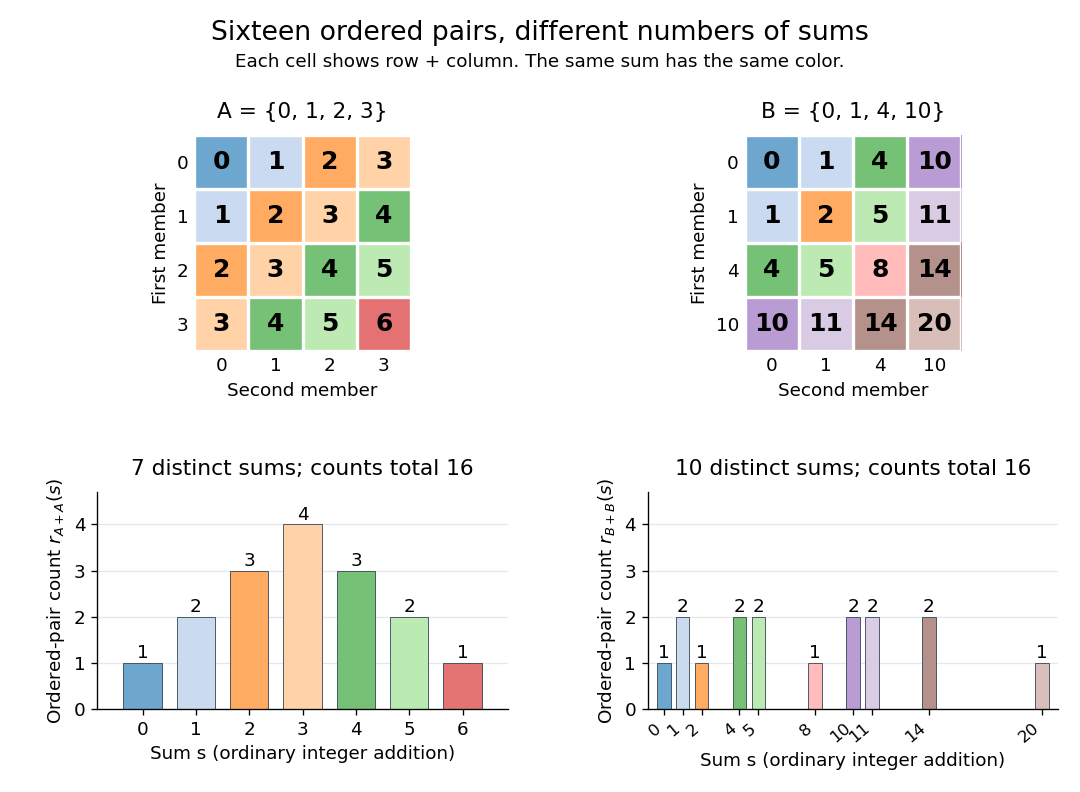
Ordered-pair sums and representation counts for an arithmetic progression and a spread-out integer set
. Details. For a subset of density in a finite cyclic group, put using normalized convolution on a finite group. Its average is , so choose with . Retain the large spectrum where . The Parseval identity on a finite group gives at most frequencies. Their phases change by at most on the associated Bohr set, contributing at most to the change of . The discarded frequencies contribute at most another , since . Therefore on the Bohr set, proving the containment.
For fixed positive density , every sufficiently large of size at least has a long arithmetic progression in its triple sumset. Embed it in , where its density is at least . A translated Bohr neighborhood in a triple sumset has bounded rank and fixed positive radius depending only on . A torus pigeonhole principle argument supplies a nonzero step whose small multiples stay in the Bohr set, with polynomially many multiples. All resulting residues have representatives in , an interval shorter than half the modulus, so their successive ordinary integer differences agree and give an actual integer arithmetic progression. The positive constant prefactor is absorbed by reducing the exponent for sufficiently large .
Given numbers , the sum associated with a subset of indices is . The empty subset gives zero. The set of all these values is the sumset .
For , adding the largest integer creates at least new sums of subsets. If is the previous maximum, the values and for are distinct new sums above . Induction gives the displayed bound. Equality holds for , whose subset sums fill the interval of integers from zero to .
Represent each element of by the lexicographically least tuple with that sum. Every coordinate projection of the resulting tuple set is itself lexicographically least for its partial sum: replacing it by a smaller representative would improve the original tuple without changing its sum. Consequently projected cardinalities are at most the corresponding partial sumset cardinalities. Projection inequalities, including the box theorem, therefore give sumset inequalities.
For finite sets in an abelian group and a bipartite graph , the restricted sumset is . It retains only sums corresponding to graph edges.
For nonempty finite subsets of an abelian group, implies that some nonempty satisfies this bound simultaneously for every integer , with . The Petridis minimal-growth lemma proves this by choosing to minimize . The Ruzsa triangle inequality then gives the Plünnecke-Ruzsa inequality .
For a nonnegative integer , the iterated sumset is the sum of copies of , with . Repetitions are allowed, so its elements are sums with each .
For finite sets in an abelian group , their difference set isHere is the additive inverse in . The difference set records possible displacements from a member of to a member of ; it is distinct from the set difference .
For the integer sets and ,The positive differences for are , each obtained once; reversing each ordered pair supplies the corresponding negative difference. Every nonempty finite set has , with representations . Swapping the members of an ordered pair also shows . In the cyclic group , the subgroup satisfies as well as .
The doubling constant of a nonempty finite set in an abelian group isIt measures the cardinality of the sumset relative to the original set. For the integer examples, and . A nonconstant arithmetic progression with members has doubling constant , which stays below two as grows. This is the sense in which its sumset has small growth.
In any abelian group, : fixing puts a translated copy inside . The stronger integer bound gives only in that setting. A finite subgroup has , as does every coset , since its sumset is . In particular has doubling constant one.
Small doubling constant is useful because it constrains repeated growth, as in the Plünnecke-Ruzsa inequality. It signals structure such as arithmetic progressions and subgroups; precise descriptions depend on the ambient abelian group and are the subject of the Freiman-Ruzsa theorem. The additive energy bound below gives a simpler immediate consequence: .
For a finite nonempty subset of an abelian group with doubling constant at most , the Plünnecke-Ruzsa inequality gives . Applying the Ruzsa covering lemma to using gives for and . Thus , and counting multiplicities in the finite set proves the displayed polynomial bound. For fixed , it is eventually at most for every .
If finite sets satisfy , then the Plünnecke-Ruzsa inequality bounds iterated sumsets and difference sets by
If a nonempty finite set minimizes among the nonempty subsets of , with minimum , thenfor every finite set . Iteration is a short proof of the Plünnecke-Ruzsa inequality.
For finite subsets of an abelian group with nonempty,An injective encoding chooses one representation of each element of and translates it by every element of .
For nonempty finite subsets of an arbitrary group,Choose one representation for each . The map is injective.
If a finite subset of a group satisfies , then repeated use of the Noncommutative Ruzsa triangle inequality gives
Let be a finite subgroup and choose with . For , the set has size at most , while contains the double coset of size . Thus bounded doubling alone gives no tripling bound in arbitrary groups.
For every , a finite set in an abelian group with is contained in a coset progression of rank and relative size bounded in terms of alone.
A finite nonempty set of integers with bounded doubling lies in a generalized arithmetic progression with rank and relative size bounded only by the doubling constant. A proof models a large subset in a dense cyclic set, finds a Bohr set in its fourfold difference set by Fourier analysis, and uses the progression in a Bohr set from successive minima. The progression lifts through a sufficiently high-order Freiman isomorphism. A greedy covering of the original set by translates of its doubled progression then gives the claimed containing progression. Geometry-of-numbers properification may make the final progression proper.
Let be a nonempty subset of with doubling constant at most . Translate to containing zero. The Petridis minimal-growth lemma and Ruzsa triangle inequality bound . In injective linear modelling of a small sumset, the image has density at least . The Finite-field Bogolyubov lemma finds a subspace of codimension at most in its fourfold sumset.
After lifting a subspace through a Freiman model, obtain with . The set uses at most cosets. Their representatives generate a quotient group of size at most two to this number. Since , adjoining those representatives and proves the displayed bound. Its constants are deliberately coarse, but depend only on . The nonempty assumption is necessary: no vector subspace has cardinality at most a constant times the size of the empty set.
For a finite subset containing zero, choose and a uniformly random linear map . Each fixed nonzero vector has zero image with probability . The union bound gives a map whose kernel meets only at zero. It is injective on , and . The Plünnecke-Ruzsa inequality makes the image of have density at least if .
Under injective linear modelling of a small sumset, every has a unique lift , because differences of two lifts lie in . For , the discrepancy lies in , so it is zero. Thus is a linear map and its image is a vector subspace of the same size as . This verifies the additive lifting step rather than assuming that a preimage chosen from a sumset is automatically a subspace.
For fixed density , rank , and progression length, every sufficiently large proper coset progression of rank at most has the property that each subset of relative density at least contains a nontrivial arithmetic progression of that length. This follows from the multidimensional Szemerédi theorem.
For every there is such that a set with and contains a nontrivial three-term arithmetic progression. The Freiman-Ruzsa theorem places densely in a bounded-rank coset progression, where the Szemerédi theorem in a bounded-rank coset progression applies.
A -approximate group is a finite symmetric subset of a group for which some set with satisfies . In additive notation the covering condition is .
For every finite -approximate group in a group , there are subgroups such that is a nilpotent group of class , and is contained in the union of left cosets of .
If is a finite -approximate group, thenfor every positive integer , where and . This follows immediately by mathematical induction.
If is a -approximate group in and , then is a -approximate group. Indeed, the at most translates of covering induce at most that many translates of covering , and the same argument covers its square inside .
If is a finite -approximate group in a torsion-free -step nilpotent group, then there are approximate groups , each with approximation parameter and each generating a group of class less than , such thatThe proof applies the large-progression form of the Freiman-Green-Ruzsa theorem in the abelianization, lifts its subgroup and cyclic directions, and uses the intersection of an approximate group power with a subgroup.
Let be the abelianization map and let be a finite -approximate group. Suppose a coset progression lies in and has size at least . ThenA section of is multiplicative up to a bounded power of inside the commutator subgroup; successively separating the subgroup and progression coordinates proves the inclusion needed for this estimate.
Let be a quotient group map, let be finite and symmetric, and suppose has . ThenChoose one lift in of each member of and multiply those lifts by . Distinct fibers are disjoint, while .
A subset of a multiplicatively written group is symmetric when it contains the identity element and . Consequently .
If finite sets satisfy , then a maximal family of disjoint translates , with , has at most members and gives
The additive energy of a finite set in an abelian group counts additive quadruples, with order and repeated members allowed:At a fixed sum , independently choosing two of its ordered pairs gives additive quadruples. Thus additive energy weights heavily represented sums more strongly than the cardinality of the sumset does.
For and , the sumset representation functions giveThe arithmetic progression has additional coincidences such as . The set still has coincidences forced by commutativity, including , so its additive energy is not merely the sixteen identical-pair comparisons.
The same additive energy can be counted using the difference set. Define . The identity is equivalent to , and the coordinate rearrangement is a bijection. ConsequentlyFor , the difference counts from through are again . For , the zero difference has four representations and each of the twelve nonzero differences has one, giving . The sumset representation functions for sums and differences can look different while their squared totals agree.
For every nonempty finite set in an abelian group ,The lower bound follows from the Cauchy-Schwarz inequality and the total sumset representation function count:For the upper bound, any three members determine at most one fourth member of an additive quadruple. See Yufei Zhao's MIT lecture 25, pages 1-3, for representation counts and the energy bounds.
In the two integer examples, the lower bounds are and , and the upper bound is . For the subgroup of , each element of has three sum representations, so and both bounds are equalities.
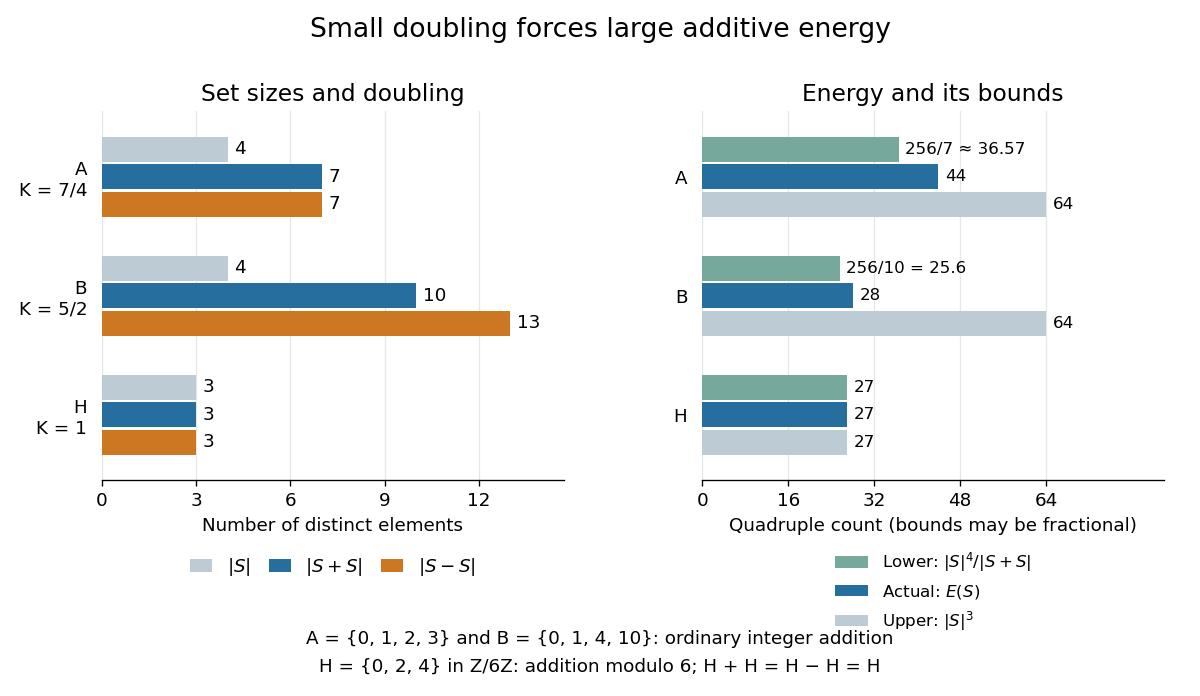
Sumset and difference-set sizes alongside additive energy and its bounds, including a cyclic subgroup
. Details. For nonempty , dividing additive energy by gives a relative measure between and one. Small doubling constant therefore forces relatively large additive energy. A converse requires care: the Balog-Szemerédi-Gowers theorem extracts a large subset with small doubling constant, rather than asserting that all of has small doubling constant.
If a subset of a cyclic group has normalized additive energy at most , every nonconstant Fourier coefficient on a finite abelian group of its indicator has modulus at most . Expanding the count of gives the frequency product . The Cauchy-Schwarz inequality and Parseval identity on a finite group bound its nonconstant part by the displayed quantity. Character doubling has multiplicity , so no assumption that the modulus is odd is needed. The error is a normalized density error multiplied by .
For a set of shifts and a map into a circle group, this additive energy counts quadruples whose shift sums and frequency sums both agree. It is the additive energy of the graph of in the product abelian group.
Suppose on a finite cyclic group, has density , and for each the multiplicative derivative has a Fourier coefficient on a finite abelian group of magnitude at least at . Align the correlation phases, apply Cauchy-Schwarz, group pairs by their shift and frequency differences, and apply Parseval identity. This proves the displayed lower bound on additive energy of a frequency graph without replacing exact frequency equalities by approximate ones.
Use the unnormalized Fourier transform and . Normalize each derivative correlation by and align its phase. Their absolute sum is at least . One Cauchy-Schwarz inequality, expansion by shift/frequency differences, and a second Cauchy-Schwarz inequality bound its fourth power by times the additive energy of a frequency graph. Parseval identity on a finite group supplies the factor ; exact equality of both shift sums and frequency sums is retained.
For every , some has this property: any nonempty finite with has an arithmetic progression of length at least in . The small-difference-set form of the Balog-Szemerédi-Gowers theorem, Ruzsa modelling lemma, cyclic Bogolyubov lemma and nonwrapping progression in a cyclic Bohr set prove it. An order-eight Freiman s-isomorphism suffices to lift the progression because its consecutive second-difference equations expand into equalities of eight-term sums.
A popular sum of a finite set is an element having at least a specified number of ordered representations as , with . Popular sums define a dense bipartite graph when additive energy is large. Since the total representation count is , there are at most popular sums.
If a finite set has at least additive quadruples, then it contains with and for an absolute constant .
There are absolute such that finite sets of size , a bipartite graph of density at least , and a restricted sumset of size at most yield subsets with and . A graph formed by popular representations of sums turns this into the usual large-additive energy form of the Balog-Szemerédi-Gowers theorem.
Articles were limited to the first 100 out of 176 total.
Articles by others on the same topic



Additive combinatorics is a branch of mathematics that studies combinatorial properties of integers, particularly focusing on additive structures within sets of numbers. It explores how subsets of integers can be analyzed using tools from both combinatorics and number theory, often involving questions about sums, differences, and other additive operations. Key topics in additive combinatorics include: 1. **Sumsets**: The study of sets formed by the sums of elements from given sets.