Alpha-globin is a globin chain used in several human hemoglobin assemblies. Two alpha chains pair with two beta-globin chains in hemoglobin A, or with two gamma-globin chains in fetal hemoglobin. Human alpha-chain production is associated with the HBA1 and HBA2 genes.[ref]
Human globin gene records in NCBI Gene. HBA1/HBA2 nomenclature and Summary, adult/fetal chain composition
A gene count, a chain count and a tetramer count describe different biological levels.Primary diffraction structures make the assembly distinction concrete. Adult deoxyhemoglobin record 4HHB contains alpha and beta chains, while fetal record 1FDH contains alpha and gamma chains.[ref]
The crystal structure of human deoxyhaemoglobin at 1.74 A resolution by G. Fermi and others. RCSB 4HHB, Macromolecules and Biological Assembly
[ref]Structure of human foetal deoxyhaemoglobin by J. A. Frier and M. F. Perutz. RCSB 1FDH, Macromolecules and Biological Assembly
A free alpha chain is not the complete oxygen-carrying tetramer.An original stoichiometry model asks what can be assembled from fixed chain pools. Let and be amounts of adult and fetal tetramers, and available chain amounts be for alpha, beta and gamma. Ignoring losses, other assemblies and kinetic restrictions,For 100 pmol alpha, 80 pmol beta and 60 pmol gamma, this gives , and . Forty pmol adult plus ten pmol fetal tetramers uses all alpha chains; twenty plus thirty does too. Increasing one product can consume the shared resource needed by the other.
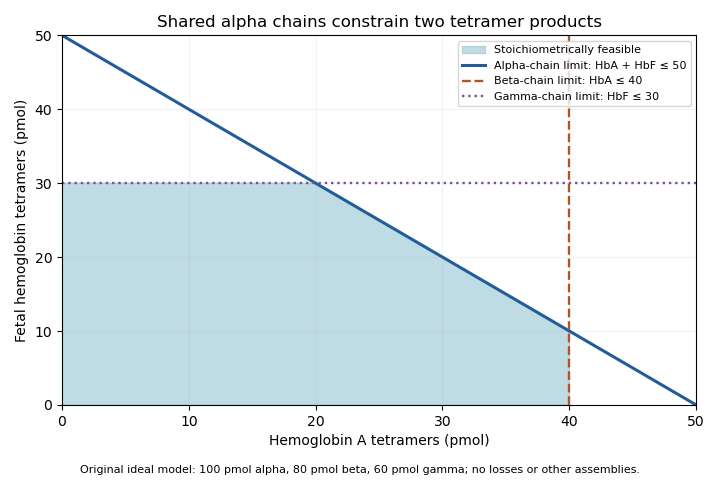
Original stoichiometric constraints on two tetramer products sharing an alpha-chain pool; no intracellular assembly rates are implied
. Details. 
The shaded region describes permitted amounts, not the product mixture a cell must actually make. Gene expression, chain stability and assembly pathways determine how much of each chain becomes available and incorporated. The calculation explains why measuring alpha-chain supply alone cannot identify the full hemoglobin composition.
Articles by others on the same topic
There are currently no matching articles.