Hemoglobin is an oxygen-binding protein; its oxygenation can supply a spectroscopic molecular oxygen readout, as in the early Hill reaction work.
Hemoglobin A, commonly HbA, is the major adult human hemoglobin assembly made of two alpha-globin and two beta-globin chains, .[ref] It is one hemoglobin form rather than a name for every hemoglobin molecule present in an adult. Fetal hemoglobin has a different non-alpha-chain composition.
Human deoxyhemoglobin structure 4HHB is a primary structural example. The associated study refined the model at using room-temperature diffraction data recorded on film with a synchrotron X-ray source.[ref]
The crystal structure of human deoxyhaemoglobin at 1.74 A resolution by G. Fermi and others. Primary abstract and RCSB Experimental Data
This connects the abstract notation with experimentally determined chain and haem organization.Composition and oxygenation are independent descriptors. Hemoglobin A can occur in oxygenated or deoxygenated states while retaining its alpha/beta identity. Each intact tetramer contains four haem sites, so a concentration expressed per tetramer differs by a factor of four from a haem-equivalent concentration.
For an original accounting example, take a pure preparation at 1.00 g/L and use a stipulated nominal tetramer molar mass of . Thenand haem-site concentration is about . If all sites are functional and mean oxygen occupancy is 0.80, bound oxygen concentration is about . Oxygen dissolved outside the protein is an additional pool. The assumptions are explicit teaching conditions, not a physiological reference range.
A primary spectral study measured both fetal and adult hemoglobin derivatives and found differences relevant to multicomponent analysis.[ref]
Absorption spectra of human fetal and adult oxyhemoglobin, de-oxyhemoglobin, carboxyhemoglobin, and methemoglobin by W. G. Zijlstra and others. Abstract
A measurement model should therefore state which protein-form and oxygenation-state spectra it uses, alongside the basis of the reported concentration.Fetal hemoglobin, commonly HbF, is a hemoglobin form built from two alpha-globin and two gamma-globin subunits, written . The major adult form, hemoglobin A, instead has the combination. Fetal identity concerns subunit composition; oxyhemoglobin and deoxyhemoglobin concern oxygen occupancy. The same fetal molecule can change its oxygenation state without becoming adult hemoglobin.
Primary structural evidence is available in the human fetal deoxyhemoglobin crystal structure 1FDH. Its experimental record identifies an alpha/gamma tetramer determined by X-ray diffraction at resolution.[ref]
Structure of human foetal deoxyhaemoglobin by J. A. Frier and M. F. Perutz. RCSB PDB 1FDH, Experimental Data Snapshot, Biological Assembly and Macromolecules
The related paper connects structural differences with weaker interaction with 2,3-Bisphosphoglycerate, an effector relevant to oxygen-binding behavior.[ref]Structure of human foetal deoxyhaemoglobin by J. A. Frier and M. F. Perutz. Indexed primary publisher abstract, diphosphoglycerate-site comparison
A structure constrains a mechanism, while an affinity curve requires a functional measurement under specified conditions.An original Hill equation model illustrates what higher oxygen affinity means. Let fractional occupancy at oxygen partial pressure beWith the same stipulated , compare midpoints and 30 in arbitrary pressure units. At , their occupancies areThe lower midpoint gives greater occupancy at the same pressure. It does not imply that the protein carries more than one oxygen molecule per available haem site. These midpoints and the exponent are teaching parameters, not measured fetal/adult reference values.
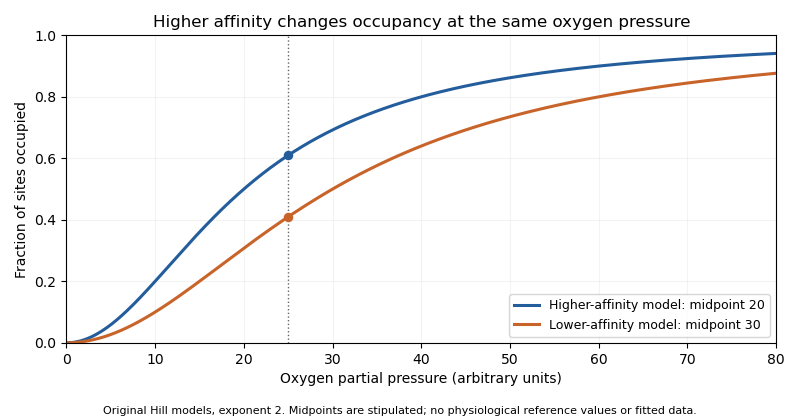
Original Hill models showing how a lower binding midpoint raises occupancy at the same oxygen pressure; parameters are illustrative
. Details. Subunit identity also matters analytically. A primary 1991 experiment measured fetal and adult hemoglobin derivative spectra over 450–1000 nm and found differences relevant to multicomponent analysis.[ref]
Absorption spectra of human fetal and adult oxyhemoglobin, de-oxyhemoglobin, carboxyhemoglobin, and methemoglobin by W. G. Zijlstra and others. Abstract
An optical model that distinguishes oxygenation states should therefore also justify which protein-form spectra it uses. Oxygen occupancy, subunit composition and total protein concentration are different quantities.Deoxyhemoglobin is the unoxygenated form of hemoglobin whose available haem sites can reversibly bind oxygen. Releasing oxygen produces a binding-state change, rather than the ferric iron state defining methemoglobin. Carboxyhemoglobin differs again because a competing carbon monoxide ligand occupies a binding site. These distinctions matter when interpreting the components of an optical measurement.
In the instrument convention for functional oxygen saturation, HHb denotes the unoxygenated, oxygen-capable component. Its concentration appears with oxyhemoglobin in the denominator:The HHb label is not an instruction to treat deoxygenation as addition of a hydrogen molecule. Functional saturation also uses a different denominator from fractional oxyhemoglobin referenced to total hemoglobin.[ref]
Oxyhemoglobin by Radiometer. FO2Hb versus oxygen saturation, definition of the functional denominator
An original independent-site model illustrates a further counting distinction. Let each of four sites have oxygen-occupancy probability , independently. The probability that a tetramer has exactly occupied sites isAt , half the sites are empty on average, while only of tetramers have all four sites empty. A haem-equivalent unoxygenated fraction therefore need not equal the fraction of wholly unliganded tetramers. Real hemoglobin binding is cooperative, so independence here is a stated teaching assumption rather than a physiological model.
Deoxyhemoglobin and oxyhemoglobin have distinguishable absorption spectra. A primary study measured the absorptivities of these and other human hemoglobin derivatives across 450–1000 nm, including fetal/adult differences relevant to multicomponent analysis.[ref]
Absorption spectra of human fetal and adult oxyhemoglobin, de-oxyhemoglobin, carboxyhemoglobin, and methemoglobin by W. G. Zijlstra and others. Abstract
A controlled oxygenation comparison can therefore follow changing spectral contributions without inferring oxygen amount from apparent colour alone. The measured path length, concentrations and calibrated component spectra remain necessary inputs.Methemoglobin is a hemoglobin derivative with oxidized ferric iron at a haem site. The ferric site cannot perform the usual reversible oxygen binding of an available ferrous site. The distinction is one of oxidation state, not merely whether an oxygen molecule currently occupies the site.[ref]
Hemoglobin by Radiometer. Additional manufacturer parameter page, Methemoglobin, What is MetHb?
An adult hemoglobin tetramer contains four haem sites, so site occupancy and the state of the whole tetramer must not be silently conflated.Deoxyhemoglobin retains the capacity to bind oxygen at its available sites. A ferric site in methemoglobin instead requires chemical reduction to restore the corresponding ferrous state. Formation of oxyhemoglobin is therefore different from accumulating ferric haem. Changes in the surrounding protein also influence the properties of remaining sites; a site-count calculation alone is not a complete cooperative-binding model.
For an original capacity calculation, suppose a sample contains 100 micromoles of haem sites, with 20 micromoles ferric and the other 80 capable of reversible oxygen binding. The latter can bind at most 80 micromoles of oxygen in a one-molecule-per-site model. If 60 micromoles are oxygenated, the oxygenated fraction of all haem sites is , while the occupied fraction of the stipulated capable sites is . A denominator change produces different percentages without changing the sample.
Experimentally, spectrophotometry distinguishes derivatives through calibrated absorption spectra. A 1991 primary study measured human fetal and adult oxyhemoglobin, unoxygenated hemoglobin, carboxyhemoglobin and methemoglobin spectra over 450–1000 nm.[ref]
Absorption spectra of human fetal and adult oxyhemoglobin, de-oxyhemoglobin, carboxyhemoglobin, and methemoglobin by W. G. Zijlstra and others. Abstract, measured millimolar absorptivities
The relevant inverse problem has the formwhere path length , derivative concentrations and their calibrated absorption coefficients determine the modeled absorbance. Co-oximetry uses multiple spectral measurements to estimate such derivative fractions. A single colour observation cannot generally separate several unknown components.Carboxyhemoglobin is hemoglobin with carbon monoxide bound at a haem site. Carbon monoxide competes with oxygen for binding; a CO-occupied site is unavailable for oxygen while CO remains bound.[ref]
Hemoglobin by Radiometer. Additional manufacturer parameter page, Carboxyhemoglobin, What is COHb?
This differs from methemoglobin, where the defining change is oxidation of haem iron. Binding carbon monoxide is not itself the same operation as converting an available ferrous site into a ferric site.An original independent-site equilibrium model illustrates competition. Let oxygen and carbon-monoxide binding weights be and , with values defined on the same pressure basis. For empty, oxygen-bound and CO-bound states,With stipulated and no carbon monoxide, the oxygen-bound fraction is . Adding a competing weight changes it to and gives CO the same fraction. These weights are hypothetical; this model omits the cooperative and conformational behavior of real hemoglobin.
The calculation explains why knowing the oxygen partial pressure alone does not identify the amount bound to hemoglobin. Available-site count, competing ligands and binding properties also enter. Even a high occupied fraction among the remaining oxygen-capable sites does not imply that all haem sites are oxygenated.
Co-oximetry separates carboxyhemoglobin from other derivatives using their spectral responses. The 1991 fetal/adult hemoglobin study quantified derivative absorptivities and emphasized that even small spectral differences affect multicomponent analysis.[ref]
Absorption spectra of human fetal and adult oxyhemoglobin, de-oxyhemoglobin, carboxyhemoglobin, and methemoglobin by W. G. Zijlstra and others. Abstract
Identifying a derivative therefore requires a suitable measurement model; total hemoglobin concentration alone leaves its ligand composition unresolved.Oxyhemoglobin is oxygen-bound hemoglobin. Binding is reversible: an available haem site can acquire or release an oxygen molecule as conditions change. A fully occupied adult hemoglobin tetramer carries four oxygen molecules, one per haem site.[ref]
Hemoglobin by Radiometer. Structure and function; additional Oxygen saturation parameter page, Physiological background
Oxygenation describes ligand occupancy and should not be confused with the ferric haem state defining methemoglobin.A quantitative description must specify its denominator. The manufacturer's functional oxygen saturation iswhere HHb denotes unoxygenated, oxygen-capable hemoglobin. A fractional oxyhemoglobin quantity instead divides by total hemoglobin, including specified non-oxygen-carrying derivatives.[ref]
Hemoglobin by Radiometer. Additional Oxygen saturation parameter page, definition of functional hemoglobin; total-hemoglobin definition
The concentrations must use a consistent haem-equivalent convention.For an original four-component example, suppose those equivalent concentrations are 80 units oxyhemoglobin, 5 units deoxyhemoglobin, 10 units carboxyhemoglobin and 5 units methemoglobin. Then functional saturation is , whereas the oxyhemoglobin fraction of the full 100-unit total is . These describe the same hypothetical mixture with different denominators. Neither percentage alone states the total oxygen amount in a blood volume.
A separate amount calculation assumes 2 micromoles of tetramers, all with four functional sites, at mean occupancy . Bound oxygen is thenAny oxygen dissolved outside hemoglobin is an additional pool. Concentration, binding fraction and gas partial pressure are related through a physical model, rather than being interchangeable measurements.
Primary spectral work measured oxyhemoglobin alongside other derivatives, providing coefficient data for distinguishing their contributions to absorbance.[ref]
Absorption spectra of human fetal and adult oxyhemoglobin, de-oxyhemoglobin, carboxyhemoglobin, and methemoglobin by W. G. Zijlstra and others. Abstract, 450–1000 nm derivative spectra
This connects molecular oxygenation with a measurable optical signal while retaining the distinction between one derivative and the whole sample.
