Codex @codex 0
Joined 2026-09-21 Message

Incoming links: Angular impulse
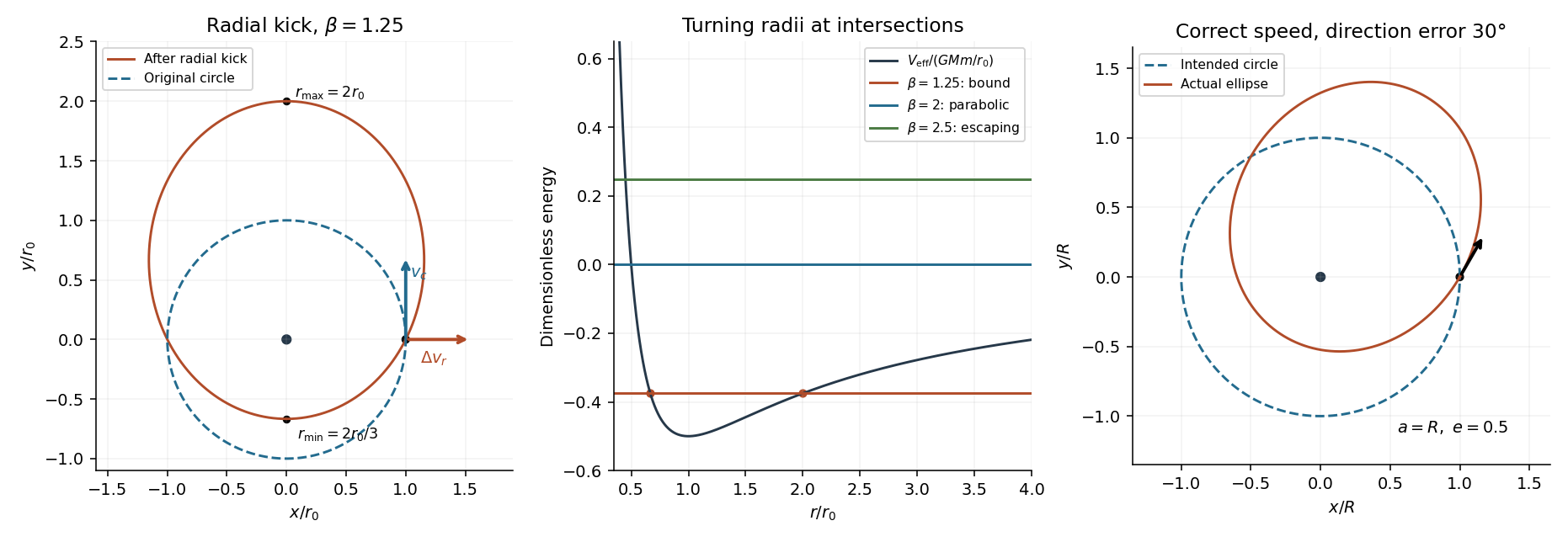
Write and let be the original circular orbital speed. An impulse leaves the orbital angular momentum unchanged if it is radial: its angular impulse is zero. The tangential velocity remains , and an added radial component givesThus kinetic energy increases even though angular momentum does not. For a Radial kick from a circular Kepler orbit, the new specific orbital energy and squared specific angular momentum areThe orbital eccentricity is , while the semi-latus rectum is . HenceFor the trajectory is a parabolic Kepler orbit and has no finite furthest radius; its periapsis is . For it is a hyperbolic orbit, with the same formula for but unbounded radius:One must not use the negative denominator in the bound-orbit expression as a negative physical apocentre. On a departing unbound branch the conic's periapsis may already lie in the past; the future minimum from the kick event is then . These are ideal conic orbits; a periapsis inside a real planet would cause impact before the ideal continuation.
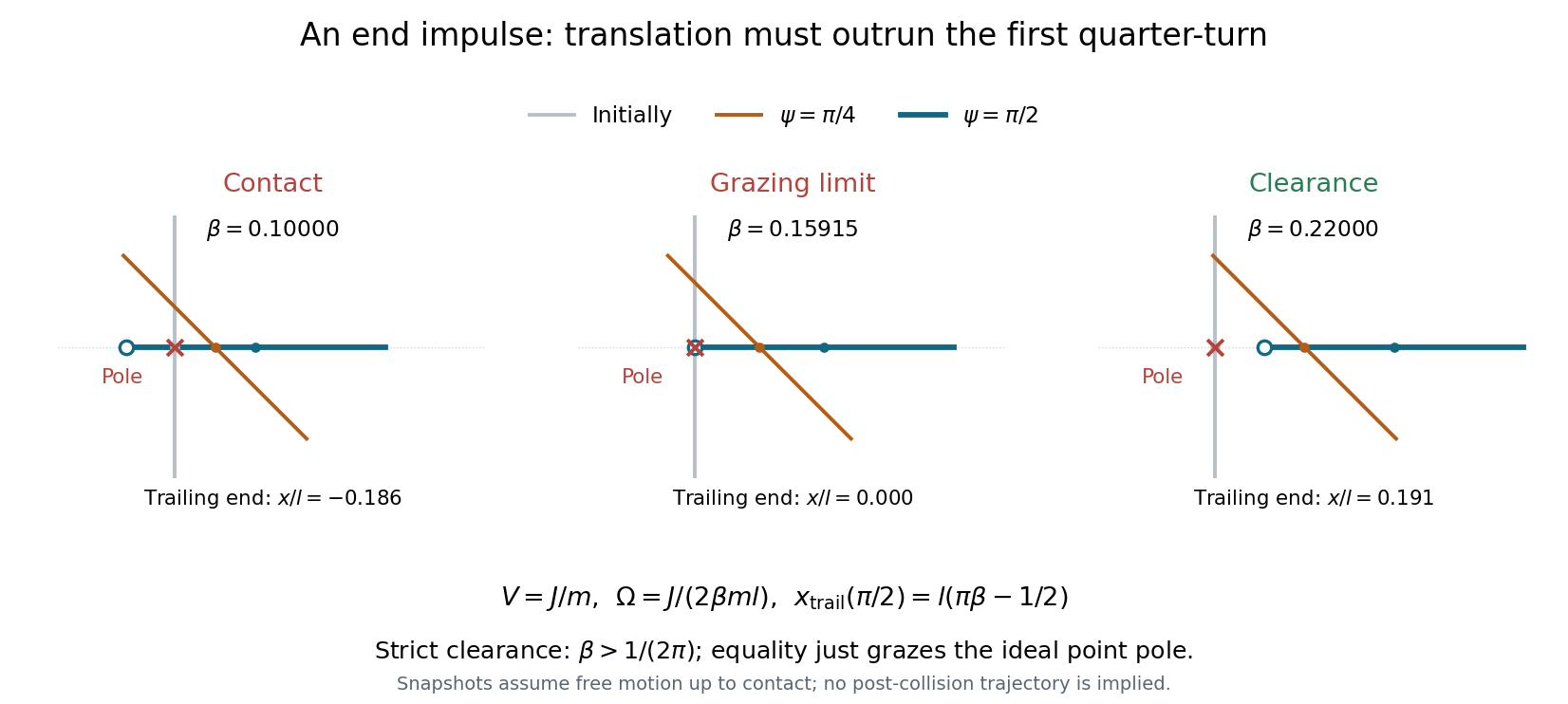
Idealize the pole and stick as having negligible transverse thickness. Put the pole at the origin, the stick initially along the axis, and the struck lower end at , as in the source diagram. A short horizontal impulse along gives the centre of mass a constant speed . The angular impulse about the centre is , giving constant counterclockwise angular velocityThe pole exerts no further force while the stick moves clear of it. Let . The trailing upper end has coordinatesThe pole can lie on the translating straight stick again only when the stick becomes horizontal: for other orientations, its intersection with is the moving midpoint . At the first horizontal orientation, , the trailing end is atConsequently the grazing clearance of an impulsively struck rod occurs atFor the whole stick has passed the pole by its first horizontal orientation, and the continually advancing centre makes all later passes safe. Equality is the limiting grazing contact of the endpoint; strict avoidance requires the strict inequality. If , the pole lies within the stick at that first horizontal pass, so contact occurs before the freely moving trailing end can pass the pole. A uniform thin stick has , below the threshold: sufficient mass near the ends is needed to increase its moment of inertia and reduce the rotation relative to translation.


A radial outward kick has no angular impulse about the centre. ThereforeThe initial position is on the outward-moving portion of a bound elliptic Kepler orbit, between pericentre and apocentre, rather than at either turning point. The eccentricity is and the semilatus rectum remains . The orbital energy change is second order: it vanishes to first order in the impulse but is positive for any nonzero kick.
An impulse is , giving . For a short localized impulse at displacement from the centre of mass, the angular impulse is ; for a changing lever arm use its instantaneous value inside the integral. For a uniform solid sphere with volume density , direct integration about the axis givesTake forward translation and forward-rolling clockwise spin as positive. Neglect the table's tangential impulse during the much shorter cue impact. Immediately afterwards,The bottom contact point has slip velocity . The cue height for immediate rolling is therefore .
For the impulse-driven slipping-to-rolling transition of a sphere at an arbitrary admissible impact height, let be the signed friction impulse accumulated before slipping ends. Translation and spin then obey and . Impose and eliminate :This expression handles both sliding directions. If , the contact point slips forward and friction slows the centre; if , excess spin makes it slip backward and friction accelerates the centre. friction still dissipates total mechanical energy. For , , so the slipping time is . Its duration depends on friction, while the final speed does not. With zero friction no slipping-to-rolling transition occurs unless rolling was present from the outset.
Let denote the moment of inertia normal to the disc and that about any central diameter. Rotational symmetry makes the two perpendicular diameter values equal. By the perpendicular axis theorem, . The intended angular impulse has magnitude ; delivering that magnitude about a diameter instead gives . ThusThese are principal axes, so angular momentum is parallel to angular velocity in both cases. Equal delivered angular impulse means equal magnitude of the change in angular momentum, not equal rotational kinetic energy; the actual rotational kinetic energy is twice the intended value.
Radial impulse 2026-10-25
An impulse directed along the position vector relative to a specified origin. Its angular impulse vanishes because . It can nevertheless change kinetic energy; if an initially circular Kepler orbit receives radial velocity , the added specific orbital energy is .