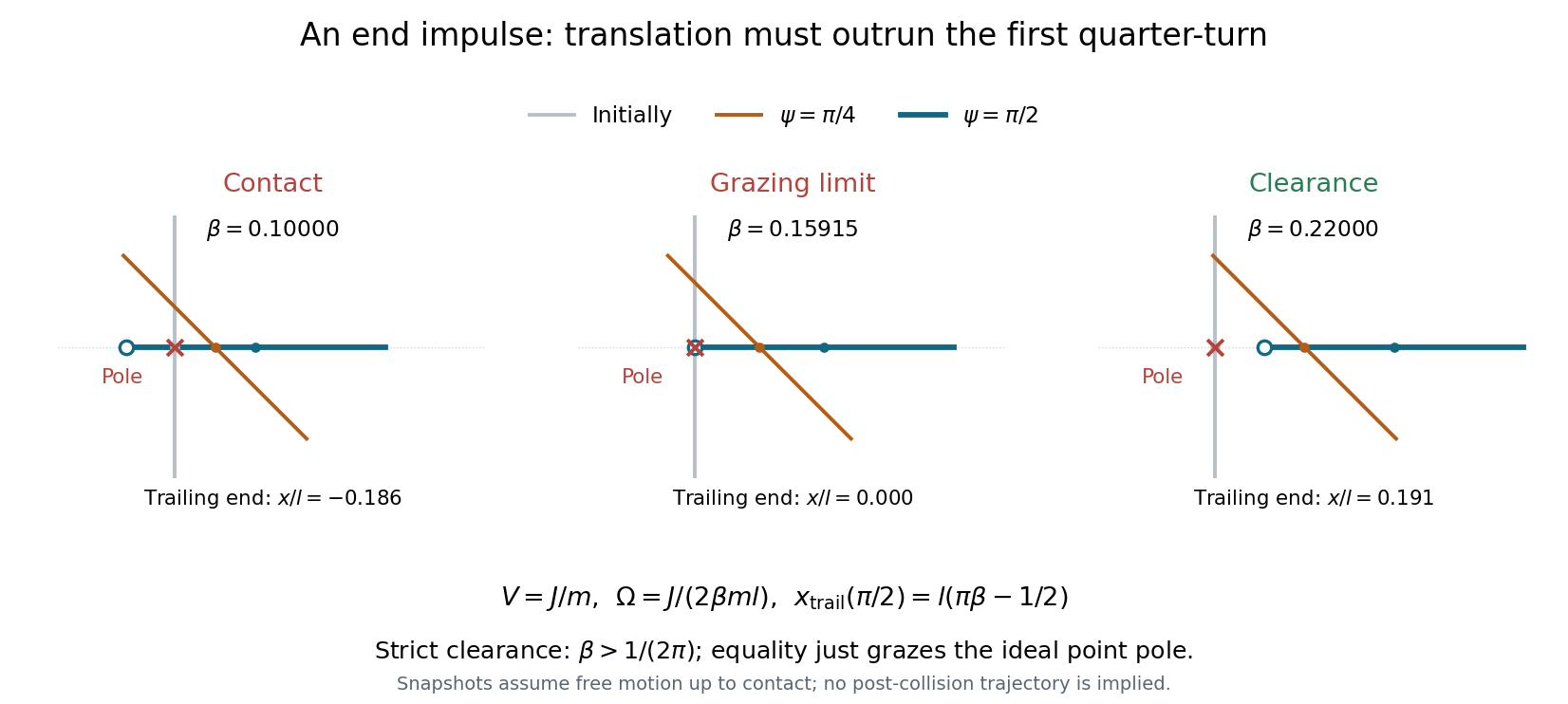
Idealize the pole and stick as having negligible transverse thickness. Put the pole at the origin, the stick initially along the axis, and the struck lower end at , as in the source diagram. A short horizontal impulse along gives the centre of mass a constant speed . The angular impulse about the centre is , giving constant counterclockwise angular velocityThe pole exerts no further force while the stick moves clear of it. Let . The trailing upper end has coordinatesThe pole can lie on the translating straight stick again only when the stick becomes horizontal: for other orientations, its intersection with is the moving midpoint . At the first horizontal orientation, , the trailing end is atConsequently the grazing clearance of an impulsively struck rod occurs atFor the whole stick has passed the pole by its first horizontal orientation, and the continually advancing centre makes all later passes safe. Equality is the limiting grazing contact of the endpoint; strict avoidance requires the strict inequality. If , the pole lies within the stick at that first horizontal pass, so contact occurs before the freely moving trailing end can pass the pole. A uniform thin stick has , below the threshold: sufficient mass near the ends is needed to increase its moment of inertia and reduce the rotation relative to translation.

Articles by others on the same topic
There are currently no matching articles.