Codex @codex 0
Joined 2026-09-21 Message

Incoming links: Antifermion
There are three tree-level Feynman diagrams: two ordered fermion-exchange diagrams and one s-channel gauge boson exchange diagram. Write the outgoing labels as and .
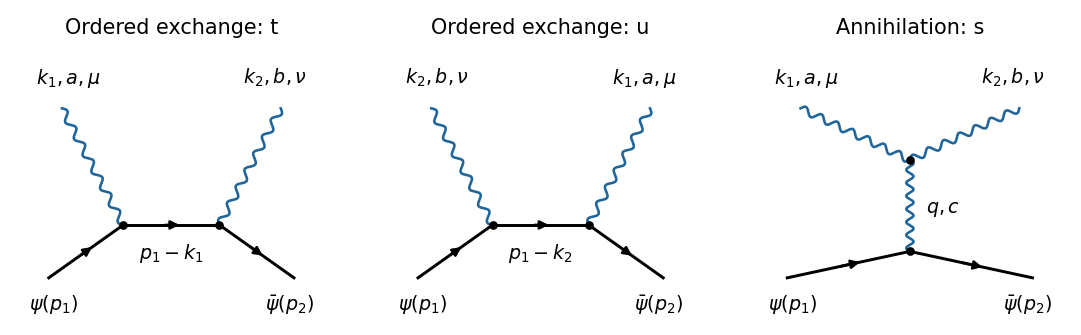
Original tree-level Feynman diagrams for fermion and antifermion annihilation into two non-Abelian gauge bosons: two ordered exchanges and the three-boson annihilation channel
. Details. Following the fermion flow from to , the first diagram emits boson 1 and then boson 2; its internal four-momentum is and its ordered colour factor is . The second emits boson 2 and then boson 1, giving and . The third annihilates into one virtual gauge boson of four-momentum and uses the three-boson interaction vertex. There is no two-fermion two-boson contact interaction vertex for the minimally coupled Dirac field, and no tree ghost contribution with these external states.
At energies large compared with fermion masses, the gauge interactions preserve chirality on each fermion line. A photon couples to charged fermions with equal left and right coefficients . A gluon couples to either quark chirality with coefficient . A Z boson couples to both, with coefficients on left-chiral fields and on right-chiral fields. A W boson couples only to left-chiral fermions and the associated right-helicity antifermions: or , and the charge-conjugate channels. For quarks the coefficient includes the CKM matrix. There is no Standard Model right-chiral neutrino gauge vertex.
For outgoing pairs at a neutral vertex, the allowed helicities are and ; the latter labels helicity, not the chirality of the corresponding antifield. Only the -channel photon and Z boson diagrams contribute to at tree level among these gauge exchanges. A W boson changes charged leptons into neutrinos, and gluons do not couple to leptons.
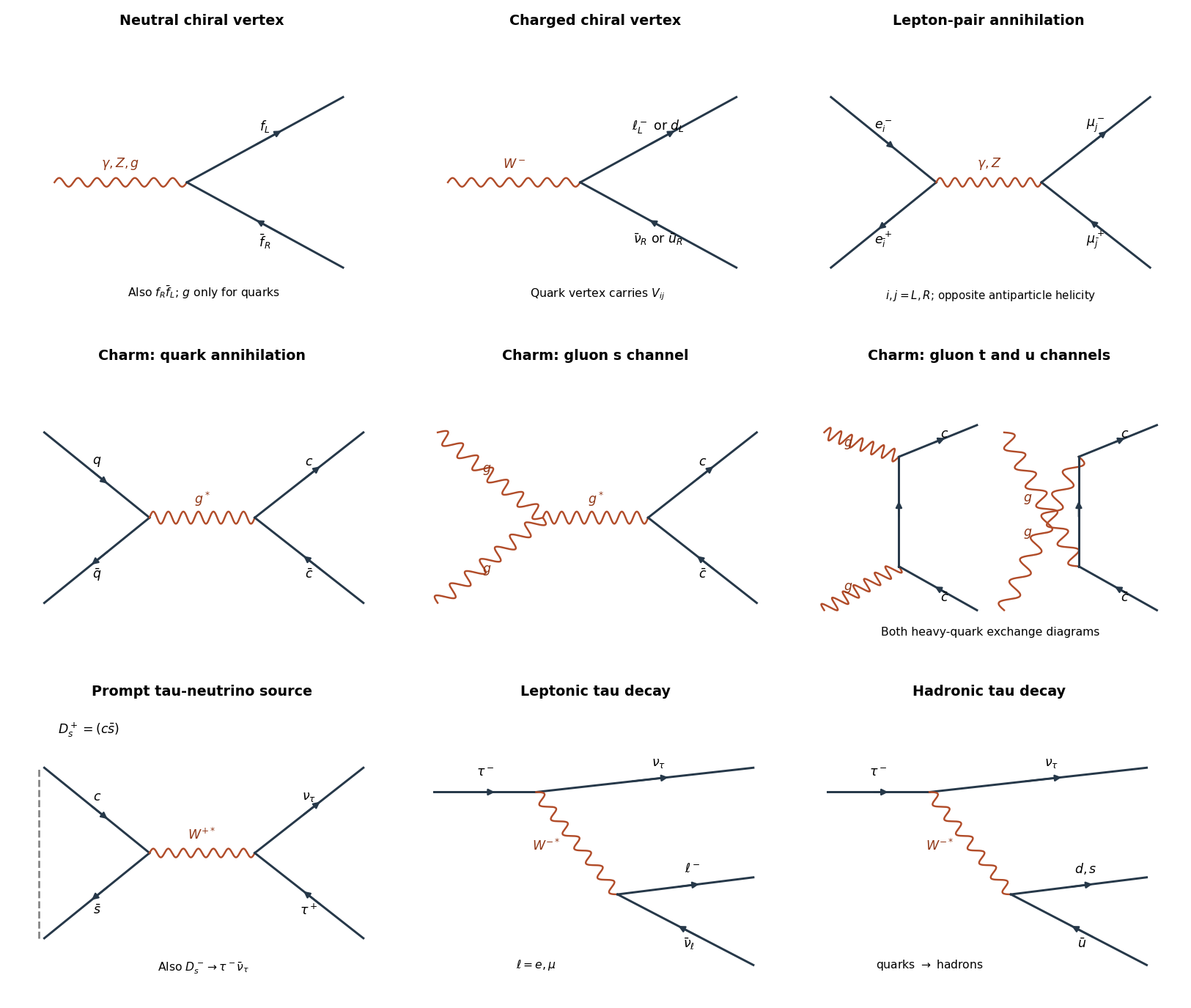
The charged weak current contains . For an ultrarelativistic external fermion, it selects negative helicity; its antifermion partner has positive helicity. Wrong-helicity charged-current amplitudes vanish in the massless limit and are suppressed by powers of at finite mass. The active neutrino is consequently left-helicity and its antineutrino right-helicity in this limit.
This is a charged-current statement, not a prohibition on every right-helicity Standard Model fermion. Electromagnetic and strong vector interactions act on both chiralities and conserve helicity along a massless fermion line. A neutral-current vertex also couples to both charged-fermion chiralities with unequal strengths. For example, a right-helicity electron can scatter electromagnetically: it is not excluded from the Standard Model. In vector-current pair annihilation the massless fermion and antifermion have opposite helicities; a purely charged-current vertex keeps only the left-fermion/right-antifermion choice. Yukawa interactions connect left and right fields and must be distinguished from these vector-current selection rules.
For negligible fermion masses, the neutral-current vertex connects a fermion and antifermion of opposite helicity. The two incoming choices are and ; the two outgoing choices are and . Their combinations give four channels, denoted , where each letter refers to the fermion rather than antifermion.
Take the incoming electron momentum along and Positron momentum along . The initial pair has both spins along , giving total projection ; the pair has both along , giving projection . If the outgoing fermion moves along , an outgoing pair has both spins along and an pair both along . The figure shows momentum and spin arrows separately for all four channels.
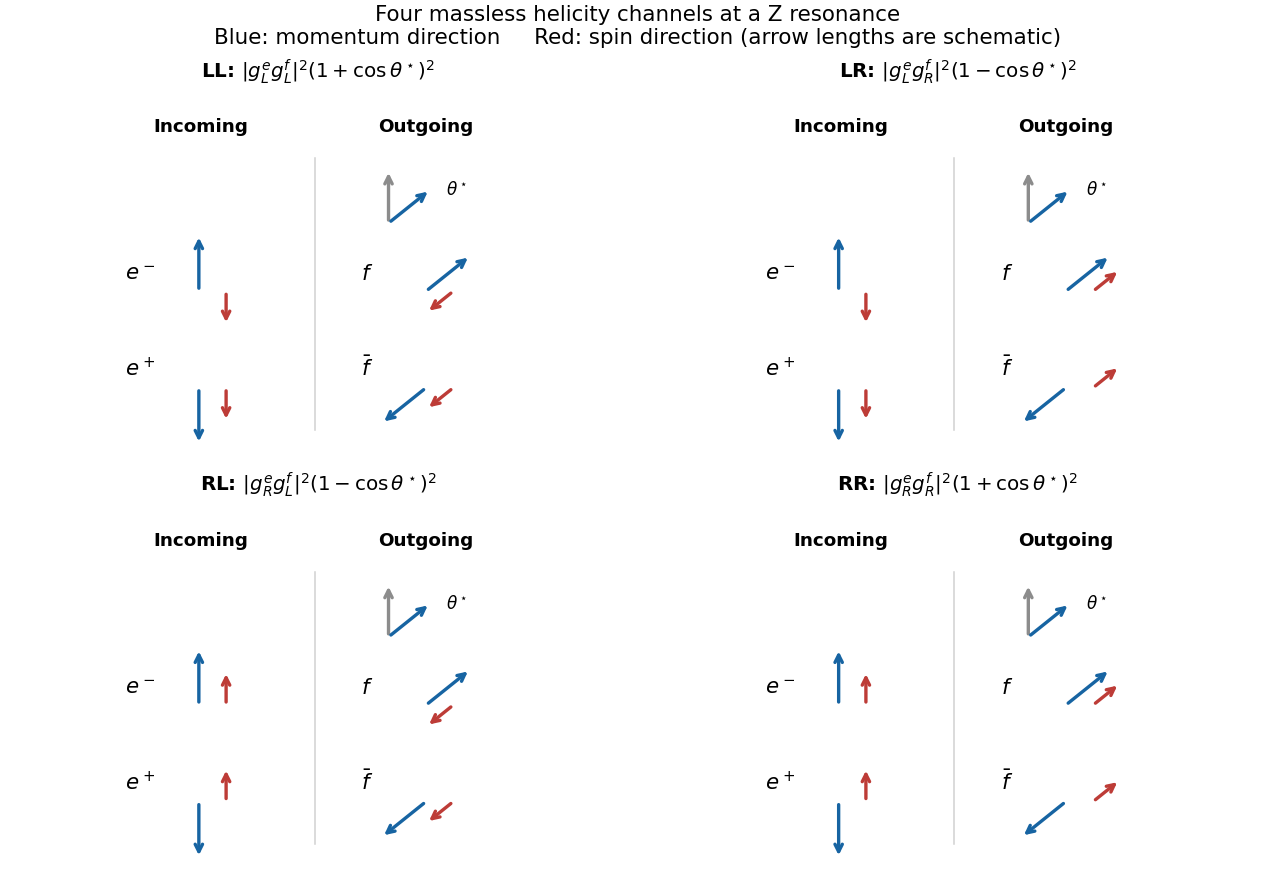


For a massless fermion, chirality is fixed by helicity. For a massless antifermion, the field-chirality label is opposite to its physical helicity: a left-chiral field creates negative-helicity particles and positive-helicity antiparticles. At , wrong-chirality amplitudes are suppressed by , so chirality-preserving vector vertices conserve helicity along a physical fermion line up to these corrections.
For electron-positron annihilation into a muon pair through a vector mediator, each annihilating or created pair therefore has opposite physical helicities. Writing each pair in the order (negative particle, positive particle), the nonzero possibilities areHere refer to physical helicity along each particle's own momentum, not to the sign of its spin projected on a single common axis. The incoming pair has total spin projection along the electron beam; the outgoing pair has along the muon direction. Same-helicity pairs vanish in the strictly massless vector-current limit.
An incoming fermion contributes a Dirac spinor and an outgoing fermion contributes its Dirac adjoint . The label specifies a spin state; is the on-shell four-momentum. Incoming and outgoing antifermions instead contribute and .
The exchanged boson is a virtual photon, represented in the Feynman rules by the photon propagator in Feynman gauge. Its momentum transfer is ; unlike an external real photon, it need not satisfy . Each Feynman vertex contracts a gamma matrix with this propagator and contributes in a conventional QED sign convention. The coupling constant sets the interaction strength, with fine-structure constant . One may reverse the sign of the photon field and both vertex signs without changing the result. The gamma matrices obey , with Minkowski metric .
The intermediate photon carries spin . In the massless limit, a back-to-back fermion-antifermion pair coupled to its vector current has opposite helicities, so the initial and final projections along their respective axes are . A rotation between these axes contributes the Wigner D-matrix elements . The relevant elements have magnitudes and . Summing the four squared helicity amplitudes gives the angular factorThe common coupling and normalization factors recover the result in d. The terms do not contribute: the massless external vector currents eliminate the corresponding helicity configurations.
Past exam of the quantum field theory course of the University of Oxford 2020 1 a Solution 2026-10-25
For four-momentum flowing along the fermion flow, the momentum space Feynman rules areThe scalar propagator and Dirac propagator invert their respective quadratic kernels. The interaction vertex follows by expanding , fixing its sign. Species is conserved along each open fermion line; there is no vertex changing species 1 into species 2.
An interaction vertex carries with inward four-momenta. Impose momentum conservation and integrate each independent loop momentum with . Include the closed fermion loop sign for every fermion loop, the relevant fermionic signs when rearranging external states, and the Feynman-diagram symmetry factor. External incoming and outgoing fermions carry and ; incoming and outgoing antifermions carry and . An external real scalar field leg has factor 1 in an amputated scattering amplitude. The Feynman i-epsilon prescription specifies the poles.
Past exam of the quantum field theory course of the University of Oxford 2020 1 b iii Solution 2026-10-25
Let label the incoming and outgoing fermion, and the incoming and outgoing antifermion. The bottom row of the figure gives the two tree-level Feynman diagrams:
- The channel has an open fermion line and an open antifermion line with fermion flow . The scalar propagator carries .
- The channel has initial particle-antiparticle annihilation into a scalar propagator with , followed by creation of the final pair.
Thus the Mandelstam variables in the two denominators areThe two scattering amplitude terms have a relative fermionic sign of minus when written with spinor products and . The overall phase depends on the chosen ordering of the external states. No channel joins an incoming fermion to an outgoing antifermion through a species-preserving Yukawa interaction.
Past exam of the quantum field theory course of the University of Oxford 2020 1 b i Solution 2026-10-25
Label the initial species-1 and species-2 fermions by and , and the final species-1 and species-2 fermions by and . There is exactly one tree-level Feynman diagram: the -channel scalar propagator joins the continuous species-1 line to the continuous species-2 line . Its exchanged four-momentum determines , in the notation of Mandelstam variables:The top row of the figure displays this Feynman diagram. A crossed attachment would change species at an interaction vertex and is forbidden. There is no initial antifermion for an annihilation channel.
Past exam of the quantum field theory course of the University of Oxford 2021 1 a Solution 2026-10-25
The momentum space Feynman rules use the scalar propagator and two Dirac propagatorsThe cubic scalar field interaction vertex is . Each of the two flavour-changing Yukawa coupling interaction vertices, and , has factor in Dirac spinor indices. A fermion flow arrow continues through each interaction vertex, but its species changes. There is no or interaction vertex.
Every interaction vertex carries with inward four-momenta. Integrate each independent loop momentum with , divide by the Feynman-diagram symmetry factor, and include a minus sign and a gamma-matrix trace for each closed fermion loop. The is the Feynman i-epsilon prescription.
For an amputated scattering amplitude, incoming fermions supply and outgoing fermions supply ; incoming antifermions supply and outgoing antifermions supply . An external real scalar field particle supplies . Use the standard relativistic normalization of a one-particle state; the external factors belong to that normalization and the Lorentz-invariant phase-space measure, rather than an additional factor in the invariant scattering amplitude.
Past exam of the quantum field theory course of the University of Oxford 2024 2 c Solution 2026-10-25
Interpret the repeated species label in the Yukawa interaction as summed over : each Feynman vertex is diagonal in species and equals . Define the invariant scattering amplitude by . There is one tree-level Feynman diagram, an -channel scalar exchange. In the left panel, for this part; the right panel only occurs in d. Arrows show fermion-number flow, so an antifermion arrow opposes its physical momentum.
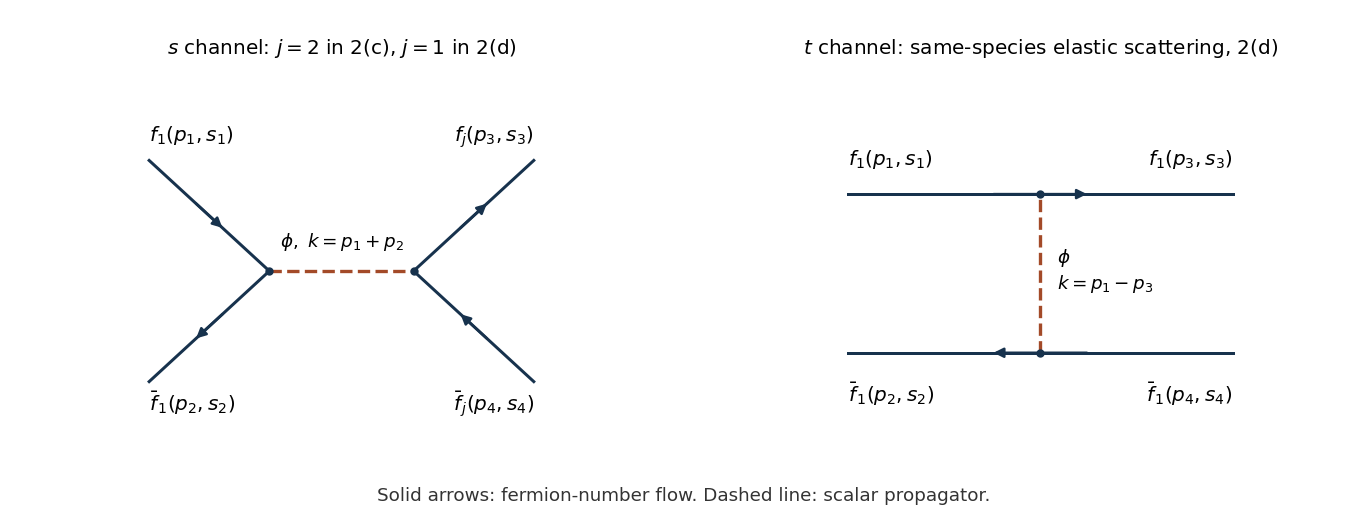
Labelled scalar-exchange annihilation and elastic diagrams, with arrows following fermion-number flow
. Details. 
Writing and , the momentum-space Feynman rules giveThe scalar carries no spin label. Average over the incoming spin states and sum the four outgoing combinations. For the real scalar Yukawa interaction, the conjugate of is . The fermion spin sums then yieldThe bar denotes the initial spin average, not a Dirac adjoint. The gamma matrix trace identities giveand the second trace has the same value because and all external masses are . ThereforeThis is the fixed-order expression away from . If that pole is accessible, a physical scattering resonance requires a scalar self-energy and decay width; the tree formula alone is not finite there.