Take an IID random variable source of bits with . Its binary entropy isA word of length containing ones has probability . Its information content per symbol isThus weakly typical sequences for this biased source have near . With tolerance bits per symbol, the exact condition isFor , this includes exactly . There are words with each count: a type class with that many possible orderings. Summing the counts and their probability masses givesThese are fewer than one percent of the possible words, yet they carry nearly 64 percent of the probability. The most likely individual word is all zeros, with probability ; it is outside this typical set. No contradiction is involved: the type classes near ten ones each contain many more individual words.
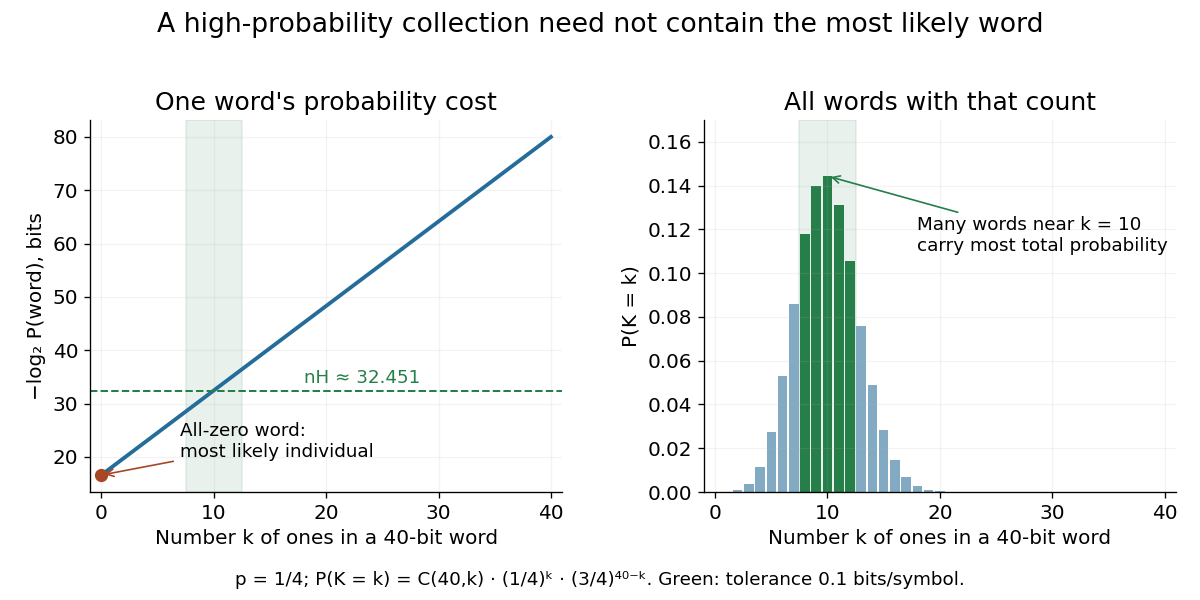
The most likely individual word differs from the counts carrying most probability
. The left plot gives the information content of one word with each number of ones. The right includes the binomial coefficient counting every such word, giving the exact binomial distribution of the count. Both use , ; the green band marks the typical set with tolerance bits per symbol. Details.
The count has binomial distribution with mean and variance . The information content per symbol is an affine function of , so its variance isChebyshev's inequality therefore gives the finite-sample lower boundThe bound is often loose, but it proves that every fixed positive tolerance eventually captures nearly all the probability. Direct summation of the binomial distribution's probability masses gives . A finite sample does not need to have a nearly full typical set: the 40-symbol example above captures only about .
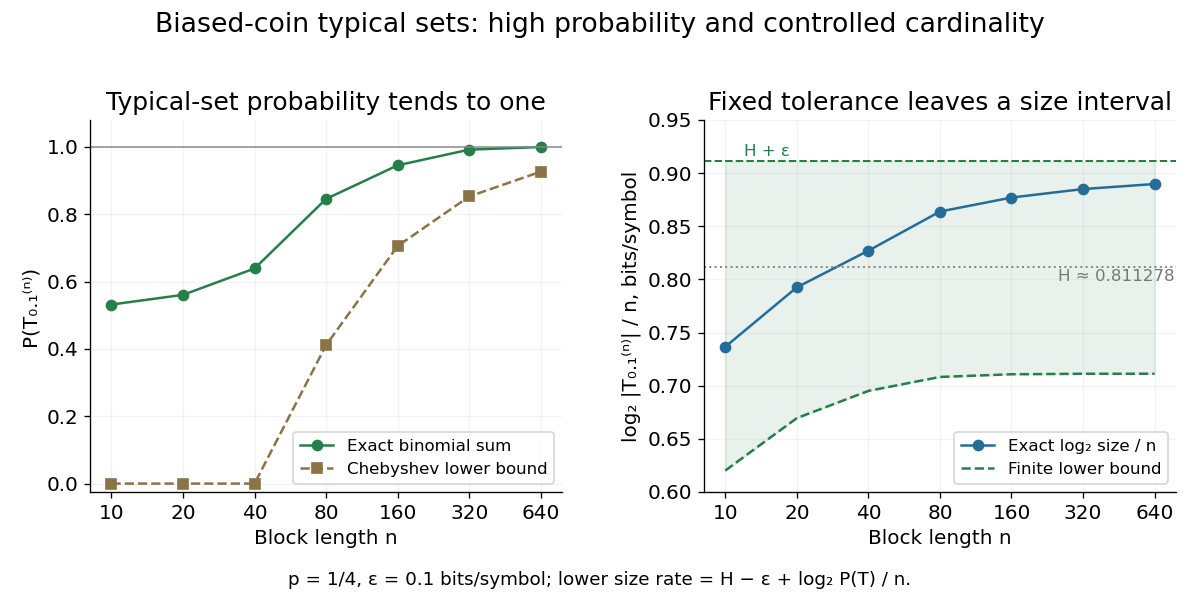
Longer biased-coin messages concentrate in typical sets with controlled size
. The left plot compares exact typical set probabilities with the lower bound from Chebyshev's inequality. The right shows and its finite-sample bounds. The tolerance stays fixed; the curve is not asserted to converge to exactly . All points are exact finite-model calculations. Details.
The typical sequence theorem turns a probability concentration into a coding construction. Assign one binary number index to each weakly typical sequence, plus a reserved index for every word outside the set. The decoder recovers every typical word exactly; the reserved index has one predetermined output. The block code usesbits and has reconstruction-error probability at most .
For this example and , needs 34 bits but permits error up to about . At , 570 bits suffice and the error bound is about . These are existence calculations for an explicitly enumerated collection, rather than claims about an efficient practical encoder. The reduction comes from protecting the whole high-probability collection, rather than just its single most likely member.
Articles by others on the same topic
There are currently no matching articles.