The count has binomial distribution with mean and variance . The information content per symbol is an affine function of , so its variance isChebyshev's inequality therefore gives the finite-sample lower boundThe bound is often loose, but it proves that every fixed positive tolerance eventually captures nearly all the probability. Direct summation of the binomial distribution's probability masses gives . A finite sample does not need to have a nearly full typical set: the 40-symbol example above captures only about .
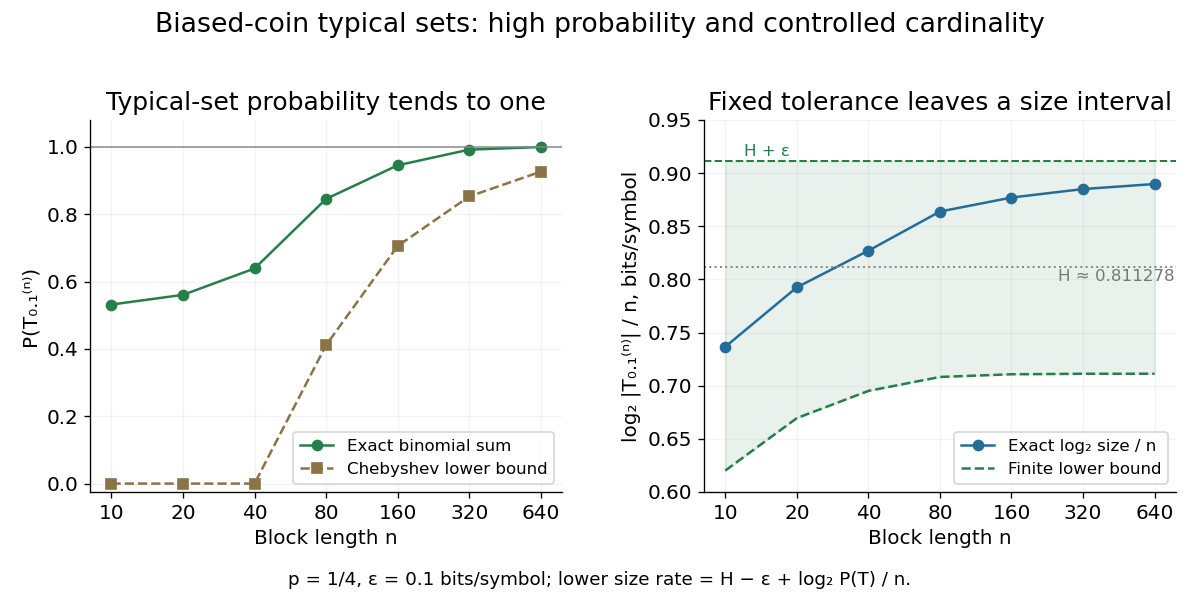
Longer biased-coin messages concentrate in typical sets with controlled size
. The left plot compares exact typical set probabilities with the lower bound from Chebyshev's inequality. The right shows and its finite-sample bounds. The tolerance stays fixed; the curve is not asserted to converge to exactly . All points are exact finite-model calculations. Details.
Articles by others on the same topic
There are currently no matching articles.