Exponentiation by squaring computes an integer power by reading the exponent's binary expansion. Appending a binary digit to a prefix of value replaces by , so the corresponding power changes byEach new digit requires one squaring and, only for digit one, one further multiplication. The number of digits grows with the logarithm of the exponent, making this useful for modular exponentiation, primality testing, and powers of matrices using matrix multiplication.[ref]
A Computational Introduction to Number Theory and Algebra by Victor Shoup. Section 3.4, pp. 65–66: binary-prefix recurrence and repeated-squaring algorithm; p. 67: primality-testing application
For a concrete calculation, , so . The optimized left-to-right algorithm used here instead keeps one accumulated power: initialize from the leading digit one, then process only the remaining digits :Thus , using three squarings and two further multiplications, instead of twelve successive multiplications starting at .
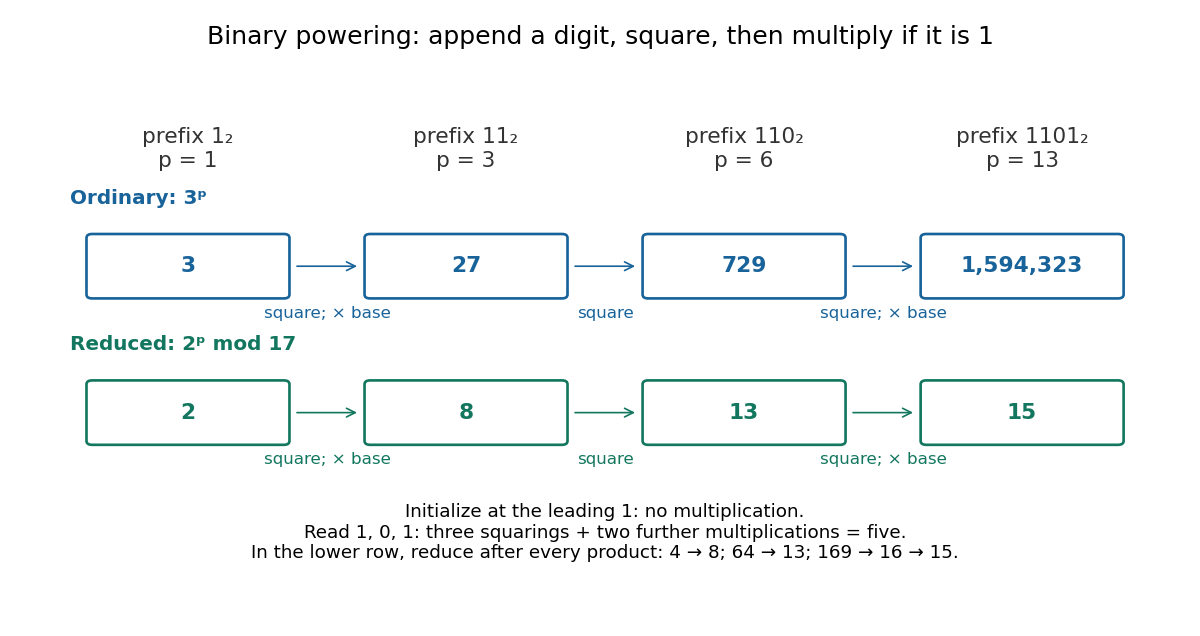
For a general positive integer with leading digit , set and, for , first replace by , then multiply it by if . Return . This explicitly skips the leading digit's otherwise unnecessary operations on one. A Computational Introduction to Number Theory and Algebra by Victor Shoup (Section 3.4, pp. 65–66) presents the version initialized at one and processing every digit; the optimization here makes the counting convention unambiguous.
The loop invariant is , where is the value of the digits already read. Initially and . If the next digit is , then squaring and optionally multiplying give , exactly the next prefix. At termination . This proof uses associativity of multiplication; it works in any monoid, including matrices with the identity matrix as identity element, and needs no commutativity between different bases.
For , return the identity element without performing a multiplication. This is the empty-product convention ; if , the algorithm therefore returns one for by convention, rather than resolving its meaning in every mathematical setting. Negative integer exponents require an inverse element: compute , counting the inversion separately. Over the integers, such an inverse generally leaves the integers, and a zero base has no inverse.
Several powers with one nonnegative exponent can share a single exponent-halving loop. For bases , maintain accumulators , current bases and a remaining exponent , with loop invariants . For an odd , multiply every accumulator by its current base; square every current base and halve . The equalities are preserved in parallel, and the nonnegative loop variant strictly decreases. For a fixed number of bases this uses arithmetic operations and one loop, while keeping each base in the intended numeric type.
For the optimized left-to-right exponentiation by squaring algorithm, let be the length of the binary expansion of a positive integer , and let be its Hamming weight, the number of digits equal to one. There are exactly digits after the leading one, and exactly remaining ones. Therefore the count isHere counts squarings and counts further multiplications by the base; every squaring counts as one multiplication in . Assignment, digit reading, and any inversion are outside this count. The formula includes , which requires zero multiplications; define separately.
For a fixed length , the bounds are . A power of two reaches the lower bound because its Hamming weight is one; reaches the upper bound because all digits are one. For , and , giving . Thus the arithmetic operation count is in Big O notation, but inputs of similar magnitude can have different counts.
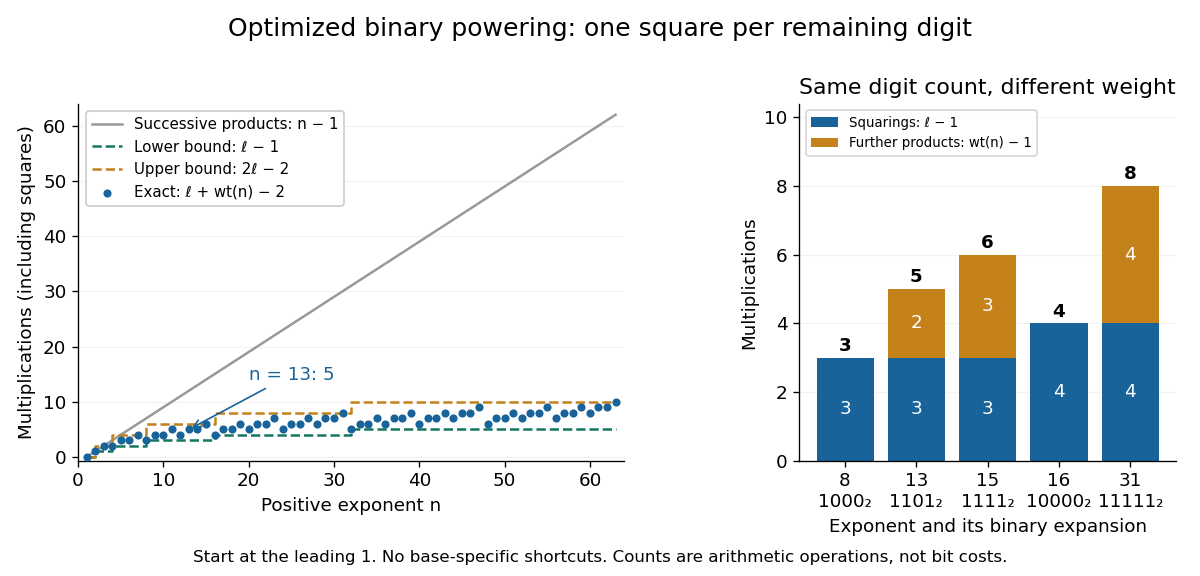
Exact multiplication counts for optimized exponentiation by squaring depend on binary length and Hamming weight
. For positive exponents through , dots show , including each squaring. The dashed curves bound all counts at each binary length. Successive multiplication needs operations. The second panel compares squarings and further multiplications for exponents . These are exact counts, not timing measurements. Details.This is a count for the specified algorithm, not a claim that it always minimizes multiplications among all methods. For instance, at the count is six, but the powers with exponents can be built in five multiplications: square, multiply by , square, square, then multiply by the already stored . Saving operations this way uses a different schedule and stored intermediate powers.
Modular exponentiation computes the remainder for an integer base , a nonnegative integer exponent , and, here, an integer modulus . It applies exponentiation by squaring while reducing after each multiplication, including each squaring. The result is the unique representative in . There is no requirement that the base be coprime to the modulus when the exponent is nonnegative.[ref]
A Computational Introduction to Number Theory and Algebra by Victor Shoup. Section 3.4, pp. 64–66: canonical representatives, modular products, and nonnegative-exponent repeated squaring
Take , , and . Initialize ; the remaining digits giveHence . The final operation multiplies by , since the preceding square has already been reduced. The computation never needs to construct .
In general reduce the base first, . For , initialize and process the remaining binary digits with , followed, for a digit one, by . The loop invariant iswhere is the processed prefix value. The congruence is preserved because modular arithmetic respects multiplication: if , then and . Thus changing representatives never changes the final congruence class.
Both factors in every product are less than , so the unreduced product is less than , and the stored result is again less than . The same bounds hold for a gigantic exponent, such as : there are squarings, each on bounded-size residues. For base two, the corresponding ordinary power would have binary digits. The benefit is avoiding the huge ordinary power altogether, rather than constructing it and taking one final remainder. Initial reduction is essential when the supplied base is much larger than the modulus.
For , return under the same empty-product convention as exponentiation by squaring. For , require , find the modular multiplicative inverse , and compute ; the extended Euclidean algorithm can find that inverse. Its cost is separate from the positive-exponent binary powering multiplication count. For example, , while is undefined because and are not coprime.
A reversible computation gives the coherent quantum modular exponentiation used in quantum order finding and discrete-logarithm Fourier sampling.
The binary powering multiplication count counts arithmetic operations. The time complexity measured in operations on individual bits also depends on operand lengths. Put , the binary length of the modulus, and let be the positive exponent's binary length. Stored residues use at most bits, and an unreduced product uses at most bits.
With ordinary long multiplication and division with remainder, one modular product costs operations on bits. Combining that cost with modular products givesThis bound includes reductions in the loop, and assumes the base has already been reduced and the exponent is available as a binary expansion. Reading the exponent takes additional work; initial reduction of a very long base depends on its input length, and an inverse for a negative exponent adds further work. More generally, if a modular product costs operations on bits, the powering loop costs . Faster multiplication and reduction methods can improve the quadratic bound.[ref]
For ordinary integer powers with , the output itself has binary digits. Even writing it takes work proportional to that length. Consequently multiplications does not imply operations on bits: the operands grow during ordinary exponentiation by squaring, whereas modular exponentiation keeps them bounded by the modulus. A squaring or multiplication by a small fixed base can also cost less than a general product, so equal counts need not mean equal running times.
Articles by others on the same topic



Exponentiation by squaring is an efficient algorithm used to compute powers of a number, particularly useful for large exponents. This method reduces the number of multiplications needed, making it much faster than the naive approach of multiplying the base by itself repeatedly. The basic idea behind exponentiation by squaring is to take advantage of the properties of exponents.