Unlike the Blackett-Occhialini triggered cloud-chamber experiment, Glaser used counter-controlled flashes after expansion. A detector trigger can select recording in sensitive liquid; subsequent expansion cannot recover a vanished latent track.[ref]
Elementary Particles and Bubble Chambers by Donald Arthur Glaser. pp. 537, 541, 550: timing distinction
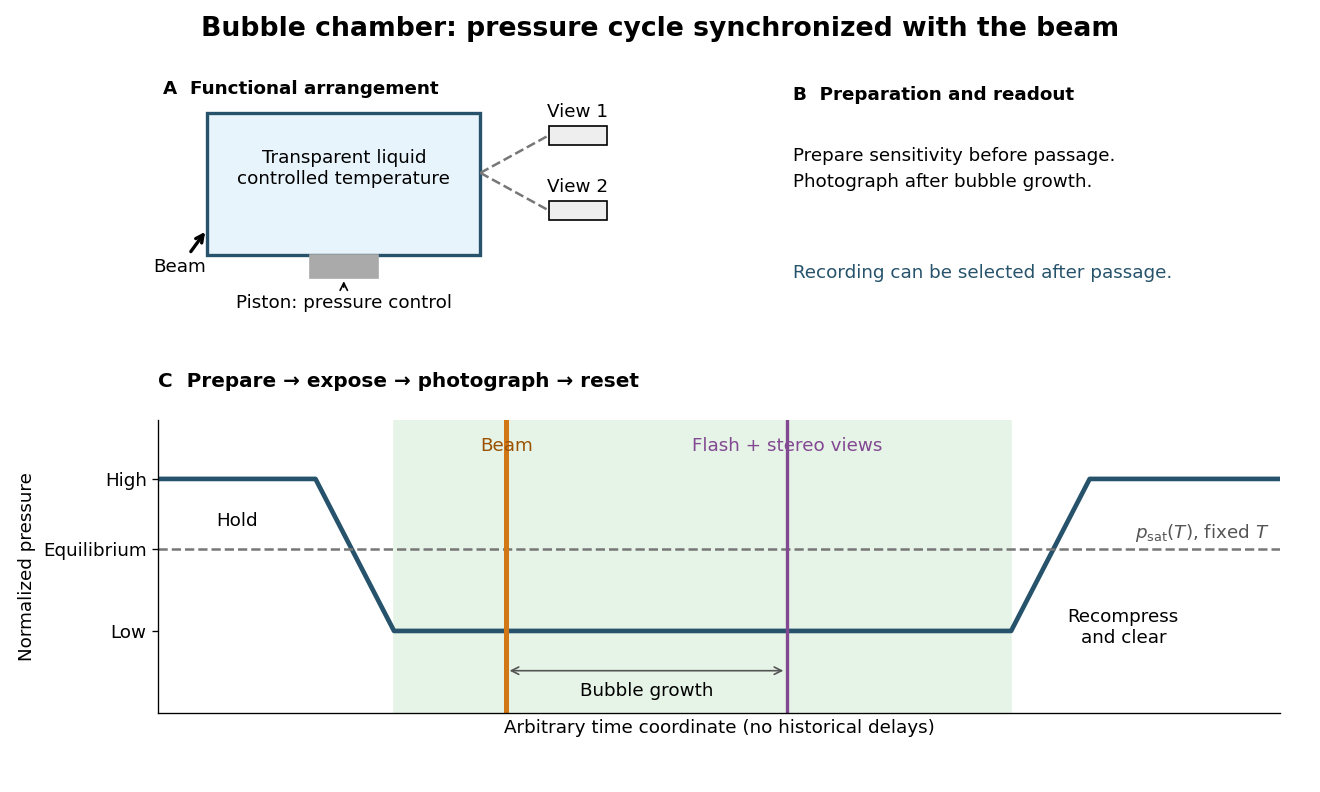
Bubble-chamber pressure cycle and photographic readout
. Original functional diagram with an arbitrary time coordinate and chosen normalized pressure levels. The dashed equilibrium line assumes fixed temperature; no measured waveform, apparatus scale or historical delay is reproduced. Details.
The diagram deliberately separates the preparation through thermodynamics from the readout decision. Its green interval is a stipulated operating window, not a prediction from pressure alone. Excess superheating can increase unwanted nucleation; insufficient superheating can suppress tracks. A useful proposed sensitivity check holds the readout settings fixed while varying pressure or temperature, with matched background exposures. A proposed timing check moves the beam within the cycle; a proposed optical check varies flash delay to distinguish growing bubbles from changes in spatial resolution. These are experimental design examples, not additional historical measurements.
Articles by others on the same topic
There are currently no matching articles.